SOC 2 Audit Costs in 2026
Updated:
September 13, 2026
Short Summary
- Updated for 2026!
- Traditional SOC 2 audit costs can range from anywhere between $15,000 to over $100,000, depending on the type of audit and overall scope.
- Organizations must evaluate their needs and risks when determining Trust Services Criteria for effective cost management.
- SOC 2 compliance automation software and expert guidance are strategies that can help reduce SOC 2 audit costs to $5,000.
( For a step-by-step breakdown, see our guide on budget-friendly SOC 2 compliance.)
What is a SOC 2 Audit?
A SOC 2 audit is a formal examination of a company’s controls related to the handling of customer data. It was developed by the American Institute of Certified Public Accountants (AICPA). The audit evaluates whether an organization manages data according to specific criteria that help protect the privacy, security, and confidentiality of information.
The main purpose of a SOC 2 audit is to assess how well a company protects client information when it stores, processes, or transmits data. This is especially important for service providers such as cloud vendors, SaaS companies, and data processors.
How Much Does a SOC 2 Audit Cost?
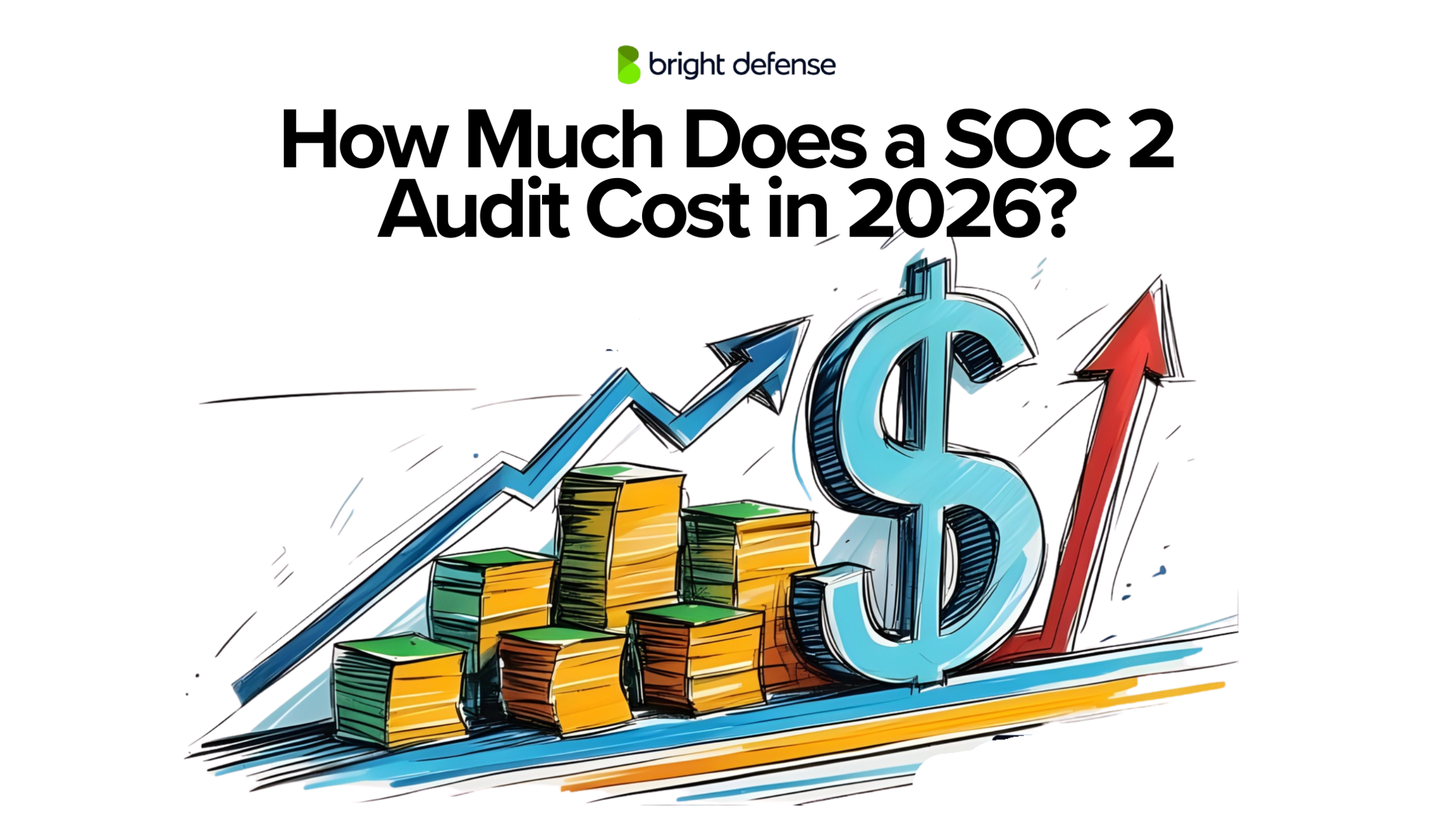
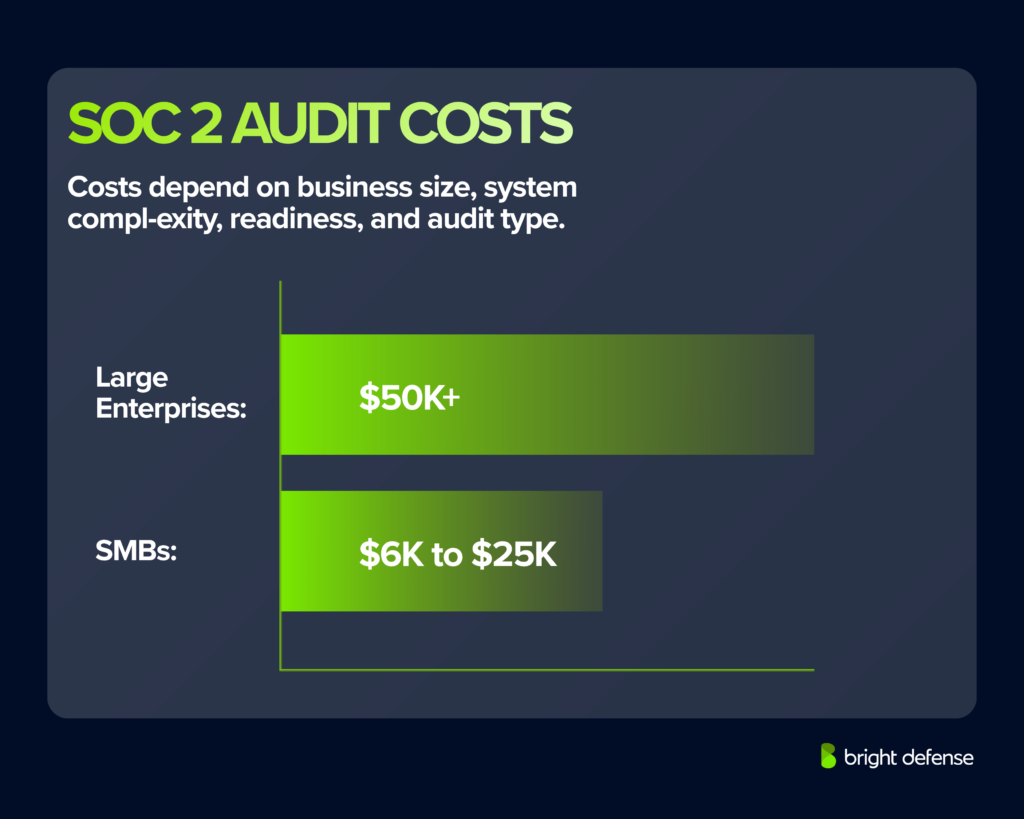
For small to medium-sized businesses (SMBs), the cost of a SOC 2 audit typically ranges from $6,000 to $25,000, though narrower Type 1 audits can start below that range.
Larger businesses and more complex environments may spend $50,000 or more, especially when total first-year compliance costs include readiness assessments, remediation, software, and internal labor.
The exact cost depends on company size, system complexity, audit scope, readiness, and whether the business is pursuing a Type 1 or Type 2 report.
The cost of a SOC 2 audit depends on numerous factors, such as:
- The type of audit
- Trust services criteria
- Organization size
- Complexity
- Level of automation deployed
Expenses that should be budgeted for when preparing for a SOC 2 audit include auditor fees, internal resource costs, technology and tool expenses, and any necessary remediation efforts to meet SOC 2 compliance requirements. It’s important for businesses to carefully consider these potential expenses and budget accordingly when planning for a SOC 2 audit.
SOC 2 Type 1 vs. Type 2 Costs
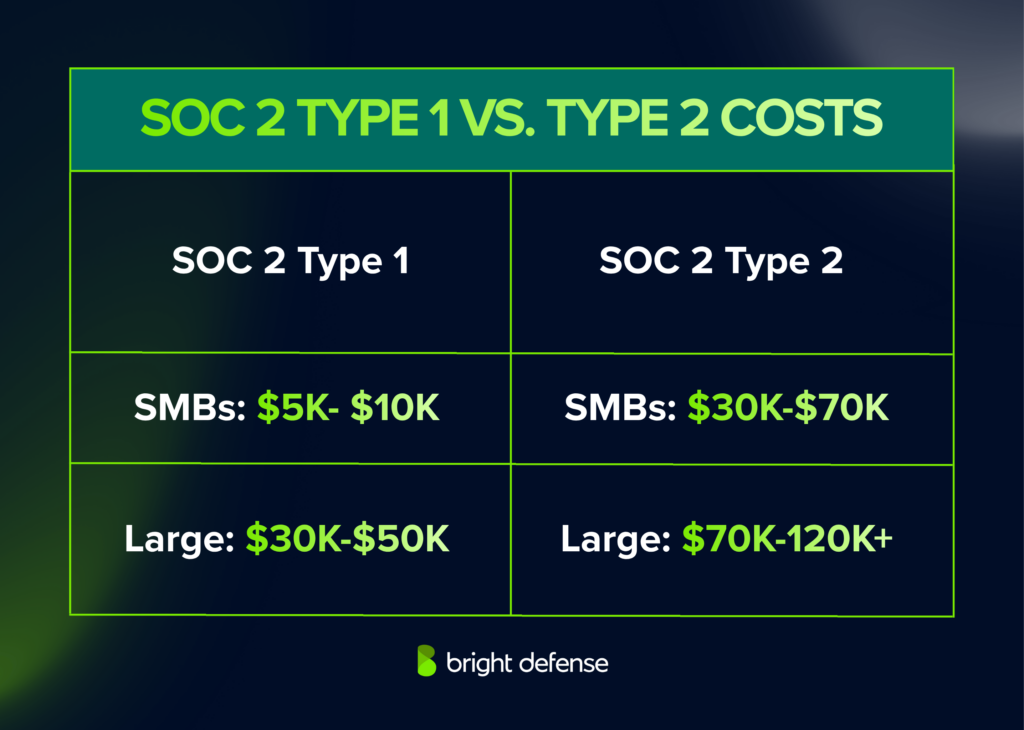
The cost of a SOC audit can vary based on the type of SOC audit you are performing. Type 1 audits, which evaluate the suitability of the design of controls at a specific point in time, generally cost less than Type 2 audits, which assess the operating effectiveness of controls over a period of time.
For a deeper look at how scope, testing duration, and deliverables differ, see our guide on SOC 2 Type 1 vs Type 2 compliance.
Here is a detailed breakdown of the costs associated with each type:
SOC 2 Type 1
Type 1 audits review whether controls are designed appropriately at a single point in time. These audits work well for companies seeking a faster path to show initial compliance.
- SMBs: $5,000 to $10,000
- Larger businesses: $30,000 to $50,000
Type 2 audits evaluate whether controls operated effectively over a defined period (usually 3 to 12 months). They involve more evidence collection and typically cost significantly more.
SOC 2 Type 2
- SMBs: $30,000 to $70,000
- Larger businesses: $70,000 to $120,000 or more
Given the difference in cost and scope, businesses must carefully weigh the benefits of each audit type.
While Type 1 audits may be less expensive, they provide a limited assessment, focusing solely on the design of controls. In contrast, Type 2 audits offer a more comprehensive evaluation, measuring the effectiveness of controls over time and addressing the impact of annual security awareness training.
Type 2 audits typically have a minimum look back period of 3 months while 6 months is more common for the first audit followed by annual audits thereafter.
Some companies choose to perform a SOC 2 Type 1 audit initially in order to gain certification, then perform the SOC 2 Type 2 audit after they have a full 12 month period to certify. Ultimately, the choice of audit type should align with the organization’s oversight requirements and risk tolerance.
Additional SOC 2 Audit Costs
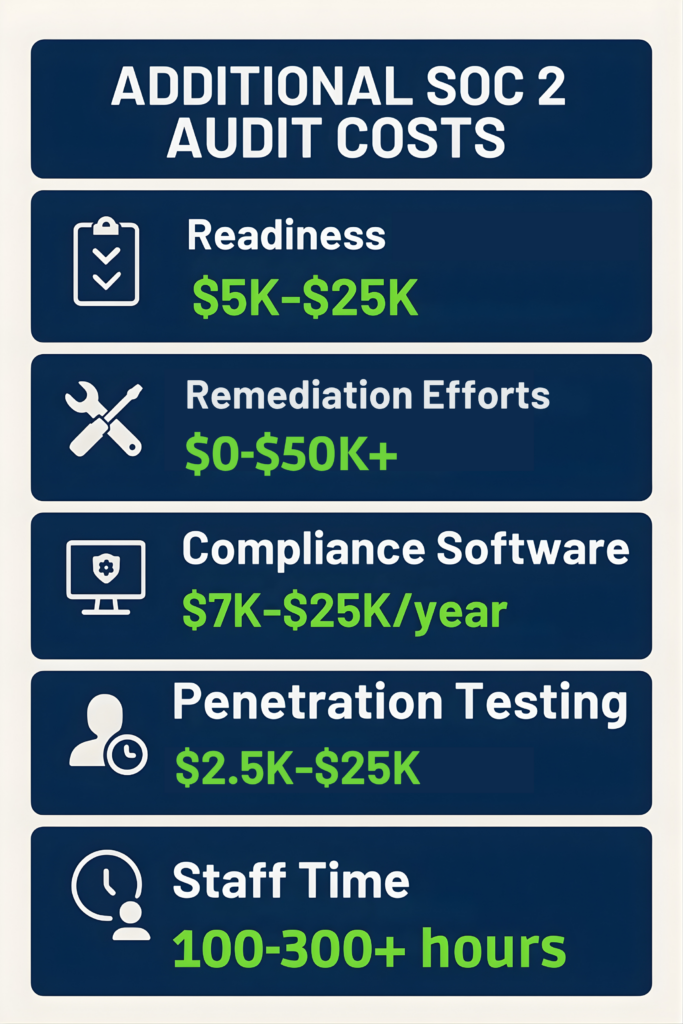
The direct audit fee is only part of the total expense. Several additional costs often come up during SOC 2 preparation and certification.
1. Readiness
Many companies use consultants or automated tools to conduct a pre-audit gap analysis. A structured SOC 2 gap assessment identifies missing policies, weak controls, and evidence gaps before fieldwork begins, which reduces surprises during the actual audit.
- Typical range: $5,000 to $25,000
2. Remediation Costs
If the readiness assessment identifies gaps, remediation may include:
- Policy creation and documentation
- Control design and implementation
- Infrastructure or system updates
- Access control changes and role assignments
- Typical range: $0 to $50K
(Varies depending on control maturity and scope of remediation)
3. Compliance Software Platforms
Automation platforms simplify evidence collection, policy management, monitoring, and auditor collaboration. A purpose-built SOC 2 compliance software platform reduces manual evidence gathering and shortens the audit cycle by keeping controls continuously monitored.
- Annual fees: $7,000 to $25,000/year
(Depends on features, integrations, and number of users)
4. Penetration Testing and Vulnerability Scans
SOC 2 typically requires annual security testing to validate control effectiveness. Scoping a SOC 2 penetration testing engagement correctly is important because the test must cover systems in scope for the audit, not the entire environment.
- Penetration testing: $2,500 to $25,000
- Vulnerability scans: $1,000 to $5,000
5. Staff Time and Internal Resources
Internal teams invest time for:
- Evidence collection
- Documentation updates
- Policy reviews and updates
- Ongoing monitoring and audit prep
- Effort: 100 to 300+ hours/year
(Varies based on team size, automation level, and scope)
6. Annual Re-Audits and Maintenance
SOC 2 Type 2 requires annual recertification to maintain compliance.
- Annual audit fees: typically 70% to 80% of the initial audit cost
- Ongoing internal monitoring and evidence collection adds recurring operational effort.
Benefits of SOC 2 Compliance
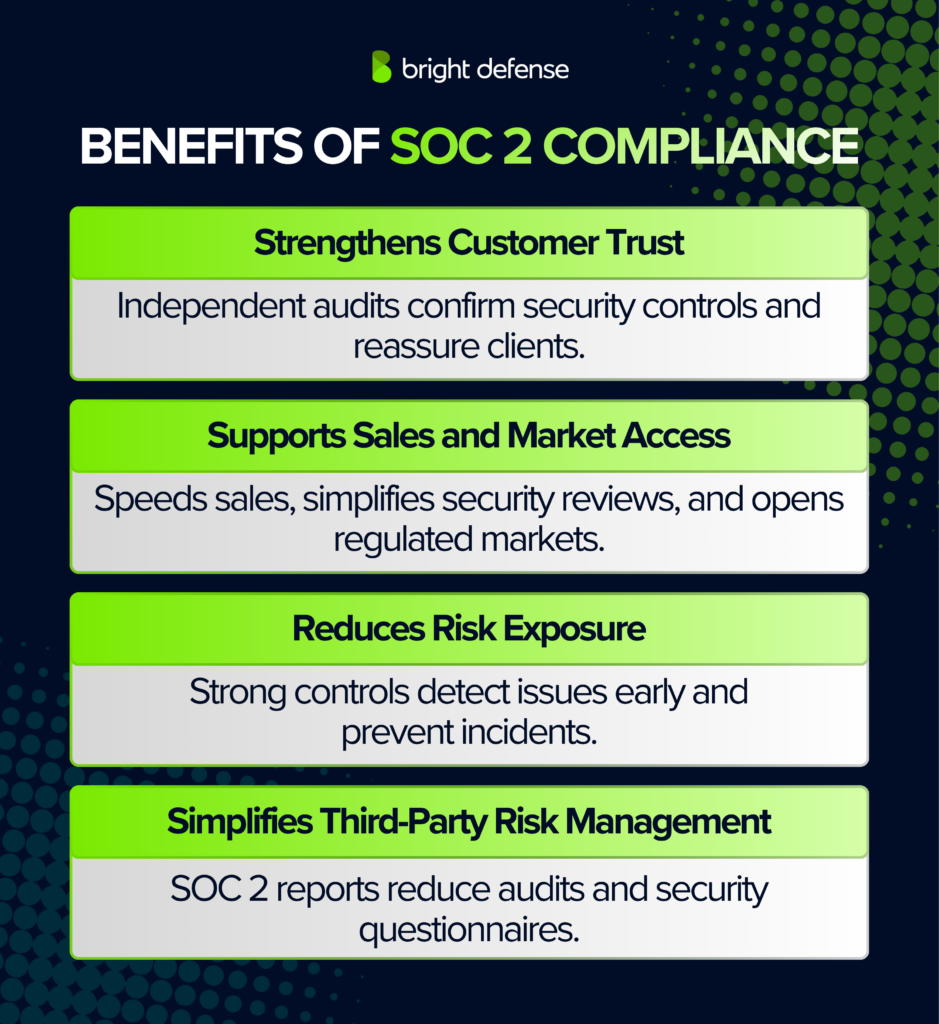
SOC 2 compliance provides a widely accepted way for organizations to prove they protect customer data and follow strict security controls. Let’s check out the benefits in a more detailed manner:
1. SOC 2 Strengthens Customer Trust
Customer trust is a critical element for any business or organizations. In, fact 94% of organizations say their customers would not buy from them if data was not properly protected, and 98% say external privacy certifications are an important factor in buying decisions. Achieving SOC 2 compliance signals to the market that customer data is protected by independently verified controls.
For companies that handle sensitive customer data, SOC 2 provides the kind of third-party validation that directly addresses those expectations and makes security posture easier to demonstrate during sales, procurement, and renewal conversations.
2. SOC 2 Supports Sales and Market Access
SOC 2 has become a baseline requirement in enterprise procurement, with 83% of enterprise buyers requiring it from SaaS vendors before signing contracts. This requirement increases to 91% among companies with more than 5,000 employees. Vendors without a SOC 2 report often face early disqualification, which means they are removed from consideration before procurement discussions even begin.
3. SOC 2 Compliance Reduces Risk Exposure
SOC 2 frameworks introduce structured vulnerability management, continuous monitoring, and incident response processes that help organizations detect and fix control weaknesses before they turn into security incidents.
The financial impact makes this discipline critical, with the average global cost of a data breach reaching $4.44 million in 2025. SOC 2’s focus on access controls, real-time monitoring, and documented response procedures gives companies a clear system to reduce exposure and limit damage when incidents occur.
4. Being SOC 2 Compliant Encourages Internal Discipline
Preparing for SOC 2 requires organizations to formalize security policies, and implement consistent controls across teams.
This process creates clear ownership for security responsibilities, addresses gaps identified during readiness assessments, and establishes repeatable workflows that remain effective even after the audit.
Over time, these controls become embedded in daily operations rather than temporary measures used only during audit periods.
5. SOC 2 Simplifies Third-Party Risk Management
69% of organizations report that regulations are too complex or that verifying third-party compliance is difficult, while 98% consider external privacy certifications important in buying decisions.
SOC 2 reports provide standardized evidence of a vendor’s security practices, which reduces the need for lengthy questionnaires and on-site audits.
A single independent attestation across multiple trust services criteria replaces much of the back-and-forth in vendor risk reviews, which allows teams to evaluate vendors faster and move procurement forward with fewer delays.
Trust Services Criteria
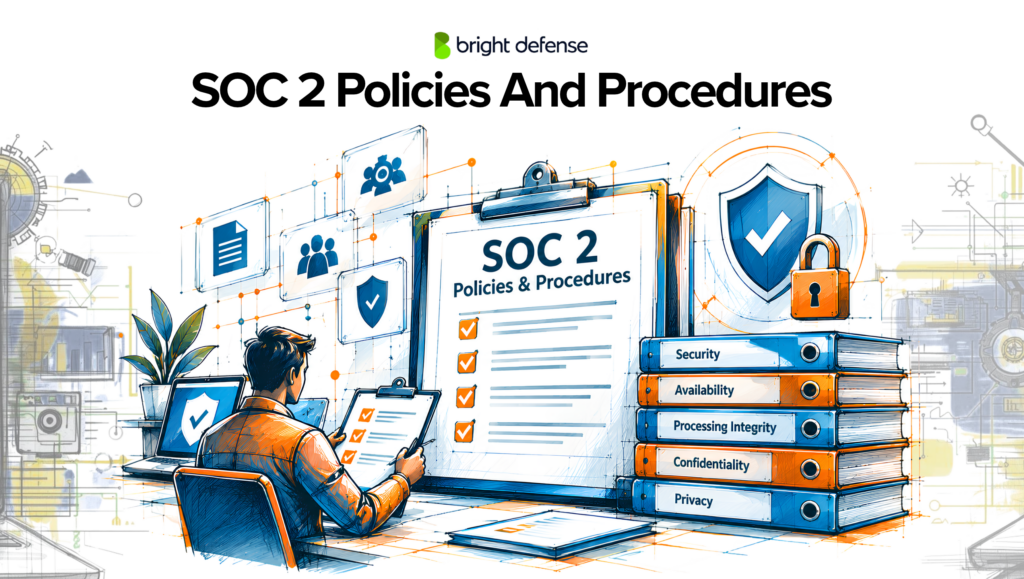
Another critical factor influencing SOC 2 audit costs is the Trust Services Criteria, which are a set of requirements that must be fulfilled to achieve a successful SOC 2 audit. These criteria cover aspects such as:
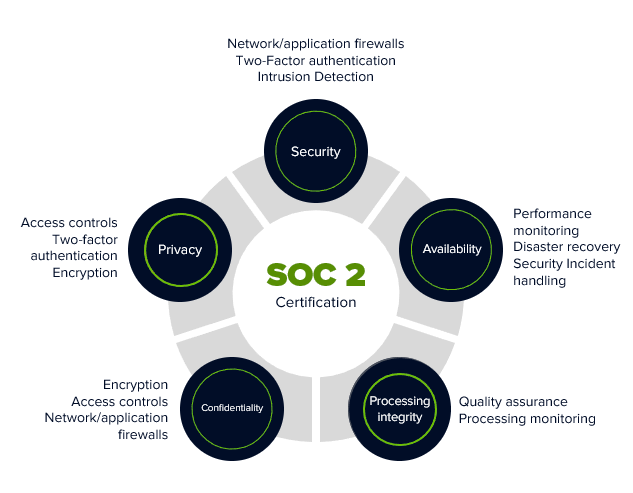
- Security
- Availability
- Processing integrity
- Confidentiality
- Privacy
They may also require regular security awareness training and adherence to data protection policies to remain compliant. Most SMBs will do Security, Availability and Confidentiality. A lot of organizations think they need to do Privacy and Processing Integrity but there are very particular and specific criteria that you need to meet before considering expanding the scope of the audit to include these Trust Services Criteria as the scope of the audit greatly increases.
The number of Trust Services Criteria an organization chooses to include in its audit directly impacts the scope and cost of the SOC 2 audit. More criteria entail a more extensive audit process, which translates to higher costs. If a certain criterion is inapplicable or unimportant, it can be omitted. The remaining smaller subset of trust services criteria will be assessed in this situation.
It’s crucial for businesses to evaluate their specific needs and risks to determine the most appropriate set of criteria for their SOC 2 audit.
SOC 2 Preparation and Readiness Assessments Costs
Preparing for a SOC 2 audit is a vital step towards achieving compliance. Preparation costs and readiness assessments help organizations identify areas of non-compliance and outline the necessary measures to attain SOC 2 compliance, ultimately influencing overall costs.
These assessments may include gap analysis and remediation efforts, both of which play a crucial role in streamlining the compliance process and minimizing expenses, as well as addressing lost productivity.
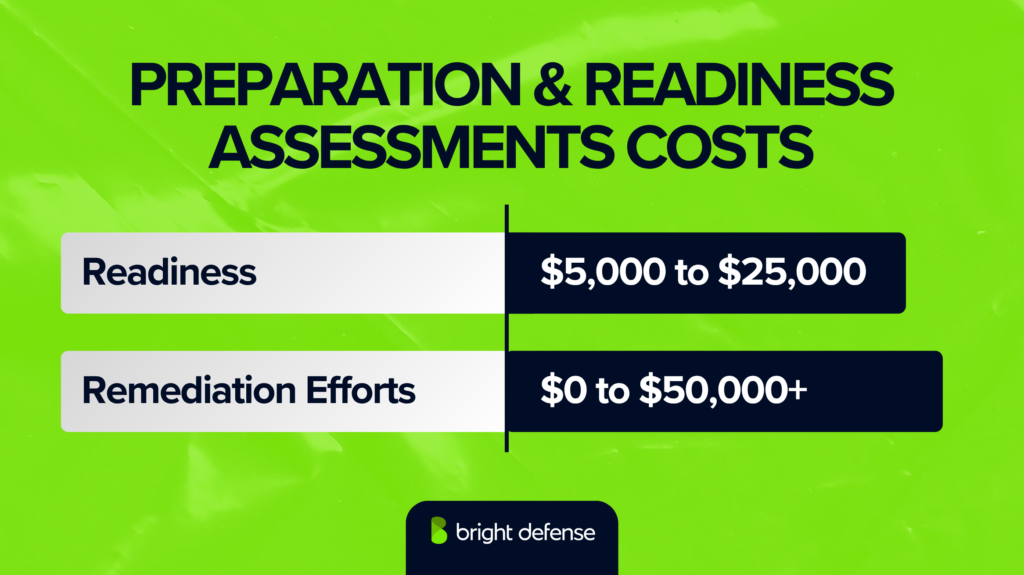
Estimated Costs:
- SOC 2 Readiness: $5,000 to $25,000, depending on the size and complexity of your organization’s information security systems.
- Remediation Efforts: Costs can range from $0 to $50,000+, depending on the scope of necessary changes, such as policy creation, control implementation, and infrastructure updates .
Investing in thorough preparation can help reduce the likelihood of audit failures and additional expenses down the line.
Estimating the Cost of SOC 2 Compliance
SOC 2 compliance costs depend on several factors. For a broader view that looks at the full SOC 2 certification cost across the entire program rather than the audit fee alone, it helps to separate budget lines into the following categories:
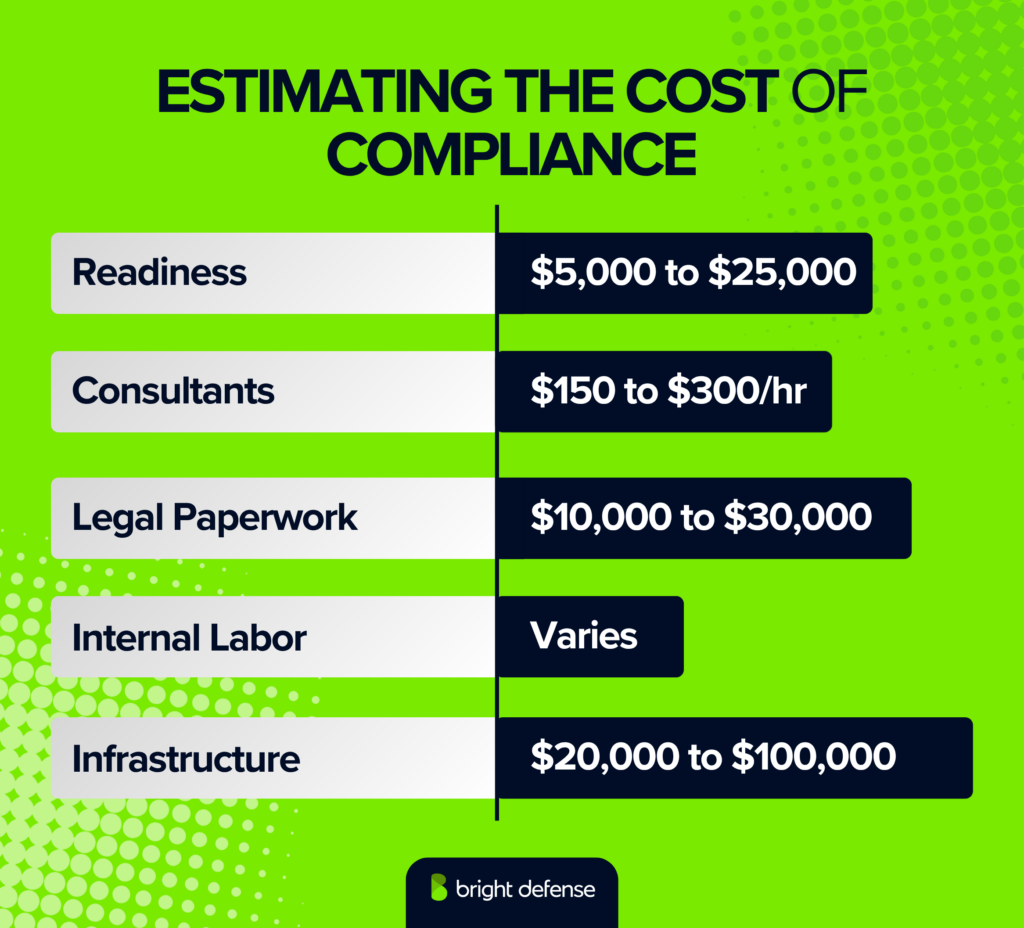
- SOC 2 Readiness: $5,000 to $25,000 to evaluate current compliance gaps.
- Consultants: $150 to $300 per hour for external expertise and guidance.
- Legal Paperwork: $10,000 to $30,000 for drafting policies, contracts, and procedures.
- Internal Labor: Varies based on staff hours and salaries for documentation, evidence gathering, and audit preparation.
- Infrastructure: $20,000 to $100,000 for new systems, tool upgrades, or control implementations.
A SOC 2 Type 1 audit reviews controls at a single point in time and typically costs less. A Type 2 audit covers control effectiveness over several months, increasing costs due to extended monitoring, evidence collection, and testing.
Understanding these categories helps organizations budget accurately for SOC 2 compliance.
Factors Influencing SOC 2 Audit Costs
SOC 2 audit costs are not fixed. They vary widely based on multiple technical, organizational, and operational factors. Understanding these drivers helps organizations avoid underestimating both financial and resource commitments.
1. Scope of the Audit
The audit scope directly impacts cost. Key scope elements include:
- Number of systems and environments: More cloud platforms, applications, or data centers increase the volume of controls and evidence.
- Number of locations: Multi-site operations add complexity.
- Customer data types handled: Sensitive or regulated data (e.g. healthcare, financial) may require additional controls.
- Number of trust service criteria (TSC):
- Security is mandatory.
- Availability, Confidentiality, Processing Integrity, and Privacy are optional but often requested by customers.
- Each added TSC expands auditor testing requirements.
The broader the scope, the more hours the auditor must dedicate to evidence review and control testing.
2. Type of Audit: Type 1 vs Type 2
- Type 1 Audit:
Assesses whether controls are properly designed at a point in time.
Shorter duration and lower cost. - Type 2 Audit:
Evaluates if controls operate effectively over a monitoring period (typically 3–12 months).
Requires continuous evidence gathering, live control operation, and expanded auditor review.
Type 2 audits are considerably more expensive due to time, labor, and control depth.
3. Readiness Level
The maturity of your security program before starting impacts both preparation and audit fees:
- High readiness: Mature policies, documented procedures, and established controls reduce preparation costs.
- Low readiness: Organizations lacking formal controls face higher costs for policy drafting, control design, remediation, and advisory services.
Often, a readiness assessment is necessary before formal audits, which itself adds cost but reduces audit failure risk.
4. Internal Team Involvement
Organizations that dedicate skilled internal compliance, security, and IT staff for audit preparation lower external consultant needs. Where internal expertise is limited, significant external advisory costs may be unavoidable.
Staff involvement includes:
- Evidence collection
- Documentation updates
- Policy writing
- Managing auditor communications
- Control operation monitoring
Internal labor cost can reach 100–300+ staff-hours across multiple departments.
5. Automation and Tooling
Automation platforms help reduce evidence collection time, maintain continuous control monitoring, and streamline auditor collaboration.
- Subscription platforms typically cost $7,000 to $25,000 per year.
- Effective automation reduces long-term labor costs and lowers auditor billable hours by simplifying access to evidence.
Organizations with manual compliance processes face higher recurring operational costs.
6. Remediation Work
Most organizations require remediation work to address gaps identified during readiness assessments:
- Policy creation
- Control development
- System hardening
- Role-based access control (RBAC) implementation
- Logging and monitoring upgrades
Remediation costs vary significantly: from $0 for minor adjustments to $50,000+ for substantial overhauls.
7. Auditor Selection
Choosing among SOC 2 audit firms is one of the largest cost variables, because rates differ sharply by firm size, specialization, and region. Key pricing drivers include:
- Firm size: Top-tier firms (Big 4 or national audit firms) charge premium rates.
- Experience level: Niche SOC 2 auditors often offer competitive pricing with deep technical expertise.
- Geography: Auditor rates differ based on jurisdiction, especially for international audits.
Typical audit fees:
- Type 1: $5,000 to $10,000
- Type 2: $30,000 to $70,000+
8. Annual Recertification
SOC 2 Type 2 audits require annual recertification. Organizations should budget for:
- Ongoing audit fees (typically 70%–80% of initial audit cost)
- Continuous evidence gathering and monitoring
- Regular policy reviews and control updates
9. Penetration Testing and Vulnerability Scanning
SOC 2 audits often expect annual penetration tests and vulnerability scans as part of security control validation.
- Penetration tests: $2,500 to $25,000 annually
- Vulnerability scans: $1,000 to $5,000
10. Legal and Contractual Requirements
Legal counsel may be required to:
- Review customer agreements
- Draft security policies
- Verify data protection clauses
Legal advisory costs may range from $5,000 to $30,000 depending on complexity.
SOC 2 Security Tools and Employee Training Costs
SOC 2 compliance requires multiple security tools. Security tools and employee training costs for SOC 2 includes the following:
- Antivirus Software: $30 to $100 per user per year
- Password Managers: $30 to $60 per user per year
- Vulnerability Scanners: $2,000 to $5,000 per year
- SIEM Tools: $5,000 to $50,000+ per year
- Security Awareness Training: $25 to $50 per user per year and upto $15,000 per session
Trains employees on security best practices and reduces the chance of user-related incidents.
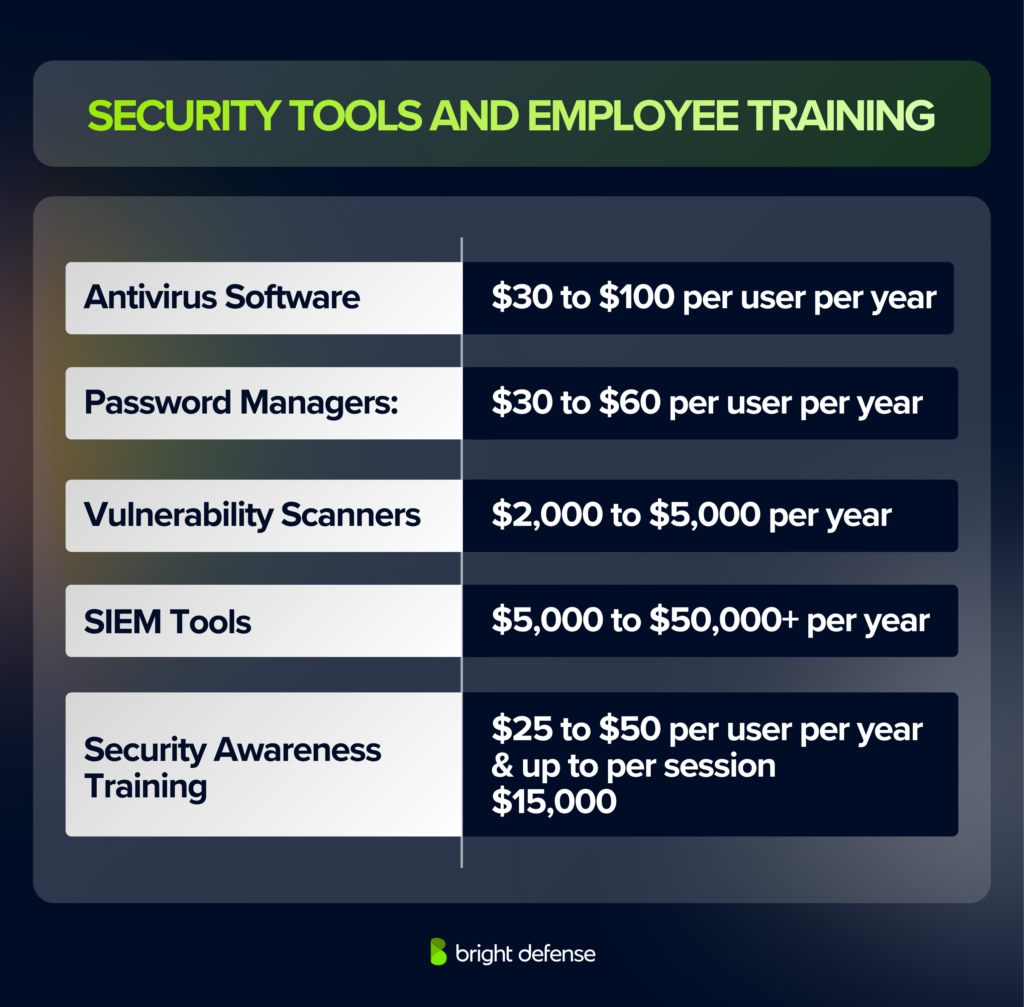
These tools and trainings help detect and fix vulnerabilities, block cyber threats, and handle security incidents. A security-first culture also lowers the risk of breaches and data leaks. Using these tools and policies shows that the business protects sensitive information and keeps customer trust.
Knowing these costs allows businesses to plan budgets for SOC 2 compliance.
Security Tool Investments
Investing in security tools, such as:
- Vulnerability scanners (Rapid7, Qualys, Tenable)
- SIEM tools (Splunk, DataDog, FortiSIEM )
- Anti-virus software (SentinelOne, Microsoft Defender)
- Password managers (1Password, LastPass)
is essential for achieving SOC 2 compliance. These tools enable organizations to proactively identify and address security vulnerabilities, reducing the likelihood of costly breaches and compliance failures. Additional investments may be necessary to cover other native services provided by cloud service providers.
Vulnerability Scanners & Gap Analysis Cost
Start with a gap analysis to find weaknesses in codebases or hosting infrastructures. Assess the risks and potential impact of these vulnerabilities. If high-risk issues appear, consider vulnerability scanners, which cost $6,000 to $25,000. The cost should be weighed against the security risks identified.
Tips for a Successful SOC 2 Audit
Preparing for a SOC 2 audit requires planning, coordination, and ongoing attention. The following tips can help simplify the process and improve results:
- Start Early: Begin preparations well in advance of the audit. This gives ample time to address any potential issues or gaps.
- Engage Stakeholders: Ensure that all relevant departments and stakeholders are involved in the audit process. This ensures a holistic approach to compliance.
- Documentation: Maintain thorough documentation of all processes, controls, and procedures. This not only aids in the audit process but also helps in identifying areas of improvement.
- Continuous Improvement: Instead of viewing the SOC 2 audit as a one-time event, treat it as an ongoing process of improvement. Regularly review and update controls and procedures to stay compliant.
Summary
In conclusion, understanding the various aspects that contribute to SOC 2 audit costs is crucial for organizations looking to achieve and maintain compliance. By carefully considering factors such as audit type, trust services criteria, preparation and readiness assessments, auditor fees, legal expenses, security tool investments, employee training, and ongoing maintenance costs, businesses can effectively budget for SOC 2 compliance and proactively address potential challenges. With a comprehensive understanding of these costs and a commitment to continuous improvement, organizations can demonstrate their dedication to data security and protect their valuable assets and reputation.
About Bright Defense
Bright Defense protects our customers from cybersecurity threats through continuous compliance. We work with SMBs, SaaS providers, and MSPs to help them achieve SOC 2, HIPAA, and CMMC compliance. We utilize compliance automation tools to help reduce the burden of evidence collection to reduce overall audit costs and audit fatigue. Our experienced team of cybersecurity experts focuses on a risk-based approach to the compliance journey versus implementing controls to pass a certification.
Bright Defense was able to help a SaaS developer that has been achieving SOC 2 certification since 2018, reduce their annual SOC 2 audit costs by 66%. Bright Defense was able to implement Drata, a compliance automation platform along with our continuous compliance service offering that provides the customer with enhanced visibility, monitoring, and automation, all in all giving them better value for a similar annual expense!
Take control of your cybersecurity journey with Bright Defense’s Continuous Cybersecurity Compliance-as-a-Service packages, tailored to fit every stage of your SMB’s compliance needs. Choose from three comprehensive packages, all powered by a compliance automation platform, to secure your business’s future:
- Sentry: Perfect for DIY, IT-savvy firms with a solid security grasp. Leverage our vCISO expertise for Risk Assessments, Incident Response playbooks, tabletop exercises, BC/DR planning, audit preparation, Internal Audits, and IT Strategy development.
- Guardian: Our full-service option delivers a robust Information Security Program, covering all aspects up to pre-audit preparation. You have the freedom to introduce your auditor, ensuring a personalized compliance journey.
- Defender: The ultimate package, including all Guardian features plus an annual SOC 2 audit by a US-based AICPA firm and monthly vulnerability scans. This comprehensive plan offers unparalleled security assurance.
Embark on your compliance journey with Bright Defense today and secure your business with our expertly designed packages. Your cybersecurity compliance is our priority. Let’s defend your business together!
In addition to continuous compliance, we offer security assessments and remediation, virtual CISO (vCISO) services, and managed security awareness training.
Frequently Asked Questions (FAQs) about SOC 2 Audits and Related Services
A SOC 2 audit is a comprehensive evaluation of an organization’s controls related to security, availability, processing integrity, confidentiality, and privacy. It’s based on the Trust Services Criteria established by the American Institute of Certified Public Accountants (AICPA).
The cost of a SOC 2 audit can vary widely. For small to medium-sized businesses, it can range from $6,000 to $25,000, while larger businesses may see costs from $50,000 to $100,000 or more. Type 1 audits generally cost less than Type 2 audits. With a compliance automation software and expert guidance the price of a SOC 2 audit can dramatically reduce to starting at $5,000 for small business.
Type 1 audits assess the design of controls at a specific point in time and are generally less expensive. Type 2 audits evaluate the operating effectiveness of controls over a period of time and are more comprehensive and costly.
Factors include the type of audit, Trust Services Criteria chosen, organization size, complexity, level of automation deployed, and geographical location.
Benefits include enhanced reputation, competitive advantage, and reduced risk of data breaches.
These are requirements covering security, availability, processing integrity, confidentiality, and privacy. They are essential for achieving SOC 2 compliance.
Preparation includes readiness assessments, gap analysis, establishing internal controls, and remediation efforts to meet compliance requirements.
Yes, any CPA who is independent and accredited by the AICPA can perform a SOC 2 audit.
These include yearly audits, continuous monitoring of information security management systems, and other recurring expenses necessary for ongoing compliance.
Implementing compliance automation software and seeking expert guidance can help streamline the audit process and potentially reduce costs.
Start preparations early, engage stakeholders, maintain thorough documentation, and treat the audit as an ongoing process of improvement.
Bright Defense offers continuous compliance, security assessments and remediation, virtual CISO services, and managed security awareness training.
Bright Defense implemented compliance automation tools and continuous compliance services, reducing annual SOC 2 audit costs by 66% for a SaaS developer client.
The cost typically ranges from $700 to $2500, a small investment compared to the potential costs of a cyber attack.
You can begin your continuous compliance journey with Bright Defense by contacting them for more information and tailored services.
SOC 2 Type I audit fees are commonly quoted at $7,500 to $15,000 for small to midsize companies, and up to $60,000 for larger organizations.
SOC 2 Type II audit fees are commonly quoted at $12,000 to $20,000 for small to midsize companies, and $30,000 to $100,000+ for larger organizations.
Yes. Type II commonly costs about 30% to 50% more than Type I because it tests operating effectiveness over a longer period.
All-in cost is often quoted at $10K to $80K+ when prep work and the audit are counted together, and some breakdowns note readiness, tools, internal time, and remediation can add $20K to $80K beyond the audit fee.
Pricing mainly shifts with audit type (Type I vs Type II), scope (Trust Services Criteria and system boundary), company size and complexity, how much remediation is needed before fieldwork, and which audit firm you pick.
21. I am a startup. What should I budget for a first SOC 2 Type II in 2026?
A common starting point is a Type II audit fee around $12,000 to $20,000, plus a broader first-year budget that can land in the $10K to $80K+ range depending on how much prep work you still need.
22. Can I skip Type I and go straight to Type II, and does it save money?
Yes, going straight to Type II is a valid path, and the cost outcome depends on readiness because skipping Type I does not remove the underlying control work that Type II still tests over its reporting period.
23. How much can readiness work or consulting add in 2026?
Readiness support is often a separate line item, and one common reference point is an additional $10K for outsourced prep work, while other breakdowns estimate broader “beyond audit” spend of $20K to $80K once tools, remediation, and internal time are included.
24. How often do SOC 2 audit costs repeat?
SOC 2 audits are typically done annually, so audit fees and ongoing program costs tend to recur each year.
25. What are practical ways to keep SOC 2 audit costs lower in 2026?
Cost control usually comes from keeping scope tight to what customers actually require, reducing last-minute remediation before fieldwork, standardizing evidence collection early in the period, and getting quotes that clearly separate audit fee, readiness help, and retesting so you can compare like for like.