Secureframe Vs Sprinto: Detailed Comparison For 2026
Updated:
August 25, 2026
Secureframe and Sprinto are compliance automation platforms that help companies prepare for certifications such as SOC 2, ISO 27001, and HIPAA. Both tools automate evidence collection, control monitoring, and auditor coordination.
Secureframe targets mid-market teams that want deeper advisory support and broader framework coverage. Sprinto targets early-stage startups that prioritize lower cost and faster deployment.
The right choice depends on budget, internal compliance expertise, and the complexity of the tech stack. This comparison covers pricing, onboarding speed, integration breadth, personnel controls, support, and global market fit.
Secureframe – Company Overview
Secureframe is a compliance software company founded in 2020 that helps businesses achieve and maintain security certifications such as SOC 2, ISO 27001, HIPAA, PCI DSS, GDPR, and FedRAMP.
The platform automates evidence collection, manages policies, and monitors controls so teams can become audit-ready quickly. The company has raised $79 million in funding and operates from hubs in San Francisco, New York, Austin, Denver, Toronto, and London.
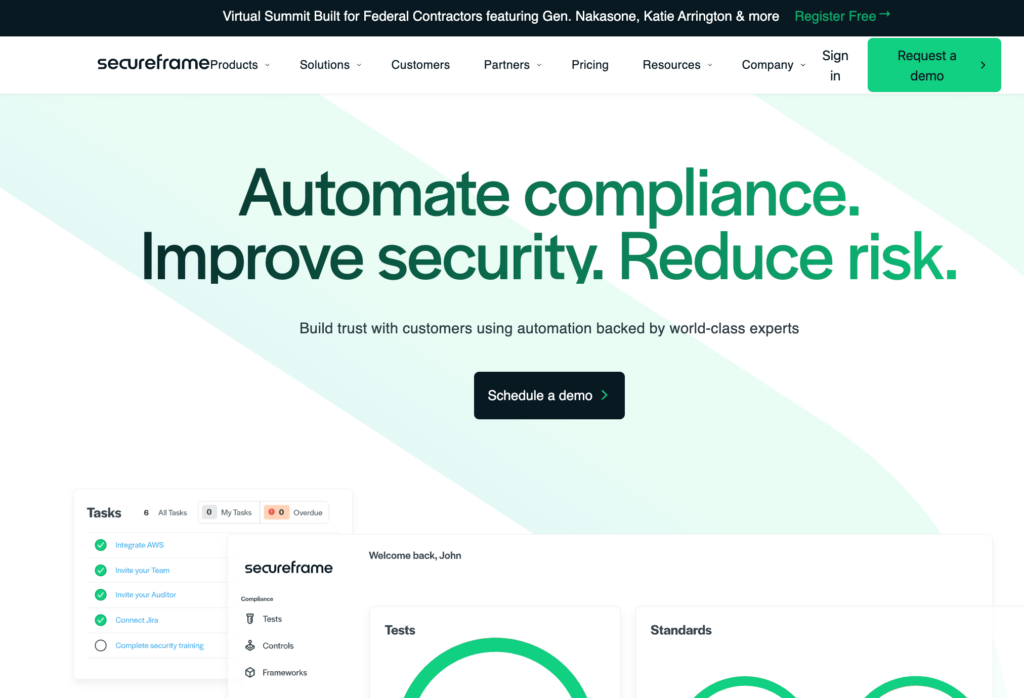
Secureframe Company Details
- Headquarters: Secureframe, Inc. lists its corporate address as 548 Market Street, Suite 30287, San Francisco, CA 94104, USA.
- Founded: 2020.
- Founders: Shrav Mehta (CEO) had backgrounds in cloud security and compliance.
- Employees And Funding: 200+ employees, more than 150 integrations, and $79 million in total funding.
- Website: https://secureframe.com
- LinkedIn: https://linkedin.com/company/secureframe
- Email: General support requests go to support@secureframe.com, while clients can contact success@secureframe.com for customer success inquiries.
Specialization
Secureframe specializes in continuous security and compliance automation. The platform connects to more than 150 cloud services and tools to automatically collect evidence and monitor controls. It covers over 15 frameworks, including SOC 2, ISO 27001, HIPAA, PCI DSS, GDPR, CMMC 2.0, CCPA, and FedRAMP.
Secureframe uses a daily monitoring approach and provides built-in background check tracking, structured policy libraries, and training management. Its dedicated compliance managers guide customers through onboarding and help interpret framework requirements.
Strengths
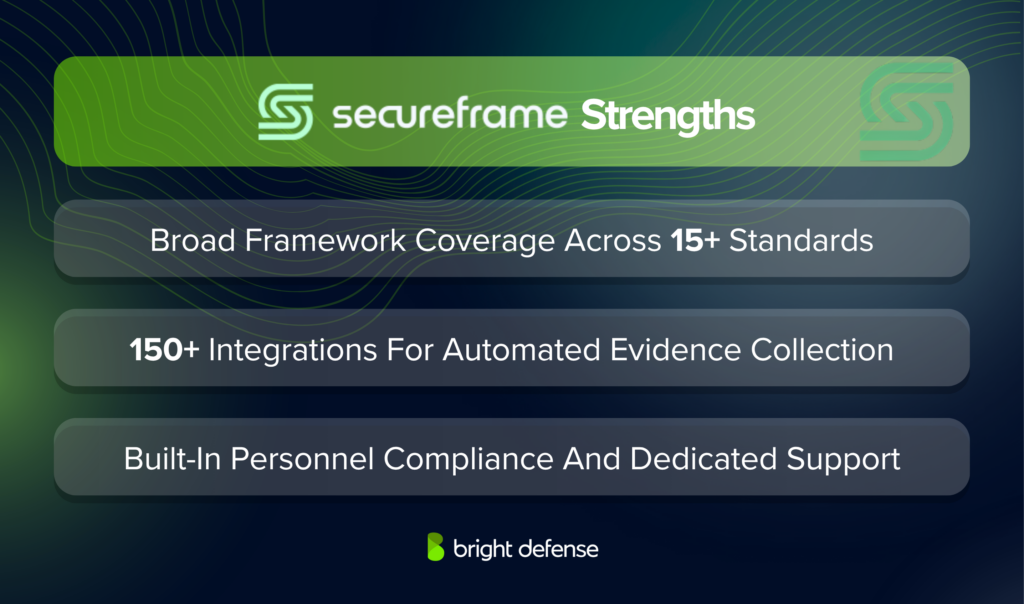
- Broad framework coverage: Secureframe supports at least 15 compliance frameworks, including SOC 2, ISO 27001, HIPAA, PCI DSS, GDPR, and government standards such as FedRAMP and CMMC 2.0. This coverage suits companies with diverse compliance obligations.
- Large integration library: The platform integrates with 150+ cloud services and tools, reducing manual evidence collection and enabling automated monitoring. SelectHub notes this integration depth accelerates compliance timelines and simplifies audits.
- Personnel compliance focus: Secureframe has built-in background-check management, training tracking, and structured onboarding workflows. SOC2Auditors.io highlights that these capabilities make it a strong fit for teams that need rigorous personnel controls.
- Dedicated compliance support: Customers receive a dedicated compliance manager who guides them through onboarding and helps interpret requirements. This human support is particularly valuable for organizations new to compliance.
- Global presence: Secureframe operates hubs across the U.S., Canada, and Europe and has a strong customer base in the U.S. and EU.
Services And Frameworks Supported
Secureframe’s platform automates controls and evidence collection across numerous standards:
- SOC 2: Covers all five trust service criteria with continuous monitoring.
- ISO 27001: Supports certification and surveillance audits.
- HIPAA: Helps healthcare companies manage PHI compliance.
- PCI DSS: Simplifies cardholder-data compliance.
- GDPR and CCPA: Provides privacy-focused controls and data subject management.
- CMMC 2.0 and FedRAMP: Offers specialized solutions for U.S. defense contractors and federal agencies.
Sprinto – Company Overview
Sprinto is an AI-native governance, risk, and compliance (GRC) platform that automates security compliance for fast-growing SaaS companies. Founded in 2020 by Girish Redekar and Raghuveer Kancherla, the company helps organizations achieve and maintain certifications such as SOC 2, ISO 27001, HIPAA, and GDPR through automated control mapping, evidence collection, and continuous monitoring. Sprinto operates globally and serves clients across 25 countries.
Sprinto Company Details
- Headquarters: San Francisco, California, United States. Sprinto operates as a Series B company based in San Francisco.
- Registered Address (India): 4th Floor, 91 SpringBoard, 175 and 176 Bannerghatta Main Road, Dollars Colony, Bangalore, Karnataka, India 560076. This is the registered address of Sprinto Technology Private Limited.
- Founded: 2020. Sprinto Technology Private Limited was incorporated in 2019, and the Sprinto platform launched in 2020.
- Founders: Girish Redekar and Raghuveer Kancherla.
- Employees: The company employs roughly 201 to 500 people, with an estimated 274 employees as of October 2025.
- Funding: Sprinto has raised approximately 32.2 million USD in Series B funding from investors such as Accel, Elevation Capital, and Blume Ventures.
- Website: https://sprinto.com
- LinkedIn: https://linkedin.com/company/sprinto-com
- Email Addresses: sales@sprinto.com and support@sprinto.com serve as general sales and support contacts.
Specialization
Sprinto specializes in autonomous trust and continuous compliance for cloud-native businesses. The platform integrates with over 100 cloud services and automates control mapping, evidence collection, and real-time monitoring. Its core focus is speed of deployment.
Startups can become audit-ready in 1 to 2 weeks and still get broad coverage for core frameworks. Sprinto offers AI-powered risk intelligence, policy templates, and an auditor dashboard, and it supports more than 20 security standards, including SOC 2, ISO 27001, GDPR, HIPAA, and PCI DSS.
Strengths
- Fast deployment and continuous monitoring: Sprinto’s onboarding process gets startups from signup to audit-ready in 1 to 2 weeks, and its continuous monitoring provides real-time alerts for compliance deviations.
- Lower cost for startups: Pricing starts around US$5,000 to $8,000 per year, making Sprinto a cost-effective option for early-stage companies. The platform’s affordability has helped it gain traction among international clients and budget-conscious startups.
- Strong international presence: Sprinto is headquartered in India with offices in San Francisco and serves 300+ customers across 25 countries. Its international focus and auditor relationships are especially strong in the Asia-Pacific region.
- Continuous compliance automation: Sprinto emphasizes continuous monitoring rather than periodic checks, which provides near-real-time visibility into security posture. This approach appeals to cloud-native teams that value speed and agility.
- Pre-built templates and policy resources: The platform includes auditor-approved policy and procedure templates that simplify compliance documentation. Its AI-powered assistance helps teams draft and remediate controls efficiently.
- Founders with deep expertise: Girish Redekar and Raghuveer Kancherla bring extensive experience in SaaS and compliance automation, and the company has raised significant venture funding.
Services And Frameworks Supported
Sprinto automates compliance for a growing list of standards:
- SOC 2: Automates evidence collection, control testing, and continuous monitoring.
- ISO 27001: Provides automated control mapping and audit readiness.
- HIPAA: Helps healthcare companies meet privacy and security requirements.
- GDPR and PIPEDA: Supports data privacy regulations with policy templates and risk assessments.
- PCI DSS: Offers controls for payment-card security.
- NIST CSF and CSA STAR: Supports additional frameworks such as the NIST Cybersecurity Framework and CSA STAR certification.
Target Customers And Positioning
According to SOC2Auditors.io, Sprinto is often the better fit for cloud-native startups that want rapid deployment, continuous compliance, and cost-competitive pricing. Sprinto’s pricing and international presence make it popular with companies in India and Southeast Asia.
Secureframe is more common among U.S. and EU teams. Sprinto’s integration library and auditor network are smaller than those of larger competitors. The platform still delivers core functionality and real-time monitoring at a lower cost.
How Much Do Secureframe And Sprinto Cost In 2026?
Secureframe costs approximately $8,000 to $12,000 per year for small teams, with custom quotes for larger deployments starting around $12,000 to $20,000 per year. Sprinto costs approximately $5,000 to $8,000 per year for startups, with plans for smaller companies starting around $5,000 to $10,000 per year. Both vendors use quote-based pricing tied to company size and the number of frameworks.
| Product | Typical entry pricing | Pricing model | Cost notes | User sentiment |
|---|---|---|---|---|
| Secureframe | $8,000 to $12,000 per year for small teams; custom quotes from $12,000 to $20,000 | Quote-based; free trial available on some plans | Bundled compliance-manager support and advisory services | Analyst rating 84/100; user sentiment 94% from roughly 900 reviews |
| Sprinto | $5,000 to $8,000 per year for startups; $5,000 to $10,000 for smaller companies | Quote-based; demo-led sales with limited free-trial availability | Lower cost reflects a smaller integration library and lighter human support | Analyst rating 86/100; user sentiment 96% from roughly 1,500 reviews |
Secureframe’s higher price pays for dedicated compliance managers and structured advisory services. Sprinto’s lower price fits teams that can run most compliance work themselves. Both vendors scale pricing with company size and framework count.
How Long Does Secureframe Vs Sprinto Onboarding Take?
Both platforms compress the path to audit readiness compared to traditional manual compliance programs. Secureframe onboarding typically takes 2 to 3 weeks. Sprinto onboarding typically takes 1 to 2 weeks. The difference reflects each vendor’s approach. Secureframe runs a guided review of the company’s environment and builds a custom evidence-collection plan. Sprinto uses a self-serve, template-driven setup designed for cloud-native startups with standard tech stacks.
Faster onboarding benefits teams with a straightforward stack and basic compliance literacy. Slower, guided onboarding helps teams without internal governance expertise. Secureframe’s advisory model adds value for first-time SOC 2 or ISO 27001 programs. Sprinto’s template model shortens time-to-first-certification for teams that already understand their controls.
How Many Integrations And Frameworks Do Secureframe And Sprinto Support?
Secureframe offers more than 150 native integrations and supports over 15 compliance frameworks including SOC 2, ISO 27001, HIPAA, PCI DSS, and GDPR. Sprinto offers more than 100 native integrations and supports SOC 2, ISO 27001, HIPAA, and GDPR. Secureframe’s library is larger. Sprinto’s is narrower and still expanding.
| Attribute | Secureframe | Sprinto |
|---|---|---|
| Native integrations | 150+ across cloud providers, identity systems, HR tools, and developer platforms | 100+ across major cloud and business platforms |
| Framework coverage | 15+ frameworks including SOC 2, ISO 27001, HIPAA, PCI DSS, and GDPR | SOC 2, ISO 27001, HIPAA, and GDPR |
| Evidence monitoring | Daily control monitoring | Continuous monitoring with real-time alerts |
| Auditor collaboration | Auditor-ready evidence rooms with structured access controls | Built-in auditor portals with audit-ready packages |
Teams with complex stacks or multiple frameworks benefit from Secureframe’s larger catalog. Teams that need real-time visibility benefit from Sprinto’s continuous monitoring model. Sprinto’s integrations occasionally require manual evidence uploads for less-supported tools.
Which Platform Handles Personnel Compliance Better?
Secureframe handles personnel compliance natively through background-check tracking, training management, and employee onboarding workflows. Sprinto handles personnel compliance through third-party integrations rather than built-in features.
Secureframe is the stronger fit for organizations where employee-level controls are audit-critical, especially for SOC 2 Type II or HIPAA programs.
Native personnel controls reduce manual coordination work. Background-check tracking connects directly to the evidence library, so auditors can pull records without additional uploads.
Sprinto can reach the same outcomes through HR integrations. Setup requires extra configuration and ongoing maintenance.
Which Platform Offers Better Policy And Document Management?
Secureframe provides a structured policy library with pre-built templates, annotated examples, and document version control. Sprinto provides auditor-approved security policy and procedure templates with narrower customization options.
Secureframe is better for teams that need granular control over policy language. Sprinto is faster for teams that accept template defaults.
G2 reviewers highlight Secureframe’s template examples and upload workflow as a time-saver for first-time compliance teams. Sprinto’s templates pass auditor review quickly. Flexibility drops when a company needs policies that differ from standard patterns.
What Support Do Secureframe And Sprinto Offer?
Secureframe’s pricing includes a dedicated Customer Success Manager (CSM) and a compliance manager who guide the full program.
Sprinto offers chat and email support on lower tiers, with a dedicated CSM on higher plans. Secureframe is designed for teams that want a human advisor on call. Sprinto is designed for teams that can self-manage and escalate only when needed.
Secureframe’s advisory model helps with complex control interpretation questions, auditor negotiations, and multi-framework scoping. Sprinto’s lighter model fits teams that already understand their framework requirements and want low-touch guidance.
Where Are Secureframe And Sprinto Used Globally?
Sprinto has strong adoption across APAC markets including India, Singapore, and Australia. Secureframe’s customer base concentrates in the US and EU, with the strongest partnerships in North America and Western Europe. Both platforms serve global customers. Each has a clear regional center of gravity.
Sprinto’s APAC presence includes local auditor relationships and familiarity with regional compliance expectations. Secureframe’s North American focus supports closer integration with US-based SOC 2 auditors and US legal and HR stacks. Teams should match vendor geography to their primary audit market and customer base.
Secureframe Vs Sprinto Strengths And Weaknesses
The table below summarizes the core tradeoffs across ease of use, automation, framework support, advisory depth, and global reach.
| Aspect | Secureframe Strengths | Secureframe Weaknesses | Sprinto Strengths | Sprinto Weaknesses |
|---|---|---|---|---|
| Ease of use | Intuitive interface, smooth onboarding, pre-built templates | Anomaly detection and DLP features could improve; cost is a barrier for small teams | Quick onboarding, clean design, continuous monitoring | Fewer integrations, limited customization, occasional UI bugs |
| Automation and monitoring | Automated evidence collection from 150+ integrations; daily monitoring | No continuous monitoring; daily checks may lag real-time events | Continuous monitoring with real-time alerts | Shallower integration depth; manual work for less-supported tools |
| Framework support | 15+ frameworks including SOC 2, ISO 27001, HIPAA, PCI DSS, GDPR | Custom frameworks are hard to build; non-standard controls need workarounds | Covers SOC 2, ISO 27001, HIPAA, GDPR; expanding library | Fewer frameworks; migration may be needed as compliance scope grows |
| Support and advisory | Dedicated compliance managers and CSMs; native personnel compliance | Advisory pricing is part of the higher cost; smaller auditor network than Vanta | Competitive pricing; responsive startup-focused support | Lighter support on lower tiers; personnel compliance depends on integrations |
| Global reach | Strong US and EU presence with solid international capabilities | Smaller APAC footprint; less regional compliance familiarity | Strong APAC presence including India, Singapore, Australia | Less adoption in US and EU; manual adaptation for some regional requirements |
Secureframe Vs Sprinto: Which Platform To Choose In 2026
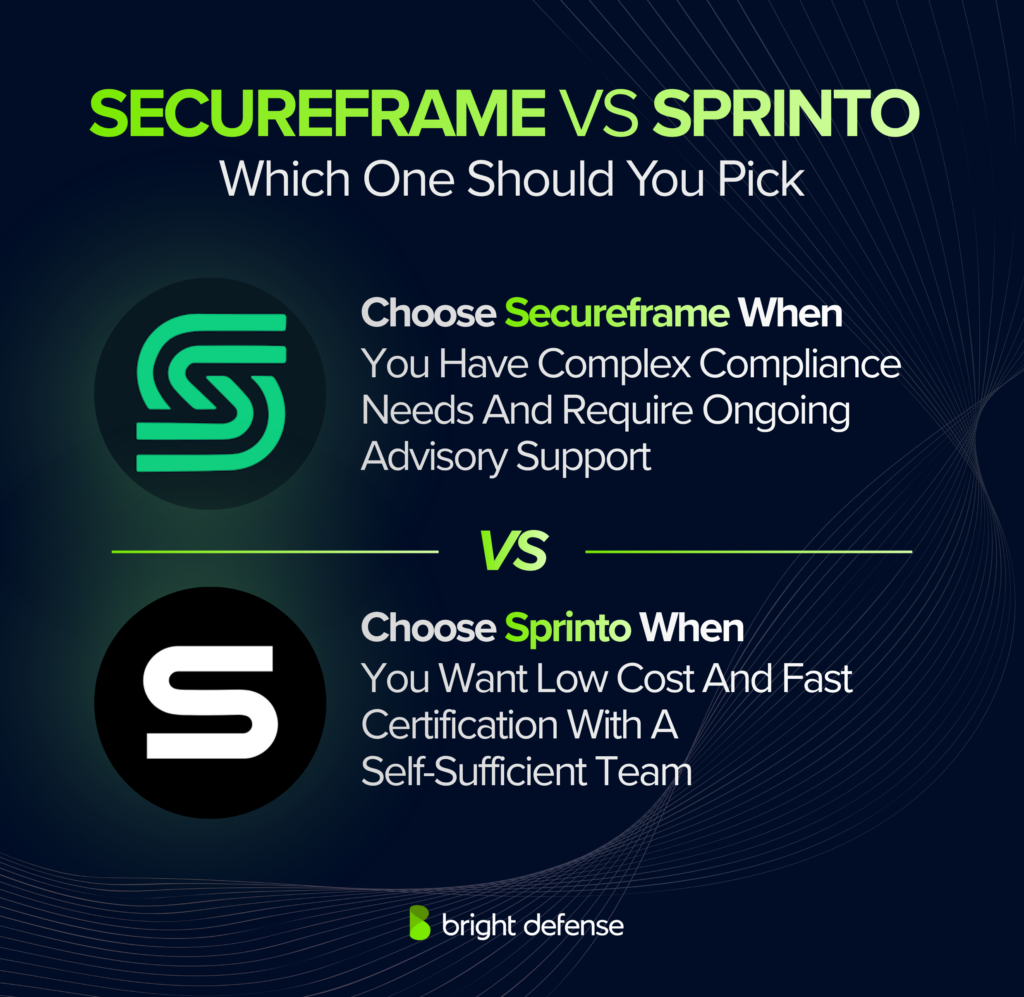
Sprinto is the stronger choice for early-stage startups, cost-sensitive teams, and companies headquartered in APAC. Secureframe is the stronger choice for mid-market teams with employee-level controls, multi-framework scope, or limited internal compliance expertise. The decision comes down to three factors: budget, required advisory depth, and framework count.
Choose Sprinto When
Budget is the primary constraint. Your team needs the fastest route to a first SOC 2 or ISO 27001 report. Your infrastructure runs on standard cloud providers. Your compliance scope stays within SOC 2, ISO 27001, HIPAA, and GDPR. Your team already understands control requirements and can run most evidence work without advisory support.
Choose Secureframe When
Your compliance scope includes significant employee-level controls, background checks, or multiple frameworks such as PCI DSS. Your team wants dedicated advisory support throughout the program. Your tech stack has non-standard tools that need a larger integration catalog. Your roadmap includes expanding into additional frameworks over the next 12 to 24 months.
Consider Future Scalability
Sprinto may require migration as integration needs grow or new frameworks enter scope. Secureframe’s custom framework support remains limited, so highly specialized controls may still need workarounds. Match the platform choice to a 2-to-3-year compliance roadmap rather than the current quarter.
Final Thoughts
Secureframe and Sprinto occupy distinct positions in the compliance automation market. Sprinto’s lower price and continuous monitoring suit startups that want speed and affordability. Secureframe’s richer integrations, deeper personnel compliance, and hands-on advisory suit mid-market teams that want a guided program. Platform choice should match budget, support needs, and the long-term compliance roadmap.
Teams weighing additional compliance platforms can review our Drata vs Secureframe comparison for context on how Secureframe stacks up against another established competitor. The Drata vs Vanta comparison covers how the two largest compliance automation platforms compare across integrations, pricing, and auditor network size.
Buyers comparing Sprinto directly against the largest enterprise platform can review our Drata vs Sprinto comparison for a side-by-side breakdown of pricing, framework coverage, and personnel controls.
FAQ
Secureframe and Sprinto are used to run audit-readiness work such as SOC 2 through evidence collection, control tracking, and reporting workflows across common compliance frameworks.
Secureframe states 300+ integrations, and Sprinto states 300+ integrations, but the practical difference comes from whether the specific connector pulls the evidence you need rather than only linking an account.
Sprinto markets 200+ frameworks, while Secureframe publishes a frameworks catalog that includes common options such as SOC 2, ISO 27001:2022, and PCI DSS.
Yes. Secureframe offers a Trust Center feature for sharing security and compliance information, and Sprinto offers a Trust Center positioned for buyer-facing security posture sharing.
Yes. Secureframe offers questionnaire automation and reports an average savings of 35 hours per month for customers, while Sprinto promotes an AI security questionnaire capability as part of its trust workflow.
You decide faster when you list your exact evidence sources and check which product has the needed connectors plus the depth to pull configuration-level evidence, since “300+ integrations” can still include shallow connectors.
Both vendors claim 300+ and 300+ integrations, so the deciding factor is whether your required tools are on the list and whether the connector covers the controls you care about.
Sprinto’s positioning around 200+ frameworks can suit teams that expect broad multi-framework coverage, while Secureframe’s published frameworks catalog can suit teams that want to pick a defined set of frameworks from its list.
Secureframe points to an API and custom integrations for missing tools, and Sprinto states it integrates with 200+ platforms and asks teams to request prioritization for missing integrations.
Match your “must-connect” systems to each vendor’s integration list 2) Run a short evidence walkthrough for your top SOC 2 controls 3) Test how each Trust Center and questionnaire workflow answers a real customer request.
The most common Drata alternatives are Vanta, Sprinto, Secureframe, Scrut Automation, and Scytale. G2 currently lists Vanta as the best overall Drata alternative and also names the others as similar options.