Drata vs Sprinto: Detailed Comparison for 2026
Updated:
August 25, 2026
Drata and Sprinto are compliance automation platforms that help organizations achieve and maintain certifications such as SOC 2, ISO 27001, HIPAA, and GDPR. Drata focuses on continuous trust management with deeper framework coverage and built-in personnel controls.
Sprinto focuses on autonomous trust, fast onboarding, and a larger integration catalog at lower cost. The right choice depends on budget, internal compliance expertise, and tech stack complexity. This comparison covers pricing, onboarding speed, integration breadth, personnel controls, support, and global market fit.
Drata Company Overview
Drata is a trust management and compliance automation company founded in 2020. The platform helps businesses achieve and maintain SOC 2, ISO 27001, HIPAA, GDPR, and PCI DSS certifications through automated evidence collection, continuous control monitoring, and real-time dashboards.
Drata has raised $328.2 million in funding at a $2 billion valuation and is headquartered in San Diego, California, with a second headquarters opened in San Francisco in February 2026. The company serves more than 8,000 customers in 80+ countries.
Drata Company Details
- Headquarters: San Diego, California, USA (second headquarters opened in San Francisco in February 2026)
- Founded: 2020
- Founders: Adam Markowitz, Daniel Marashlian, and Troy Markowitz
- Employees: Approximately 720 as of early 2026
- Funding: $328.2 million across Seed, Series A, Series B, and Series C rounds, with a $200 million Series C in December 2022
- Valuation: $2 billion (as of December 2022)
- Customers: 8,000+ customers in 80+ countries, including one-third of the Forbes Cloud 100
- Website: https://drata.com
- LinkedIn: https://linkedin.com/company/drata
- Email: support@drata.com for general support and sales@drata.com for sales inquiries
Drata Specialization
Drata specializes in continuous trust management. The platform connects to over 120 cloud services and SaaS tools to automatically collect evidence, monitor controls, and generate real-time dashboards.
Drata supports 30+ pre-built frameworks, including SOC 2, ISO 27001, HIPAA, GDPR, PCI DSS, DORA, NIS 2, and ISO 42001 for AI governance.
The platform includes native background check tracking, policy libraries, training management, and risk scoring, giving organizations a unified compliance and risk view in one place.
Drata Strengths
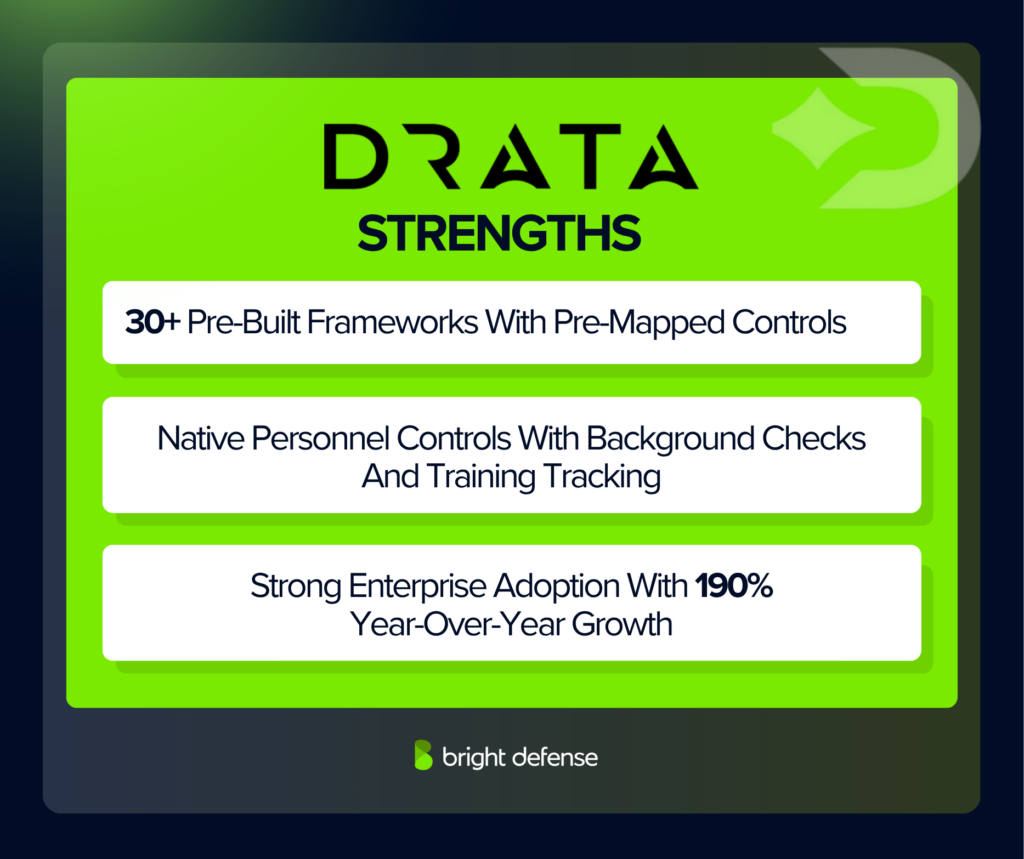
Drata’s strengths center on framework depth, enterprise readiness, and built-in personnel controls. The platform supports 30+ pre-built frameworks with pre-mapped controls, covering SOC 2, ISO 27001, HIPAA, GDPR, PCI DSS, DORA, NIS 2, and ISO 42001.
The integration library includes 120+ native integrations across cloud platforms, code repositories, identity providers, and HR systems.
Native background check tracking, training management, and employee onboarding workflows link personnel records directly to control evidence.
Drata reported 190% year-over-year enterprise revenue growth over the most recent 12 months, with a customer base that now includes Fortune 100 organizations, Abnormal Security, Tenable, Notion, and Kandji.
Frameworks Drata Supports
The following standards are supported natively on the Drata platform:
- SOC 2: Continuous monitoring and evidence collection across all five trust service criteria.
- ISO 27001: Certification and surveillance audit readiness with automated control mapping.
- HIPAA: Privacy and security controls for healthcare organizations managing protected health information.
- GDPR, NIS 2, and DORA: Data privacy and operational resilience requirements for EU operators and financial-services entities.
- PCI DSS: Payment card security controls for merchants and service providers.
- ISO 42001: AI management framework support for trusted AI systems.
- Custom frameworks: Organizations can map and monitor controls against internal or industry-specific standards.
Sprinto Company Overview
Sprinto specializes in autonomous trust and continuous compliance for cloud-native startups and mid-market companies. The platform connects to 300+ cloud services and automates control mapping, evidence collection, and real-time monitoring for 200+ global standards.
AI-powered risk intelligence and policy templates help teams implement controls quickly. Sprinto’s guided workflows are built for companies that need audit readiness within one to two weeks at a lower total cost than enterprise-focused platforms.
Sprinto Company Details
- Headquarters: Bangalore, India, with US operations in San Francisco, California
- Founded: 2020
- Founders: Girish Redekar and Raghuveer Kancherla
- Employees: Approximately 300 to 345 as of late 2025
- Funding: $32.2 million across Seed, Series A, and Series B rounds, with a $20 million Series B in April 2024
- Customers: 3,000+ companies across 75 countries
- Website: https://sprinto.com
- LinkedIn: https://linkedin.com/company/sprinto-com
- Email: sales@sprinto.com for sales and support@sprinto.com for support
Sprinto Specialization
Sprinto specializes in autonomous trust and continuous compliance for cloud-native startups and mid-market companies. The platform connects to 300+ cloud services and automates control mapping, evidence collection, and real-time monitoring for 200+ global standards.
AI-powered risk intelligence and policy templates help teams implement controls quickly. Sprinto’s guided workflows are built for companies that need audit readiness within one to two weeks at a lower total cost than enterprise-focused platforms.
Sprinto Strengths
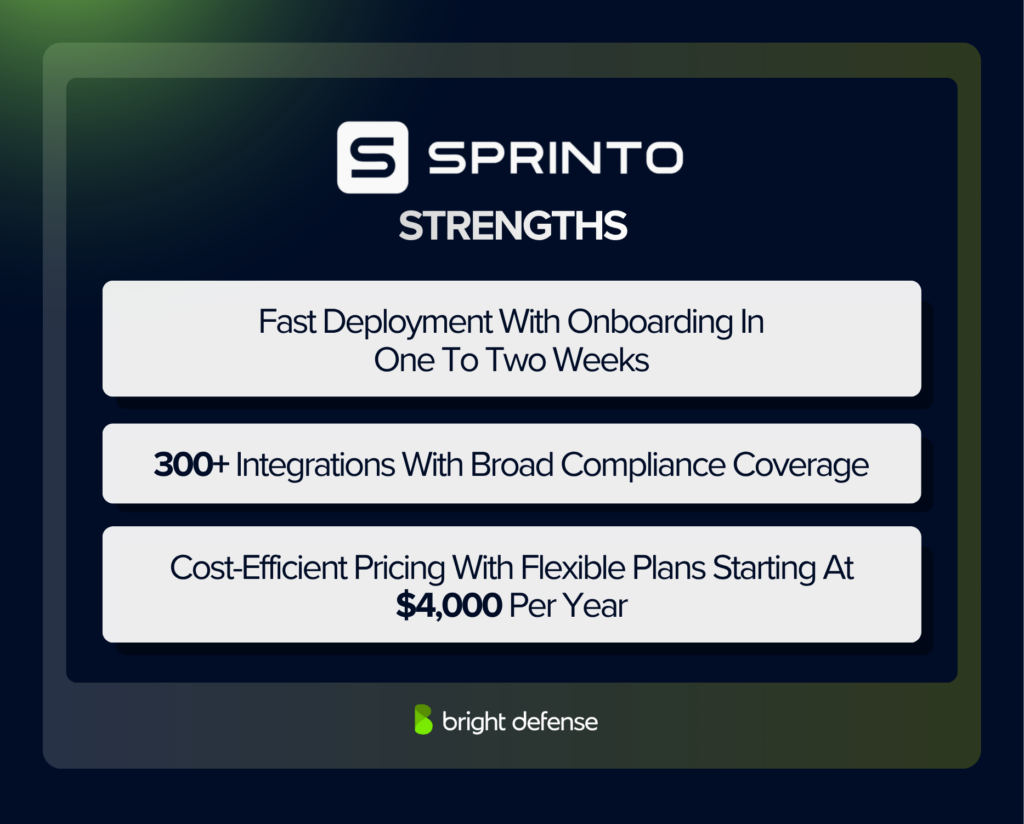
Sprinto’s strengths center on deployment speed, integration breadth, and cost efficiency. Onboarding typically takes one to two weeks, and continuous monitoring provides near real-time alerts.
Pricing starts around $4,000 to $8,000 per year with flexible plans based on company size and framework count.
The integration catalog includes 300+ native integrations and 200+ supported standards, covering SOC 2, ISO 27001, HIPAA, GDPR, PCI DSS, CSA STAR, NIST CSF, and ISO 42001.
AI agents automate risk assessments, remediation, and policy updates. Sprinto has strong adoption among companies in India, Singapore, and Australia, with local auditor relationships across the APAC region.
Frameworks Sprinto Supports
The following standards are supported natively on the Sprinto platform:
- SOC 2: Automated evidence collection, control testing, and continuous monitoring.
- ISO 27001: Automated control mapping and audit readiness.
- HIPAA: Privacy and security requirements for healthcare organizations.
- GDPR and PIPEDA: Data protection requirements for EU and Canadian operators.
- PCI DSS: Payment card compliance with automated control testing.
- NIST CSF and CSA STAR: Cybersecurity and cloud security frameworks.
- ISO 42001: AI governance framework for organizations managing AI systems.
- Custom frameworks: Over 200 global standards and custom mappings supported, including Infinite Frameworks for mapping contracts and internal policies.
Sprinto Target Customers and Positioning
Sprinto is the better fit for cloud-native startups that want rapid deployment, continuous compliance, and cost-effective pricing. Drata is built for mid-market and enterprise teams that need deeper framework coverage, polished dashboards, and personnel compliance controls.
Sprinto’s pricing and APAC presence attract companies in India, Singapore, Australia, and emerging markets. Drata is more common among North American and European teams with complex audit programs and enterprise buyers.
How Much Do Drata and Sprinto Cost in 2026?
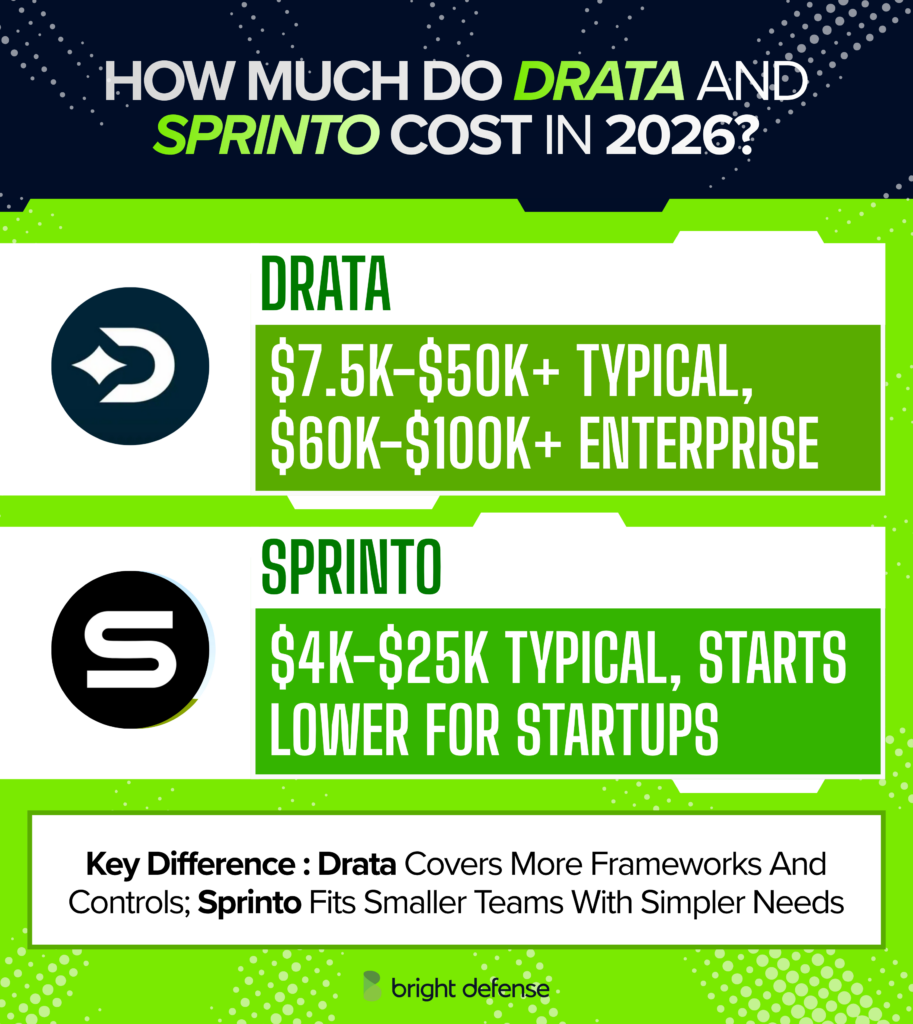
Drata costs $7,500 to $50,000+ per year depending on plan tier, with enterprise deployments exceeding $60,000. Sprinto costs $4,000 to $25,000 per year depending on company size and framework count.
Drata’s higher price reflects broader framework coverage and built-in personnel controls. Sprinto’s lower price fits startups that can run compliance work with minimal professional services.
Drata’s Foundation plans range from $7,500 to $15,000 annually. Advanced plans range from $15,000 to $50,000. Enterprise plans typically exceed $50,000 and can reach $100,000 or more for complex deployments with multiple entities, custom frameworks, and paid add-on modules like Vendor Risk Management Pro and Trust Center Pro.
Sprinto’s Starter plan begins at $4,000 to $8,000 per year for small teams with a single framework. Professional plans range from $8,000 to $10,000, Advanced plans from $11,000 to $15,000, and Enterprise plans start at $20,000 and can exceed $25,000 for companies with multiple entities, custom infrastructure, and higher-touch support.
How Long Does Drata vs Sprinto Onboarding Take?
Drata onboarding typically takes around four weeks with professional services support. Sprinto onboarding typically takes one to two weeks through template-driven setup.
Drata’s guided model includes a compliance manager who reviews the customer environment. Sprinto’s self-serve model uses AI guidance and pre-built templates for faster deployment.
Drata’s guided onboarding involves a compliance manager who reviews the customer’s environment and builds a custom evidence collection plan. Simple environments can reach basic configuration in 15 to 30 minutes, though a full rollout across integrations, policies, and controls usually runs four weeks or longer.
Sprinto uses self-serve, template-driven setup backed by AI guidance. Startups with standard cloud stacks often reach audit readiness within two weeks. Customers running multi-region or multi-entity environments on either platform should expect longer timelines, regardless of vendor.
How Many Integrations and Frameworks Do Drata and Sprinto Support?
Drata supports 120+ native integrations and 30+ pre-built frameworks. Sprinto supports 300+ native integrations and 200+ global standards. Drata’s library focuses on depth across major cloud, identity, and HR providers.
Sprinto’s library emphasizes breadth across a wider catalog of SaaS tools.
Drata’s integrations cover AWS, Azure, GCP, Okta, GitHub, Jira, Slack, and most major HR and identity platforms, with 45+ native AWS service integrations. The depth of each integration allows precise evidence collection and control testing.
Sprinto’s larger catalog extends across hundreds of SaaS tools, including HR, engineering, and productivity platforms. Teams with complex stacks and multiple enterprise frameworks benefit from Drata’s deeper integrations. Teams that need wide connector coverage and lower pricing benefit from Sprinto’s catalog.
Which Platform Handles Personnel Compliance Better?
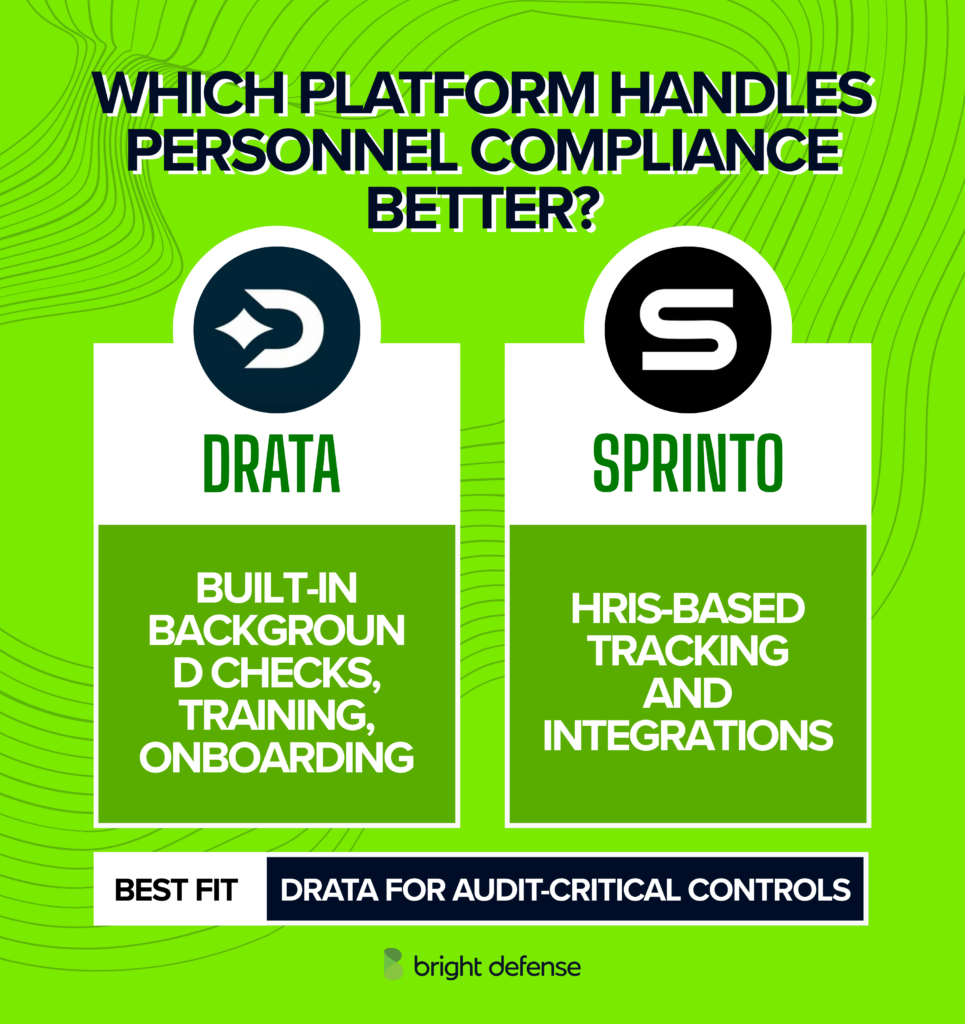
Drata handles personnel compliance natively with built-in background check tracking, training management, and employee onboarding workflows. Sprinto handles personnel compliance through HR integrations rather than built-in features.
Drata is the stronger fit where employee-level controls and background checks are audit-critical. Sprinto suits teams that already run a modern HRIS.
Drata automatically imports background checks from providers and links records directly to employee profiles in the compliance workspace. The platform is a strong fit for organizations where employee-level controls and background checks are audit-critical, particularly for SOC 2 Type II and HIPAA programs.
Sprinto pulls personnel data from HRIS integrations and maps it to security training, access reviews, and policy acknowledgments. The approach works well for teams that already use a modern HR platform and prefer to centralize personnel records outside the compliance tool.
Which Platform Offers Better Policy and Document Management?
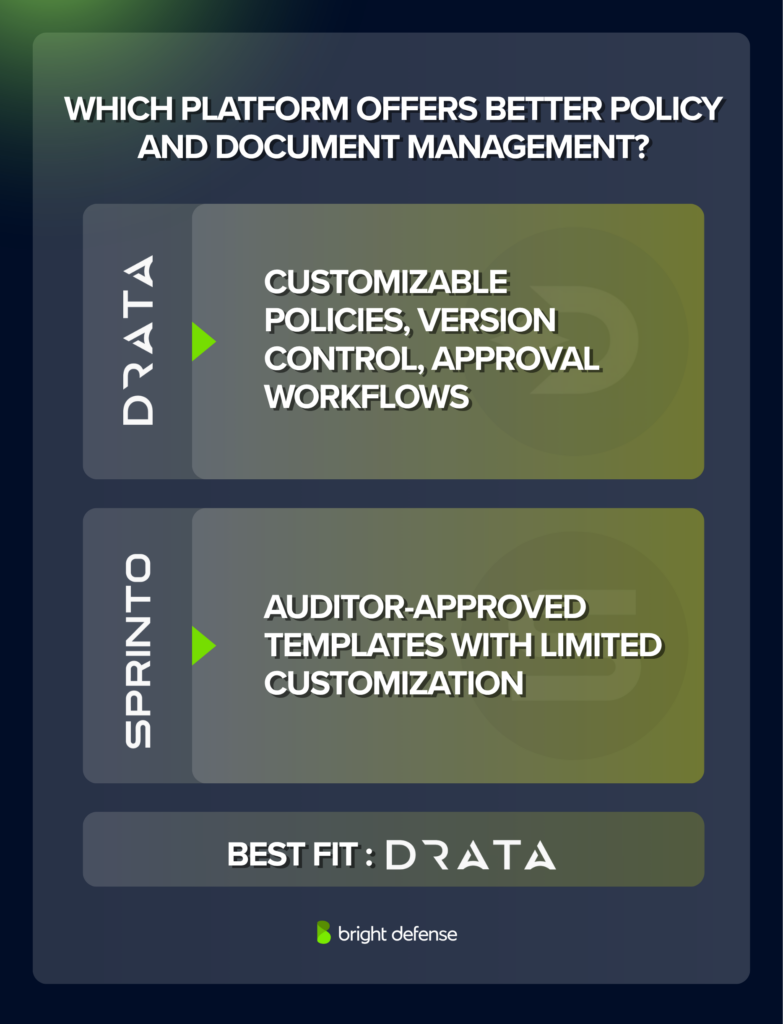
Drata provides a structured policy library with customizable templates, annotations, and version control. Sprinto provides auditor-approved policy and procedure templates with narrower customization options.
Drata suits teams that need granular policy control. Sprinto suits teams willing to adopt standard templates for speed.
Drata’s policy library supports multi-version approvals, annotations, and cross-entity policy management. Teams that need granular control over policy language and approval workflows benefit from this depth.
Sprinto ships auditor-approved templates that cover common frameworks. Teams that prioritize speed over customization move through audit cycles quickly with these templates. Both platforms support policy acknowledgment workflows and employee attestation.
What Support Do Drata and Sprinto Offer?
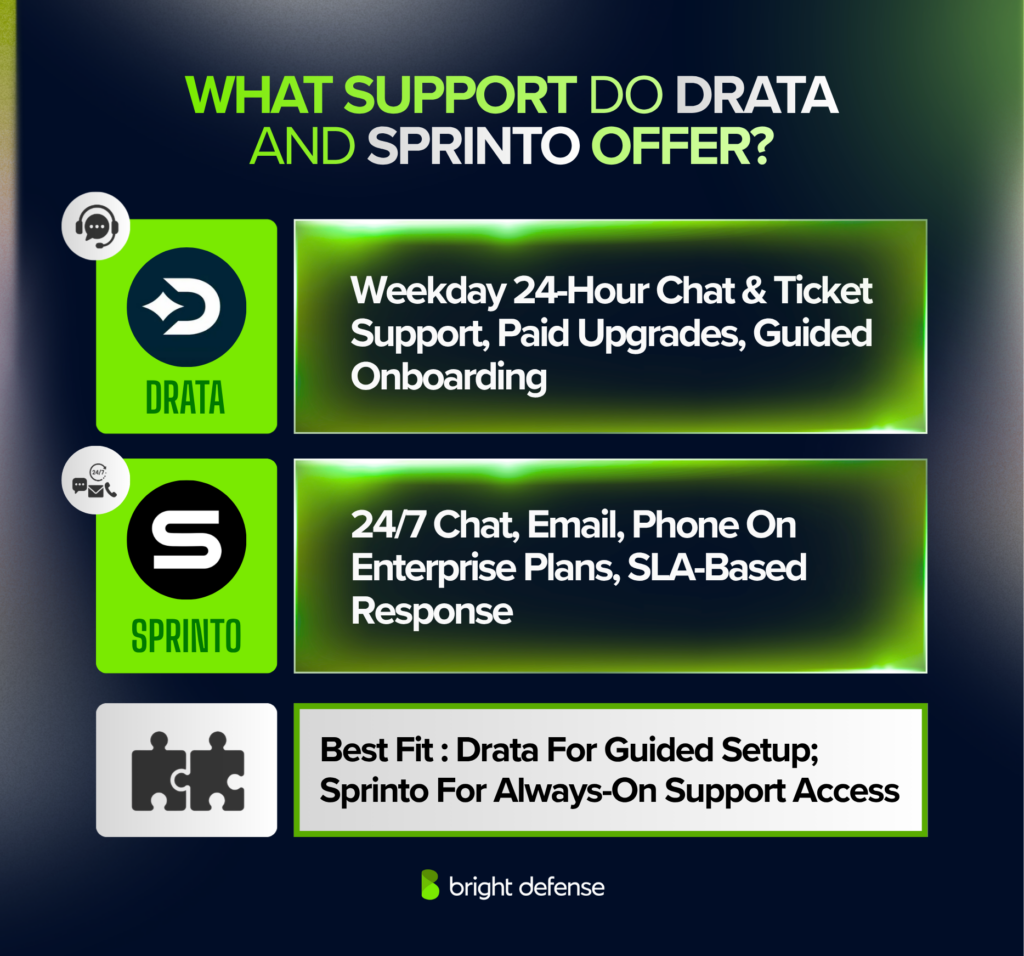
Drata provides chat and ticket support 24 hours per day from Monday through Friday, with professional services and upgraded support available for an additional fee. Sprinto provides 24/7 customer support across chat, email, and phone on enterprise plans, with SLA-backed response windows. Each vendor assigns a customer success manager on higher tiers.
Drata offers a guided onboarding model with compliance experts who review the customer environment and help configure controls. Additional professional services cover complex audit prep, custom framework mapping, and multi-entity rollouts.
Sprinto offers a self-serve model with on-demand expert access for configuration questions. Enterprise plans include phone support and faster SLA-backed response windows. Both vendors assign customer success managers on higher tiers.
Where Are Drata and Sprinto Used Globally?
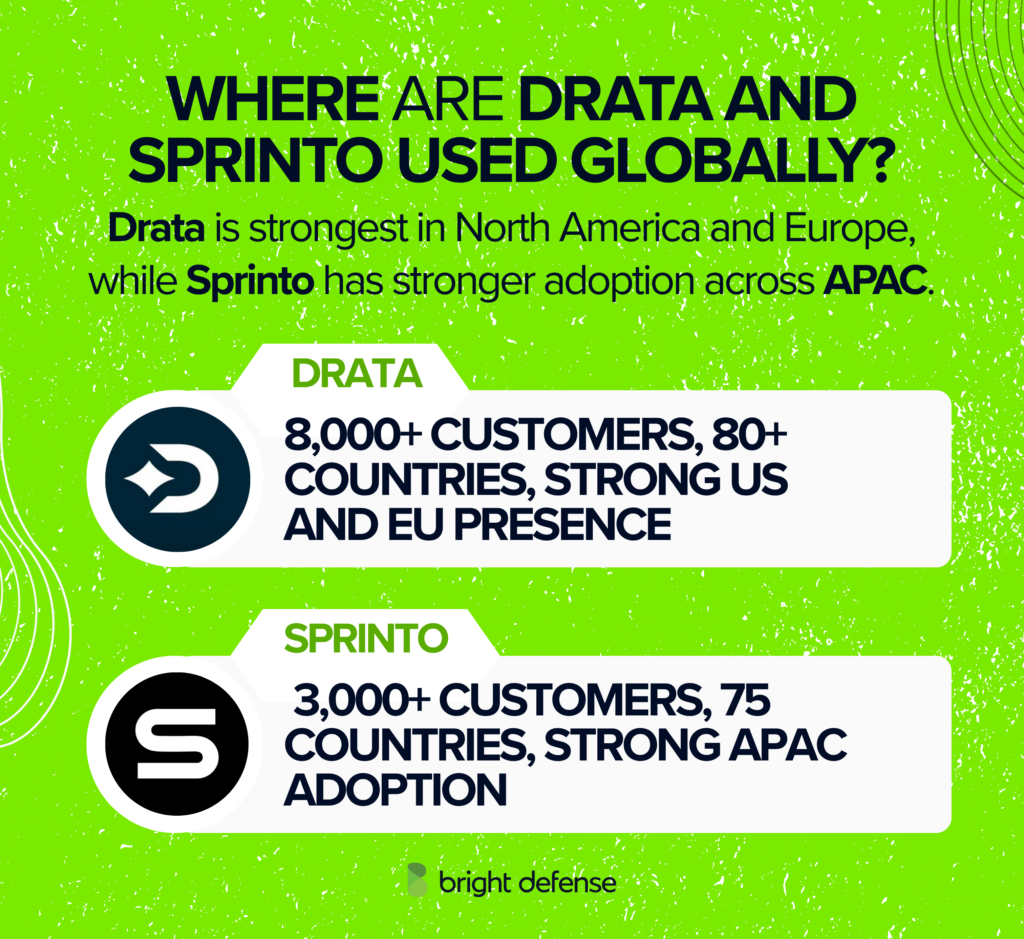
Drata’s customer base is concentrated in North America and Europe, with a growing APAC presence through a Sydney office and Australian data center. Sprinto has strong adoption in APAC, particularly India, Singapore, and Australia, and growing share in North America and Europe. Teams should match vendor geography to their primary audit market.
Drata’s 8,000+ customer base spans more than 80 countries, with roughly one-third of customers based outside the United States. The Sydney office, launched in 2025, and the Australian data center support APAC data sovereignty requirements.
Sprinto reports 3,000+ customers in 75 countries, with strong auditor partnerships across India and Southeast Asia. An Australian data center launched in April 2026 supports APAC data residency requirements.
Drata vs Sprinto Strengths and Weaknesses
The table below summarizes the key differences between Drata and Sprinto across eight attributes.
| Attribute | Drata | Sprinto |
|---|---|---|
| Framework coverage | 30+ frameworks with deep control mappings | 200+ standards with broad coverage |
| Integrations | 120+ integrations with polished configuration | 300+ integrations with rapid connectivity |
| Pricing | $7,500 to $50,000+ per year depending on tier | $4,000 to $25,000 per year depending on size and frameworks |
| Onboarding time | Approximately 4 weeks with guided onboarding | 1 to 2 weeks with template-driven onboarding |
| Personnel compliance | Built-in background checks and training | Handled through HR integrations |
| Policy management | Structured policy library with version control | Auditor-approved templates with limited customization |
| Support | 24x5 chat and ticket support, optional professional services | 24/7 chat, email, and phone support with SLA |
| Regional strength | Strong in North America and Europe | Strong in APAC and emerging markets |
Drata vs Sprinto: Which Platform to Choose in 2026
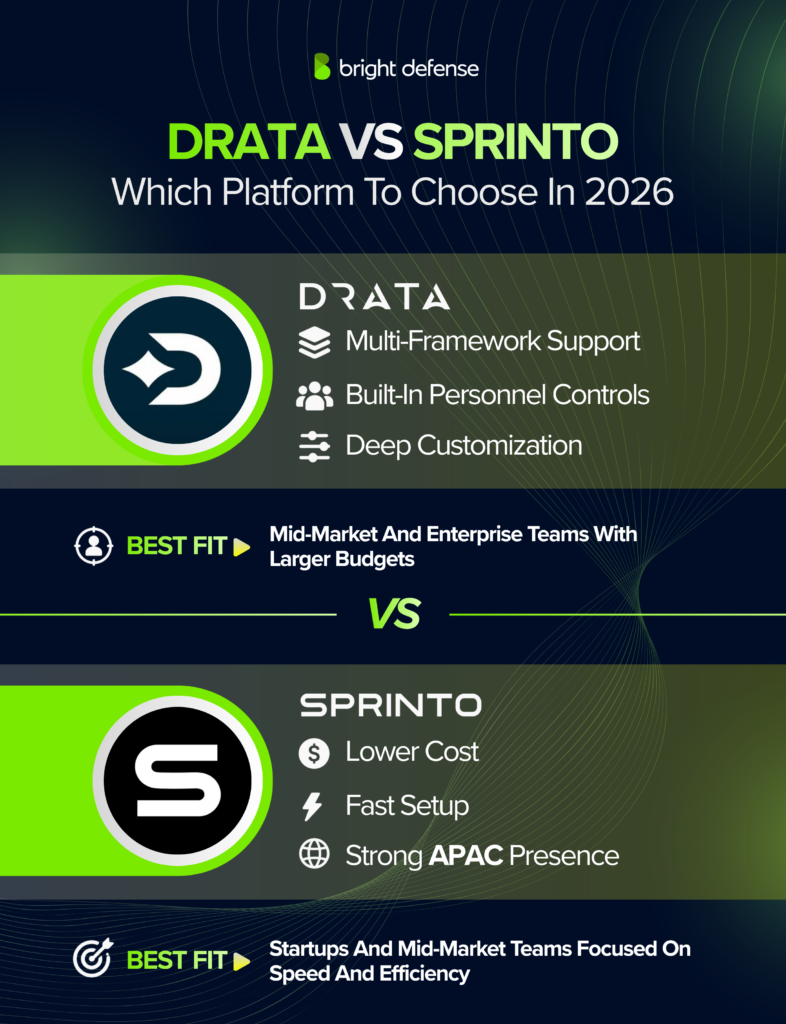
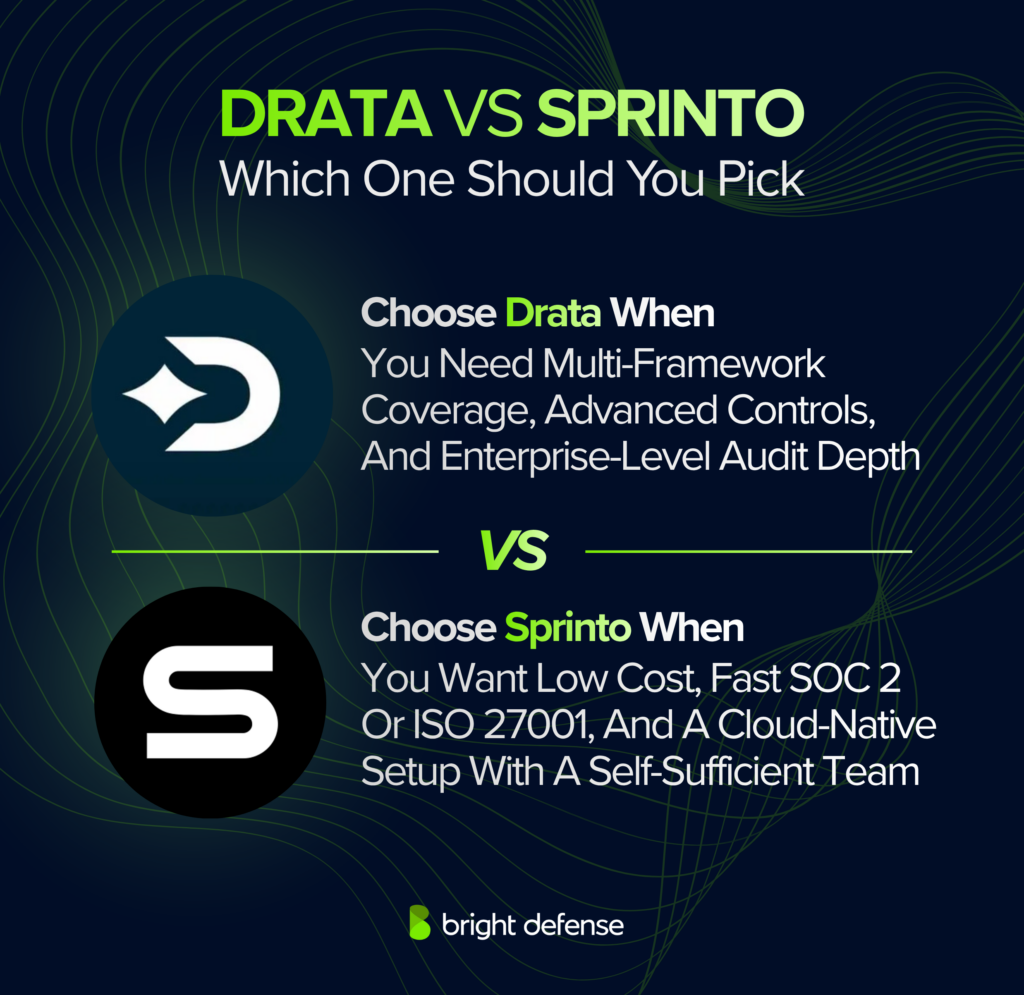
The right platform depends on budget, team size, framework scope, and regional audit market. Drata fits mid-market and enterprise teams with complex compliance programs and higher budgets. Sprinto fits startups and mid-market companies that need speed, affordability, and breadth of integrations.
When Drata Is the Right Choice
Drata is the right choice for teams in the following situations:
- Compliance scope includes multiple frameworks or emerging standards beyond SOC 2 and ISO 27001, such as DORA, NIS 2, or ISO 42001.
- The team needs built-in background check tracking, training management, and detailed policy customization.
- The organization values polished dashboards and deeper control mappings for enterprise audits.
- Budget allows for higher subscription tiers and professional services support.
Examples of Drata customers include Notion, Abnormal Security, Tenable, Kandji, and one-third of the Forbes Cloud 100.
When Sprinto Is the Right Choice
Sprinto is the right choice for teams in the following situations:
- Budget is the primary constraint and cost efficiency is paramount.
- The team needs the fastest route to a first SOC 2 or ISO 27001 report.
- Infrastructure is cloud-native with standard providers and the team prefers template-driven onboarding.
- The company operates in APAC or emerging markets and wants a vendor with local auditor relationships.
Examples of Sprinto customers include Emergent, CodeRabbit, Anaconda, Whatfix, Bizongo, and Happay. Many of these companies adopt Sprinto to accelerate a first SOC 2 for startups engagement before scaling into additional frameworks.
Future Scalability Considerations
Sprinto’s lower cost and rapid onboarding suit early-stage startups, though organizations may need to reassess the platform as integration needs grow or as new frameworks enter scope.
Drata offers stronger coverage for emerging regulations and custom frameworks, though highly specialized controls may still require manual processes.
Teams should match the platform choice to a two– to three-year compliance roadmap rather than the current quarter. Reviewing the wider landscape of best SOC 2 compliance software alongside this comparison can help buyers avoid expensive platform switches as their program matures.
Final Thoughts
Drata and Sprinto occupy distinct positions in the compliance automation market. Drata’s broader framework support, deeper integrations, built-in personnel controls, and real-time dashboards make it the stronger choice for mid-market and enterprise teams with complex compliance needs.
Sprinto’s lower pricing, faster onboarding, and larger integration catalog make it the stronger choice for cost-sensitive startups and companies in APAC and emerging markets. Platform choice should match budget, support needs, and long-term compliance goals.
Teams evaluating the wider vendor field often round out their analysis with a side-by-side Drata vs Vanta review, which benchmarks Drata against another leading compliance automation platform. Organizations leaning toward Drata can accelerate implementation by working with Bright Defense’s Drata partner program for hands-on deployment and continuous compliance support.
FAQ
Drata and Sprinto are platforms that connect to your systems, collect compliance evidence, and track control status for audits such as SOC 2. Drata describes compliance automation that connects to core systems and uses native integrations.
Sprinto markets support for 200+ frameworks, and it positions this as coverage across many standards beyond SOC 2 for teams that plan multi-framework programs.
Sprinto states 300+ integrations, while Drata says it offers 200+ native integrations, and both position integrations as the main driver of automated evidence coverage.
Drata documents Custom Connections and Tests that let teams define a schema, submit evidence, and run custom tests, and it also notes custom tests can run daily after publication.
Yes. Drata says its Trust Center provides a self-serve portal and a controlled access request process, while Sprinto describes a Trust Center that publishes a security profile with controls over what is shared.
The deciding factor is usually which product connects to your current stack with the least manual work, plus whether the built-in workflow matches your auditor’s evidence expectations, since integration coverage drives most day-to-day effort.
Sprinto’s positioning around 200+ frameworks can suit teams that expect fast expansion across standards, while Drata’s tiered plans list “any available framework” at higher tiers, which can suit staged growth.
Drata documents Custom Connections and Tests that accept structured evidence from external systems, which can cover internal tools when a native integration is missing.
Ask which integrations pull configuration-level evidence versus basic metadata, how often checks run, what happens when a check fails, and how exceptions are tracked through to closure, since “automation” varies by connector depth.
Switching is usually a mapping and migration task where controls, policies, and evidence need re-linking inside the new platform, and teams often plan a transition window around audit timing to avoid gaps in evidence collection.
The main direct competitors most often mentioned with Drata are Vanta, Sprinto, Secureframe, and Thoropass. In wider GRC evaluations, Optro, OneTrust, Hyperproof, and Scrut Automation also appear as alternatives.
Sprinto is usually positioned as a more compliance-first platform with guided automation, continuous monitoring, and support for 200+ frameworks, which makes it a common fit for teams focused on audit readiness and ongoing compliance work. Vanta also automates compliance, but it has moved further into a broader trust platform with dedicated GRC and third-party risk management products, so it is often treated as the broader option when a company wants compliance plus vendor risk and trust workflows in one platform.