Updated:
June 28, 2026
List of Recent Data Breaches in 2026
In an increasingly digital world, the threat of data breaches looms larger than ever. From multinational corporations to individual users, no one is immune.
The headlines are filled with stories of compromised personal information, stolen financial data, and disrupted services, painting a stark picture of our vulnerability.
This blog will delve into the recent surge of data breaches, examining the causes, consequences, and crucial steps we can take to protect ourselves.
We’ll explore the latest trends, analyze the impact on businesses and consumers, and discuss the evolving landscape of cybersecurity.
Let’s begin!
Data Breaches that Occurred in May 2026
1. Canvas Breach Exposes 275M Users
Breach Disclosed: 30 Apr, 2026
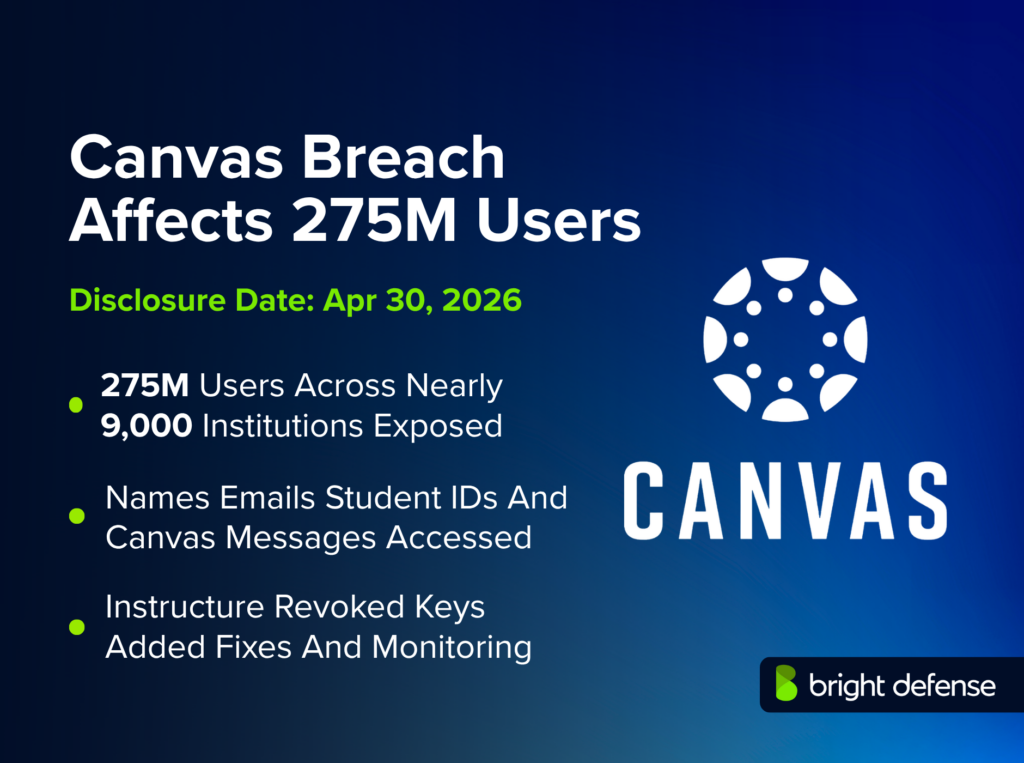
Instructure disclosed a Canvas cyberattack on 30 Apr, 2026, then confirmed on 1 May, 2026 that a criminal actor was involved. The incident disrupted API-dependent tools and exposed names, email addresses, student ID numbers, and Canvas messages. ShinyHunters later claimed theft of 3.65 terabytes from 275 million users across nearly 9,000 institutions. Instructure said it revoked privileged credentials, reissued keys, deployed fixes, and added monitoring. The company stated there was no evidence that passwords, birth dates, government identifiers, or financial data were involved, though private messages still create phishing and privacy risk.
Bright Defense empowers educational technology providers to fortify their defenses through comprehensive penetration testing and risk assessments, specifically targeting the vulnerabilities inherent in massive student data platforms.
Latest Update
Instructure reported that the same threat actor accessed Canvas again on May 7, 2026, through a second vulnerability. The company said no additional data was accessed or taken during that second event. Canvas service has returned, Free-for-Teacher has been permanently discontinued, and Instructure said it received assurances and deletion evidence for the stolen data.
Source: SecurityWeek
3. Carnival Hack Hits 5,995,277 Guests
Breach Disclosed: 27 May, 2026
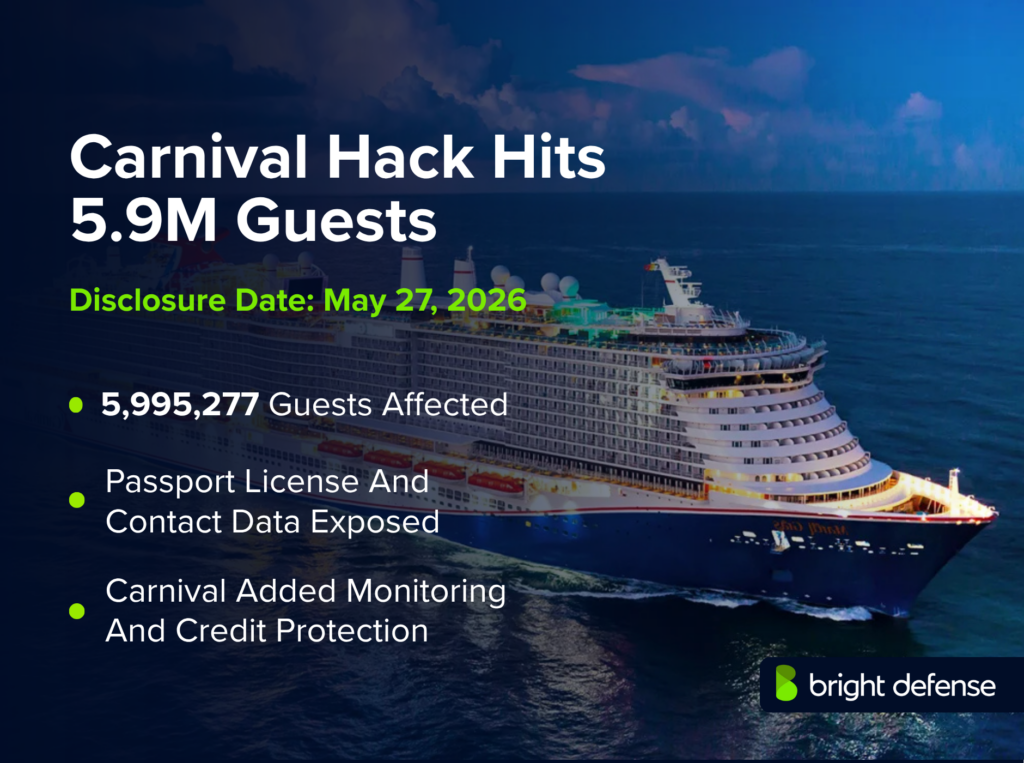
Carnival Corporation disclosed the breach on 27 May, 2026 after its security team detected unauthorized activity involving an employee account on 14 Apr, 2026. A Maine Attorney General filing listed 5,995,277 affected individuals and said the breach occurred on 10 Apr, 2026. Carnival said a social engineering attack gave an unauthorized actor access to part of its IT environment, and investigators determined on 22 Apr, 2026 that personal information had been copied.
Exposed data varied by person, but may include names, addresses, emails, phone numbers, birth dates, driver’s license numbers, and passport numbers. Carnival blocked the activity, hired third-party experts, added monitoring controls, and offered two years of credit monitoring.
Bright Defense specializes in protecting the travel and hospitality sector by deploying advanced red teaming exercises to uncover and remediate social engineering risks that threaten high-volume customer databases.
Carnival Hack Latest Update
Carnival began sending breach notifications on May 27, 2026, after unauthorized access exposed personal data tied to guests. The affected information may include names, addresses, emails, phone numbers, birth dates, and government ID numbers. The Texas Attorney General later opened an investigation after more than 800,000 Texans were affected.
Source: Carnival Corporation
4. Spectrum Hack Exposes 4.9M Accounts
Breach Disclosed: 26 May, 2026
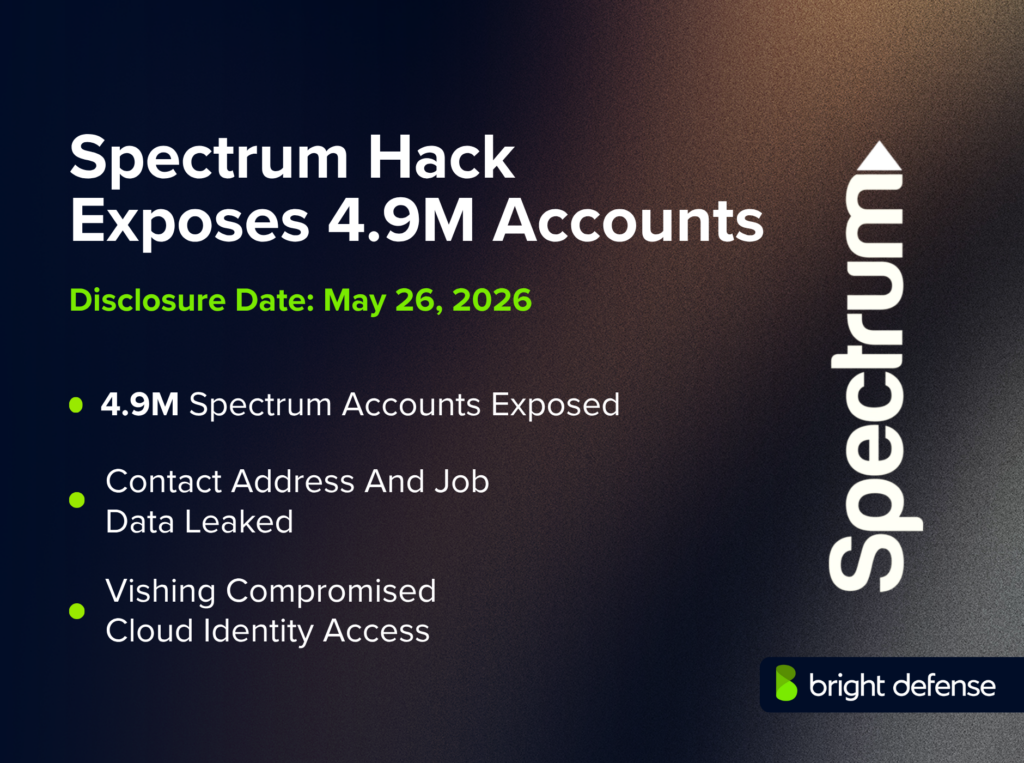
Charter Communications confirmed a Spectrum-linked data breach on 26 May, 2026, after ShinyHunters threatened to leak stolen data. The group claimed it breached Charter around 1 Apr, 2026 through a vishing attack that compromised an employee Microsoft Entra account and opened access to Salesforce data.
Charter said no sensitive personal information or CPNI was exfiltrated, though later breach monitoring tied the exposed dataset to 4.9 million accounts. Reported data included names, email addresses, phone numbers, physical addresses, and job titles. The incident shows how one social engineering call can turn cloud identity access into mass customer exposure.
Bright Defense helps telecommunications firms secure their cloud identity infrastructure through targeted SaaS security testing and vishing-defense programs to mitigate the risk of mass subscriber account breaches.
Spectrum Latest Update
ShinyHunters later released Spectrum-linked data that researchers said covered at least 13 million people and nearly 10 million customer-support records. Charter Communications maintains that no sensitive personal information or customer proprietary network information was released. Multiple federal lawsuits have since accused Charter of failing to protect customer data
Source: BleepingComputer
5. Foxconn Hack Spills 8TB Tech Secrets
Breach Disclosed: 12 May, 2026
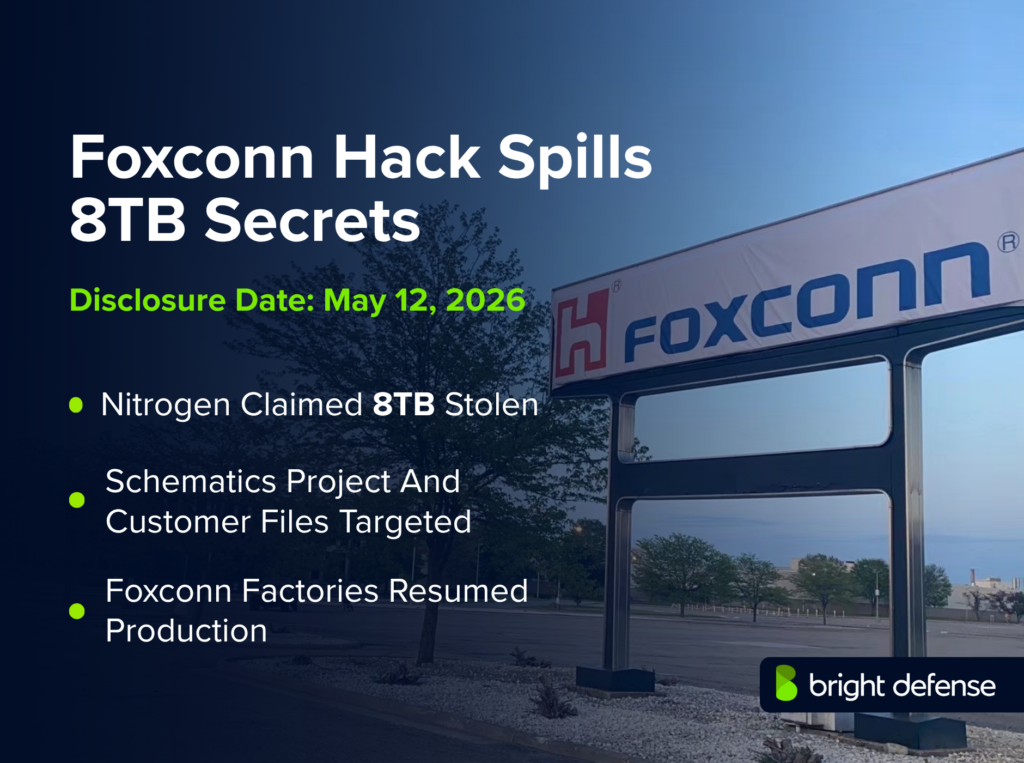
Foxconn acknowledged a cyberattack on its North American factories on 12 May, 2026, after the Nitrogen ransomware group claimed it stole 8 terabytes of sensitive data. The extortion claim involved schematics, project details, and customer documents tied to major technology clients, including Apple, Dell, Google, and Nvidia.
Foxconn said affected factories were resuming normal production after the incident, but the company did not publicly confirm the exact data volume, facilities, or full compromise scope. The event follows earlier Foxconn ransomware incidents in 2020, 2022, and 2024, which makes this a repeated supply chain security warning.
Bright Defense provides industrial-grade vulnerability management and supply chain security assessments to ensure that manufacturers protect their intellectual property and technical secrets from persistent ransomware threats.
Foxconn Hack Latest Update
The Foxconn update remains limited. Foxconn confirmed that affected North American factories were returning to normal production after the cyberattack. Nitrogen’s claims that it stole 8TB of data and more than 11M files remain unverified because Foxconn has not publicly confirmed the exact data volume, facility scope, or full impact.
Source: WIRED
6. Mediaworks Leak Dumps 15M Files
Breach Disclosed: 04 May, 2026
Mediaworks Hungary disclosed the incident on 04 May, 2026, stating that it became the victim of a serious hacker attack on 30 Apr, 2026. Hungary’s data protection authority later said hackers unlawfully obtained nearly 15 million files totaling about 8.5 terabytes and published them on the dark web. The exposed material reportedly included names, addresses, bank account details, internal records, and public-interest documents.
Mediaworks said the investigation remained ongoing, the exact scope was not fully known, and affected data may include contact details such as names, emails, home addresses, and phone numbers. The company filed required authority reports, began investigation work, and warned readers about phishing abuse.
Bright Defense supports media enterprises in validating their web application security and data protection protocols to prevent large-scale leaks of internal files and public-interest documentation.
Mediaworks Leak Latest Update
Hungary’s data protection authority opened an official investigation into the Mediaworks breach. Reports cited nearly 15M files and about 8.5TB of data published on the dark web. The regulator warned that storing, republishing, or helping others access unlawfully disclosed personal data may create GDPR exposure.
Source: Mediaworks Hungary
7. West Pharma Hack Triggers Global Shutdown
Breach Disclosed: 07 May, 2026
West Pharmaceutical Services disclosed a material cyberattack on 07 May, 2026, after detecting the intrusion on 04 May, 2026. The company said an unauthorized party exfiltrated certain data and encrypted certain systems, forcing West to take systems offline globally for containment. The incident temporarily disrupted business operations across its pharmaceutical packaging and drug delivery supply chain, though the company had not yet confirmed the full scope of affected data.
West activated incident response protocols, notified law enforcement, engaged external cyber-forensic experts, and worked to reduce the risk of stolen data being released. The timeline shows a fast response, but the remaining data uncertainty creates compliance, supplier assurance, and customer trust risk.
Bright Defense strengthens pharmaceutical supply chains by performing rigorous network security assessments that minimize the likelihood of operational shutdowns caused by exfiltration and encryption attacks.
West Pharmaceutical Services Hack Latest Update
West Pharmaceutical Services said on May 13, 2026, that Unit 42 found the unauthorized activity contained and the immediate operational risk reduced. The company restored core enterprise systems, and shipping, receiving, and manufacturing restarted at some sites while recovery work continued at others.
Source: SEC Filing
8. 7-Eleven Hack Exposes 185K Emails
Breach Disclosed: 01 May, 2026
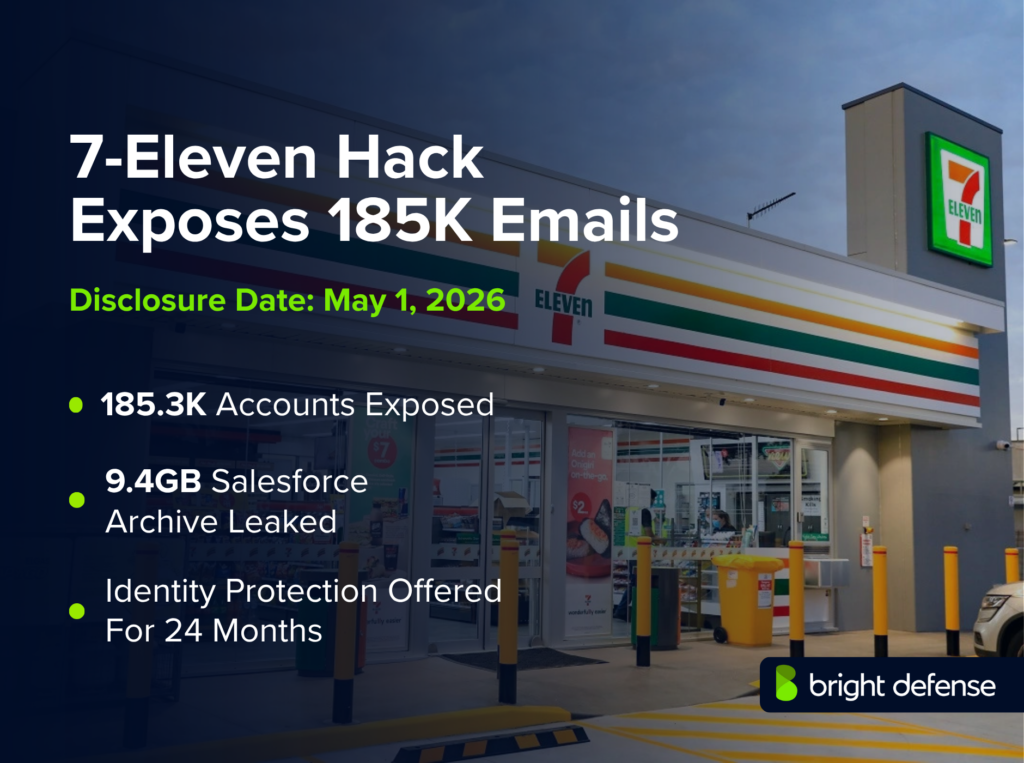
7-Eleven sent breach notices on 01 May, 2026 after detecting unauthorized access on 08 Apr, 2026 to systems used for franchisee documents. ShinyHunters claimed responsibility on 17 Apr, 2026, alleged theft of more than 600,000 Salesforce records, and later leaked a 9.4GB archive after ransom talks failed.
Have I Been Pwned later listed 185.3 thousand exposed accounts, including names, email addresses, physical addresses, dates of birth, and phone numbers. 7-Eleven said the breach was limited to certain franchisee-document systems and offered affected individuals 24 months of identity protection and dark web monitoring.
Bright Defense offers retail and franchise networks specialized testing for decentralized systems, ensuring that franchisee records and customer contact details remain secured against extortion-driven cybercrime.
7-Eleven Hack Latest Update
Have I Been Pwned listed about 185,000 exposed people in the 7-Eleven breach. The impact appears more sensitive than an email-only incident because some filings reportedly referenced Social Security numbers and driver’s license numbers. 7-Eleven said the breach involved certain franchisee-document systems and offered identity protection.
Source: BleepingComputer
9. Trellix Hack Exposes Source Code
Breach Disclosed: 04 May, 2026
Trellix disclosed a data breach on 04 May, 2026 after identifying unauthorized access to part of its source code repository. The cybersecurity firm, formed from the 2021 merger of McAfee Enterprise and FireEye, serves more than 50,000 business and government customers and protects over 200 million endpoints. Trellix said it brought in leading forensic experts, notified law enforcement, and found no evidence that its source code release or distribution process was affected.
The company said there was no evidence the accessed code had been exploited, but it did not disclose when access began, how attackers entered, whether data was copied, or whether extortion was attempted.
Bright Defense aids cybersecurity and software vendors in securing their development pipelines and source code repositories through expert-led penetration testing aimed at preventing high-impact supply chain incidents.
Trellix Source Code Breach Latest Update
RansomHouse claimed responsibility for the Trellix source code breach on May 7, 2026. Trellix said it was aware of the claim and was reviewing it. The company maintained that it had no evidence that its source code release or distribution process was affected, and no evidence that the accessed code had been exploited.
Source: BleepingComputer
Data Breaches that Occurred in April 2026
1. Teen Suspect In 11.7M France ID Breach
Breach Disclosed: 20 Apr, 2026
France Titres (ANTS) disclosed on 20 Apr, 2026 that attackers accessed data from individual and professional accounts on the ants.gouv.fr portal after suspicious activity was detected on 13 Apr, 2026 and authorities were notified on 16 Apr, 2026. The exposed fields included names, email addresses, dates of birth, postal addresses, phone numbers, login IDs, and unique account identifiers.
A threat actor using “breach3d” advertised up to 19 million records, while the agency’s update put confirmed affected accounts at 11.7 million. Police detained a 15-year-old suspect on 25 Apr, 2026, and prosecutors sought charges tied to unauthorized access and data exfiltration.
Bright Defense can help agencies and regulated businesses test identity portals and prove control readiness through cybersecurity compliance and penetration testing services before exposed account data turns into phishing campaigns.
Teen Suspect In France 11.7M ID Breach Latest Update
France Titres kept the incident framed as an ants.gouv.fr portal security event involving personal and professional account data, with exposed fields such as login IDs, names, email addresses, dates of birth, unique account IDs, and sometimes postal addresses, birthplaces, and phone numbers. The newest material follow-up is the law-enforcement action: French authorities detained a 15-year-old suspect accused of selling data stolen from France Titres, while the confirmed affected-account figure remains 11.7M.
Source: (bleepingcomputer.com)
2. 13.5M McGraw Hill Accounts Exposed
Breach Disclosed: 14 Apr, 2026
McGraw Hill confirmed on14 Apr, 2026 that hackers accessed a limited dataset from a Salesforce-hosted webpage after exploiting a Salesforce environment misconfiguration. ShinyHunters had listed the education publisher on its leak site and threatened exposure unless payment arrived before 14 Apr.
McGraw Hill said its Salesforce accounts, courseware, customer databases, and internal systems were not breached, and that SSNs, financial data, and student platform data were not affected. Have I Been Pwned later reported more than100GB of leaked files tied to13.5 million accounts, exposing names, emails, addresses, and phone numbers.
Bright Defense can help education vendors test SaaS integrations and compliance controls before misconfigured customer-facing systems expose user data.
McGraw Hill 13.5M Account Exposure Latest Update
McGraw Hill’s incident now has stronger dataset confirmation through Have I Been Pwned, which lists 13.5M unique email addresses tied to more than 100GB of publicly distributed data. The reported data includes names, email addresses, phone numbers, and some physical addresses, while McGraw Hill said the incident came from a Salesforce-hosted webpage misconfiguration and did not affect SSNs, financial data, courseware, or student platform data.
Source: BleepingComputer
3. Adobe Hit By 13M Ticket Breach Claim
Breach Disclosed: 03 Apr, 2026
Adobe faced an alleged support-system breach publicly reported on03 Apr, 2026, after threat actor “Mr. Raccoon” claimed access to13 million support tickets,15,000 employee records, HackerOne submissions, and internal documents. The report said the intrusion likely started through an Indian BPO vendor, where a phishing email delivered a remote access tool to a contractor machine before access expanded through a manager account.
Cybernews noted Adobe had not officially confirmed the incident at publication, so the disclosure timeline remains an allegation-based public report. The claimed exposure could support phishing, account-targeting, and vulnerability exploitation because support tickets may include customer details and technical issues.
Bright Defense can help software companies test vendor access paths and validate compliance controls before third-party support environments become breach entry points.
Adobe 13M Support Ticket Breach Claim Latest Update
The Adobe item should remain labeled as an alleged breach, not a confirmed breach. Cybernews reported that “Mr. Raccoon” claimed theft of 13M support tickets and 15,000 employee records, but the reporting still treats the incident as a threat-actor claim rather than an Adobe-confirmed disclosure. That wording is important because support-ticket exposure could create phishing and vulnerability-targeting risk, but the core event has not been publicly confirmed by Adobe in the sources found.
Source: Cybernews
4. 9M Medtronic Records Spark Leak Threat
Breach Disclosed: 24 Apr, 2026
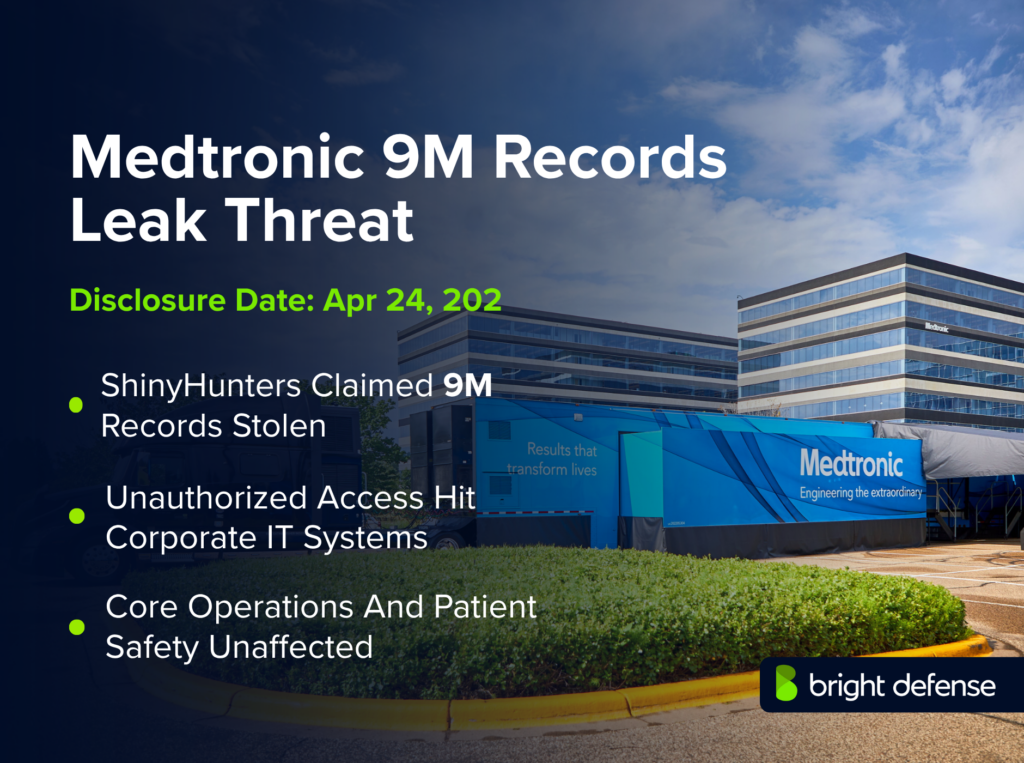
Medtronic confirmed on24 Apr, 2026 that an unauthorized third party accessed data in certain corporate IT systems after ShinyHunters claimed the theft of more than9 million records. The group listed Medtronic on18 Apr, 2026 and set a ransom-contact deadline of21 Apr, 2026, claiming PII exposure and terabytes of internal corporate data.
Medtronic said products, patient safety, customer connections, manufacturing, distribution, and financial reporting were not affected. The company contained the incident, activated response protocols, hired external cybersecurity experts, and continued reviewing whether personal information was accessed so notifications and support services could follow.
Bright Defense can help medical device companies test corporate IT access paths and validate cybersecurity compliance controls before extortion groups turn exposed data into operational and regulatory pressure.
Medtronic 9M Records Leak Threat Latest Update
Medtronic confirmed unauthorized access to certain corporate IT systems, but its latest company statement said products, patient safety, customer connections, manufacturing, distribution, financial reporting, and its ability to meet patient needs were not affected. SecurityWeek later reported that Medtronic was removed from ShinyHunters’ leak site, but there is no public confirmation that a ransom was paid or that the data issue was fully closed.
Source: BleepingComputer
5.5M ADT Customers Exposed In Leak Threat
Breach Disclosed: 24 Apr, 2026
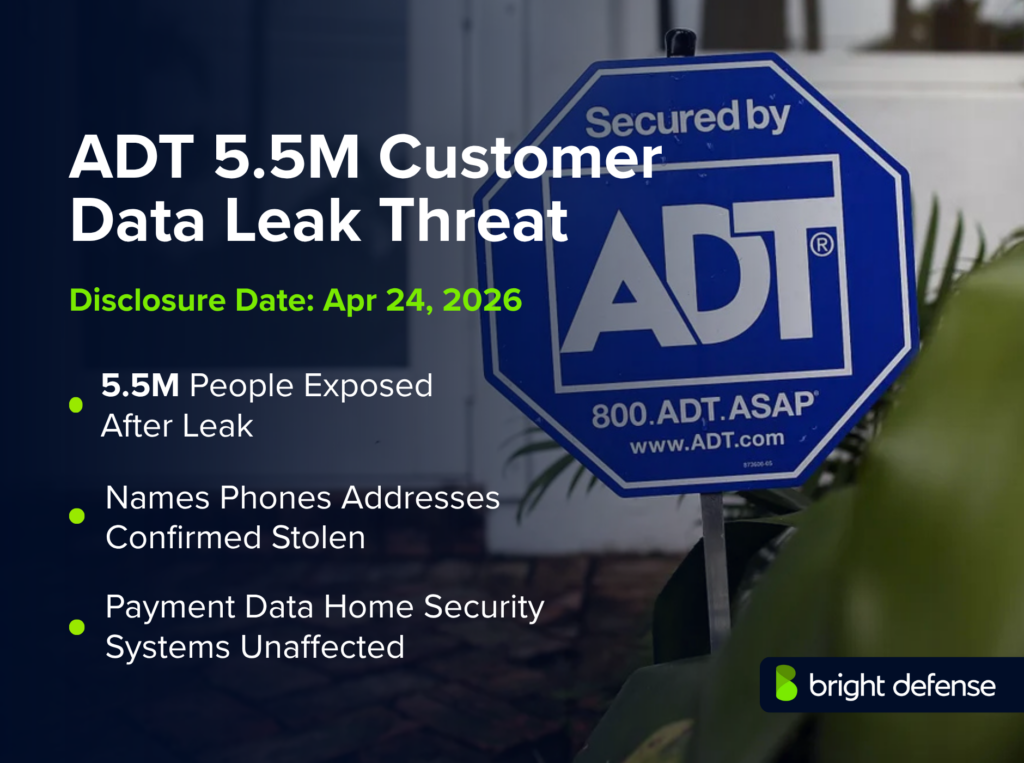
ADT confirmed on24 Apr, 2026 that unauthorized access to customer and prospective customer data was detected on20 Apr, 2026 and stopped after an internal response. ShinyHunters claimed theft of more than10 million records and set a27 Apr, 2026 leak deadline, while Have I Been Pwned later measured the exposed dataset at5.5 million people.
ADT said stolen data was limited to names, phone numbers, and addresses, with dates of birth and last-four SSN or tax ID digits included in a small share of cases. Payment data and home security systems were not affected, but the data was later leaked.
ADT 5.5M Customer Data Leak Threat Latest Update
ADT’s update is now stronger because Have I Been Pwned measured the exposed dataset at 5.5M unique email addresses. ADT said it detected unauthorized access on Apr 20, 2026, terminated the intrusion, started a forensic investigation, and notified law enforcement. The exposed data included names, phone numbers, and physical addresses, with dates of birth and partial government ID values present in a small share of cases.
Source: BleepingComputer
6. Cisco Code Heist Hits 300 GitHub Repos
Breach Disclosed: 31 Mar, 2026

Cisco suffered a reported development-environment breach publicly disclosed on31 Mar, 2026 after attackers used stolen credentials from the Trivy supply chain compromise to access internal build systems. The attackers allegedly stole multiple AWS keys, cloned more than300 GitHub repositories, and accessed source code tied to Cisco and some customers.
Affected repositories reportedly included AI Assistants, AI Defense, unreleased products, and code connected to customers such as banks, BPOs, and U.S. government agencies. Cisco teams contained the incident, isolated affected systems, began reimaging devices, and started wide-scale credential rotation, while the company had not publicly replied to BleepingComputer at publication.
Cisco 300 GitHub Repo Code Heist Latest Update
The Cisco item remains report-based rather than a fully detailed company-confirmed breach narrative. BleepingComputer reported that attackers used credentials from the Trivy-linked supply chain compromise to access Cisco development systems, clone more than 300 GitHub repositories, and reach source code tied to AI products, unreleased work, and some customer-linked repositories. SANS ISC later summarized the same event as part of the TeamPCP supply chain campaign.
Source: BleepingComputer
7. Udemy Leak Threat Hits 1.4M Accounts
Breach Disclosed: 24 Apr, 2026
Udemy faced a ShinyHunters extortion claim first reported on24 Apr, 2026, when the group listed the learning platform on its dark web victim site and threatened to leak more than1.4 million records. Cybernews said Udemy had not confirmed the breach at publication, so the disclosure remains claim-based.
The group later released a dataset, and Have I Been Pwned added1.4 million unique email addresses tied to customers and instructors. Exposed data reportedly included names, physical addresses, phone numbers, employer details, and instructor payout methods such as PayPal, check, and bank transfer. The data creates clear phishing and account-targeting risk for learners, instructors, and employers.
Bright Defense can help online learning platforms test SaaS, vendor, and payout workflows before exposed records create phishing risk across instructors, students, and business customers.
Udemy 1.4M Account Leak Threat Latest Update
The Udemy item should be framed as a ShinyHunters extortion claim with leaked-dataset confirmation, not a company-confirmed breach. Have I Been Pwned added 1.4M unique email addresses tied to Udemy customers and instructors, with exposed data including names, physical addresses, phone numbers, employer information, and instructor payout methods. Cybernews said Udemy had not confirmed the breach at publication.
Source: Cybernews
8. 7 KEV Bugs Put Microsoft And Adobe On Alert
Breach Disclosed: 13 Apr, 2026
CISA addedseven actively exploited vulnerabilities to KEV on13 Apr, 2026, includingfour Microsoft flaws andtwo Adobe flaws that deserve immediate remediation. The Microsoft entries wereCVE-2012-1854,CVE-2023-21529,CVE-2023-36424, andCVE-2025-60710; Adobe entries wereCVE-2020-9715 andCVE-2026-34621.
The agency said each had evidence of exploitation, not just theoretical risk. FCEB agencies received a27 Apr, 2026 remediation deadline for the Microsoft and Adobe KEV entries. The action path is straightforward: apply vendor mitigations, follow cloud guidance, or remove affected products where fixes are unavailable. Security teams should prioritize Exchange, Windows endpoints, Acrobat workflows, and document-processing systems across production.
CISA Adds 7 KEV Bugs Across Microsoft, Adobe, And Fortinet Latest Update
The CISA item needs a title correction because the 7 KEV entries were not limited to Microsoft and Adobe. CISA added 4 Microsoft vulnerabilities, 2 Adobe vulnerabilities, and 1 Fortinet vulnerability on Apr 13, 2026: CVE-2012–1854, CVE-2020–9715, CVE-2023–21529, CVE-2023–36424, CVE-2025–60710, CVE-2026–21643, and CVE-2026–34621. The agency said each entry had evidence of exploitation and directed federal civilian agencies to remediate them under BOD 22–01 timelines.
Source:CISA
Data Breaches that Occurred in March 2026
1. European Commission Cloud Breach Hits Europa
Breach Disclosed: 27 Mar, 2026
The European Commission said on 27 Mar, 2026 that a cyberattack struck the cloud infrastructure hosting the Europa web platform on 24 Mar, 2026. Early findings indicate data was taken from affected websites, though the Commission said the incident was contained quickly and its internal systems were not impacted. Officials have not named a threat actor and said the full scope remains under investigation. The case points to exposure in public-facing cloud environments, with forensic work still underway to determine what data was accessed, how much was taken, and whether affected parties require notification.
Incidents like this show gaps in public-facing cloud environments, which goes to show organizations can reduce exposure through regular testing and compliance alignment, and Bright Defense delivers this through targeted penetration testing and cybersecurity compliance services, with more details available at.
European Commission Cloud Breach Hits Europa Latest Update
The European Commission’s latest official position remains that data was taken from affected Europa websites, internal Commission systems were not affected, and the full impact was still under investigation. The strongest update is that the case remains a contained cloud-hosting incident rather than a confirmed internal-network breach.
Source: Reuters
2. Anthropic Leak Exposes 500,000 Code Lines
Breach Disclosed: 31 Mar, 2026
Anthropic publicly disclosed the incident on 31 Mar, 2026 after an internal packaging error pushed Claude Code source material to a public developer registry, exposing about 500,000 lines across nearly 2,000 files. The leak did not expose customer data or credentials, according to the company, but it gave developers and rivals a detailed view of Claude Code’s architecture, unreleased features, and development roadmap. The archive spread quickly across GitHub within hours, increasing competitive risk and expanding the attack surface for follow-on research. Anthropic said the release was caused by human error rather than an external intrusion and said new controls were being rolled out to stop a repeat.
Want to Read the Full Claude Source Code Leak Story? Check Out the full news here!
Source: Axios
This type of internal misconfiguration highlights gaps in release governance and code exposure controls, which is why teams rely on Bright Defense for cybersecurity compliance and penetration testing services that assess development pipelines and prevent unintended public disclosures.
Anthropic Leak Exposes About 500,000 Code Lines Latest Update
The Anthropic leak now has more technical detail: later reporting traced the incident to the Claude Code npm package and a source map file that exposed roughly 500,000 to 513,000 lines across about 1,906 to 2,000 files. No customer data or credentials were reported exposed, but copies spread quickly across GitHub, which increases source-review and competitive risk.
3. NYC Hospital Hack Hits 1.8M People
Breach Disclosed: 24 Mar, 2026
NYC Health + Hospitals disclosed the breach on 24 Mar, 2026 after finding suspicious network activity on 2 Feb, 2026. Its investigation found unauthorized access from approximately 25 Nov, 2025 through 11 Feb, 2026, with files copied from internal systems.
The potentially exposed data included health insurance details, medical records, biometric data such as fingerprints and palm prints, billing information, Social Security numbers, government IDs, financial account information, precise geolocation data, and online credentials.
Later reporting tied the incident to about 1.8 million individuals. The system reset compromised credentials, added detection rules, updated remote access policies, and offered 24 months of identity protection.
Bright Defense assists healthcare organizations in achieving rigorous cybersecurity compliance and identifies critical security gaps through clinical-environment testing to prevent the exposure of sensitive patient health records.
NYC Hospital Hack Hits 1.8M People Latest Update
The NYC Health + Hospitals update is stronger than the original notice because later reporting tied the breach to about 1.8M affected people and confirmed theft of highly sensitive data, including medical records, Social Security numbers, banking data, fingerprints, and palm prints. The reported intrusion window remained Nov 2025 through Feb 2026.
Source: NYC Health + Hospitals
Data Breaches that Occurred in February 2026
1. PayPal Confirms 6 Month Breach, Funds Stolen
Breach Disclosed: 10 Feb, 2026
PayPal confirmed a breach tied to its PayPal Working Capital loan application after a threat actor accessed PayPal systems starting July 1, 2025.
PayPal said access continued until Dec 12, 2025, when the incident was detected, and the exposure window ran through Dec 12, 2025. Breach letters dated Feb 10, 2026 began reaching impacted PPWC users, and the Feb 22, 2026 update added user reports of unauthorized transactions, transaction refunds, and forced password resets as containment.
PayPal advised heightened monitoring for fraud and phishing using exposed personal details.
In regards to funds stolen, no public aggregate dollar total has been disclosed for the PayPal Working Capital incident because PayPal’s notification language and media reporting describe unauthorized transactions and subsequent refunds without stating a total amount. TechRepublic reported that a few customers experienced unauthorized transactions and that PayPal issued refunds, while publishing no figures.
This incident reflects prolonged detection gaps in financial systems and user account monitoring, which is why organizations work with Bright Defense for cybersecurity compliance and penetration testing services that identify access control weaknesses and reduce the risk of undetected account compromise.
PayPal Confirms 6-Month Breach And Unauthorized Transactions Latest Update
The PayPal update remains that no public aggregate dollar total has been disclosed for stolen funds. Reporting confirmed that the PayPal Working Capital issue exposed names, emails, phone numbers, business addresses, Social Security numbers, and dates of birth from Jul 1, 2025 to Dec 12, 2025, and Forbes reported unauthorized transactions, refunds, and password resets in some cases.
Source: Forbes, TechRepublic
Read the full PayPal Breach story here!
2. Figure Technology Breach – Nearly 1M Records Stolen
Breach Disclosed: 14 Feb, 2026
Figure Technology Solutions confirmed a data breach that was publicly disclosed on 14 Feb, 2026 after a social engineering attack manipulated an employee into providing access to internal systems, allowing hackers to download a limited set of files, with the threat group ShinyHunters claiming responsibility and posting roughly 2.5 GB of stolen customer records online.
The leaked dataset exposed nearly 967,000 user accounts containing names, dates of birth, email and postal addresses, and phone numbers, raising identity theft and phishing risks for affected individuals. Figure stated it is notifying impacted users and offering credit monitoring while investigators examine the full scope of the incident.
Source: Security Week
- Go through the Entire Figure Breach Story Here!
Penetration testing prevents data breaches by identifying and validating exploitable security weaknesses before attackers can use them, and nearly 60% of breaches result from known but unpatched vulnerabilities, which goes to show how proactive testing directly reduces real-world attack success. A controlled simulation of real-world attacks reveals flaws in systems, applications, and human processes, which allows organizations to fix those weaknesses in advance. Bright Defense supports this process through expert-led penetration testing services that uncover critical risks and guide remediation to reduce breach exposure.
Figure Technology Breach Hits Nearly 967,000 Accounts Latest Update
The Figure Technology update is now clearer through Have I Been Pwned analysis reported in later coverage. The exposed population is roughly 967,000 user records, and the data includes names, dates of birth, email addresses, postal addresses, and phone numbers.
3. 200K Driver’s Licenses Hacked in youX Breach
Breach Disclosed: 18 Feb, 2026
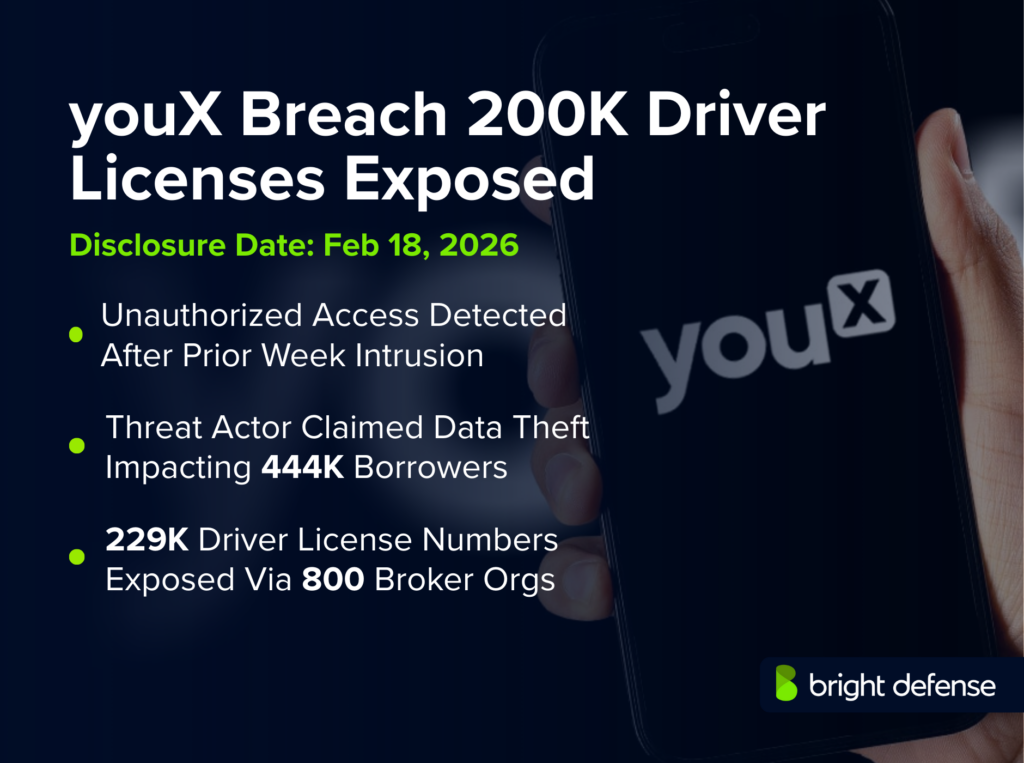
Sydney fintech youX disclosed a breach on 18 Feb, 2026, after detecting unauthorized access to its systems the prior week and later learning a threat actor had posted data it claimed to have taken.
The attacker alleges exfiltration affecting 444,538 borrowers, including government ID details, phone numbers, email addresses, and home addresses, plus 229,226 driver’s license numbers drawn from nearly 800 broker organizations using the platform.
A public disclosure date earlier than 18 Feb, 2026 has been referenced, yet it remains unverified in accessible reporting. youX said monitoring and defensive controls were raised, outside experts were engaged, and the Office of the Australian Information Commissioner was kept informed.
youX Breach Exposes More Than 200,000 Driver’s License Numbers Latest Update
The youX update confirms a broader borrower and broker impact than a simple driver’s license incident. Reporting cites 444,538 borrowers, 629,597 loan applications, 229,226 driver’s license numbers, and data tied to 797 broker organizations, with risk centered on fraud, phishing, and loan-application identity misuse.
Source: News.com.au
4. Panera Leak Exposes 5.1M Customer Contacts
Breach Disclosed: 02 Feb, 2026

Panera Bread confirmed a cybersecurity incident after ShinyHunters claimed theft in late Jan 2026 and later leaked a roughly 760 MB archive when extortion failed. Analysis from Have I Been Pwned indicates about 5.1M unique accounts were exposed even though the attackers advertised 14M records, a distinction that still leaves millions of customers at risk.
Leaked fields include names, email addresses, phone numbers, and physical addresses, which can fuel targeted phishing and identity fraud. The leaked archive appears limited to contact data, yet the volume enables long term scam campaigns that mimic Panera support. Panera reported notifying authorities while investigating the access path and reviewing what data left its environment.
Panera Leak Exposes 5.1M Customer Contacts Latest Update
The Panera figure should stay at 5.1M unique accounts, not 14M customers. Have I Been Pwned lists names, email addresses, phone numbers, and physical addresses, while Panera confirmed the involved data was contact information and said authorities were notified.
Source: BleepingComputer
5. Adidas Extranet Scare: 815,000 Rows Exposed
Breach Disclosed: 17 Feb, 2026
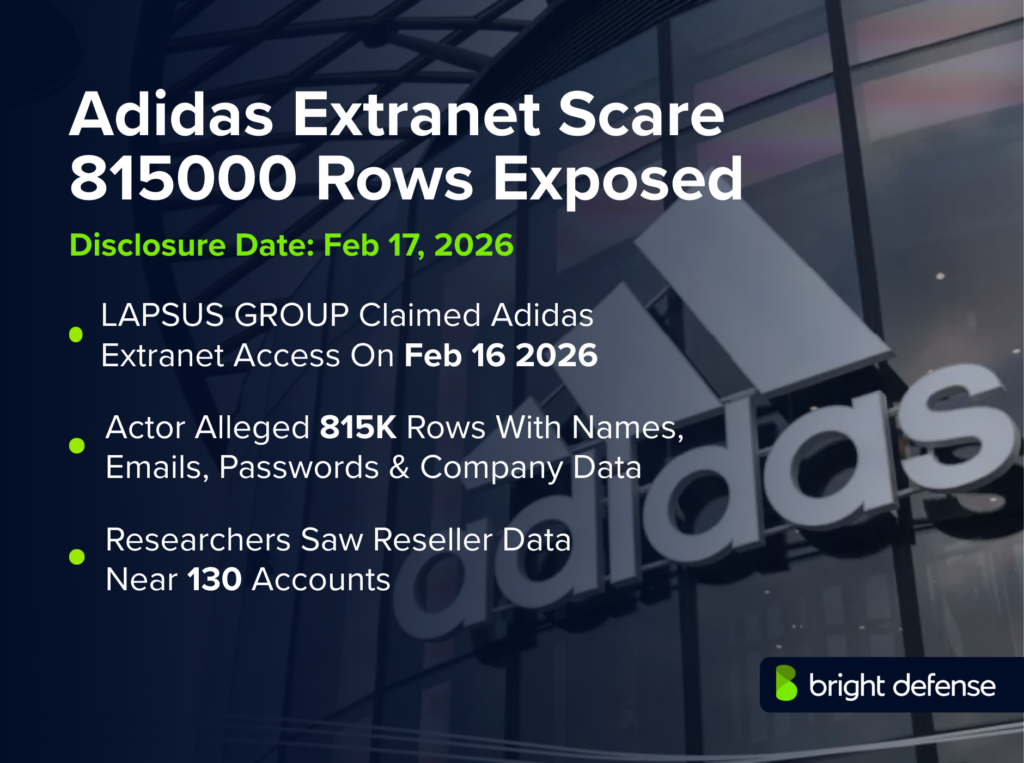
Adidas is investigating a suspected breach tied to an independent licensing partner after a threat actor using the name “LAPSUS-GROUP” posted on BreachForums on 16 Feb, 2026, claiming access to the Adidas Extranet.
The actor claims roughly 815,000 rows were taken, listing names, emails, passwords, birthdays, company details, and technical data, and teasing an extra 420GB linked to France.
Researchers reviewing the dump said the content looks tied to reseller firms and may involve about 130 accounts, yet exposed credentials can drive follow-on phishing. Adidas said there is no sign its core IT, e-commerce systems, or consumer datasets were affected while investigation and partner access checks continue.
Adidas Extranet Scare Remains A Third-Party Partner Incident Latest Update
The Adidas update should keep the incident framed as a partner-linked claim rather than a confirmed breach of Adidas core systems. Lapsus$ claimed about 815,000 exposed rows, while Adidas said the incident involved a third-party licensing partner and did not affect its core IT, e-commerce systems, or consumer datasets.
Source: Cybernews
6. Odido Leak Exposes 6.2M Customer Data
Breach Disclosed: 12 Feb, 2026
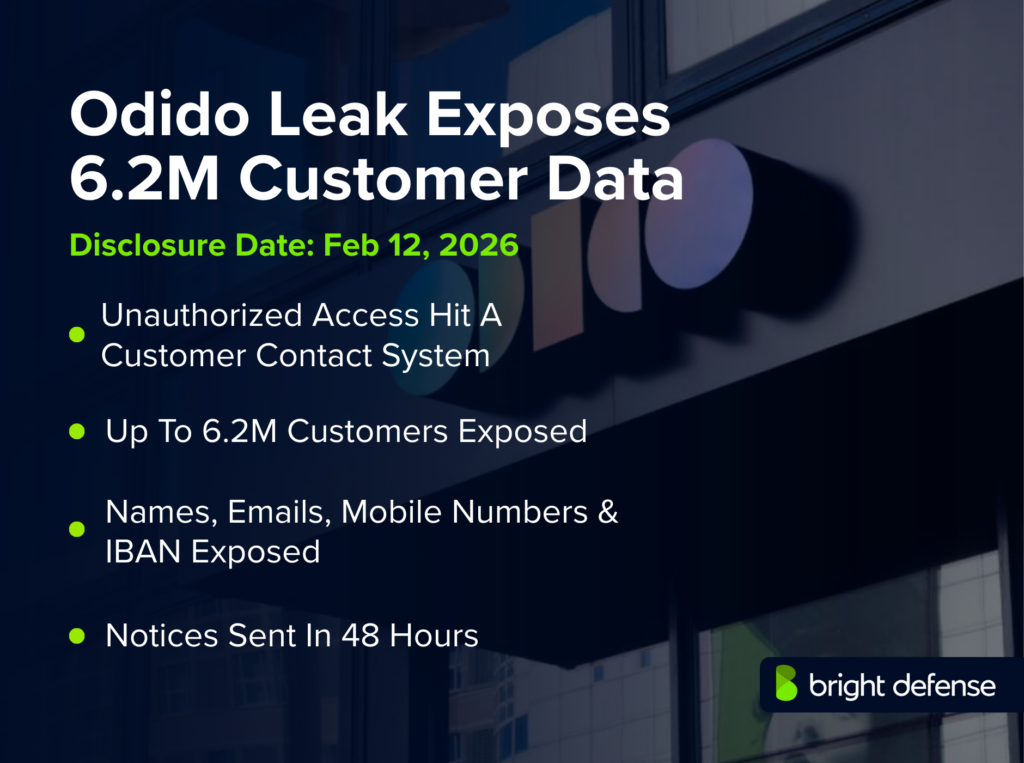
Odido disclosed a cyberattack affecting up to 6.2 million customers after investigators found unauthorized access over the 07 Feb, 2026 weekend. Attackers breached a customer contact system and downloaded varying data, which can include names, addresses, email addresses, mobile numbers, customer numbers, IBANs, dates of birth, and passport or driver’s license details.
Odido said passwords, call records, billing data, location data, and ID document scans were not impacted. The company said it ended access quickly, reported the incident to the Dutch Data Protection Authority, and began notifying impacted customers within 48 hours while external responders increased monitoring.
Odido Breach Count Increased To About 6.39M People Latest Update
The Odido update changes the figure from 6.2M accounts to about 6.39M affected people on Odido’s official update page. Odido says the affected group includes active and inactive Odido and Ben customers, Simpel customers were not affected, and all affected customers have been notified.
Source: BleepingComputer
7. Canada Computers Breach Hits 1,284 Guests
Breach Disclosed: 04 Feb, 2026
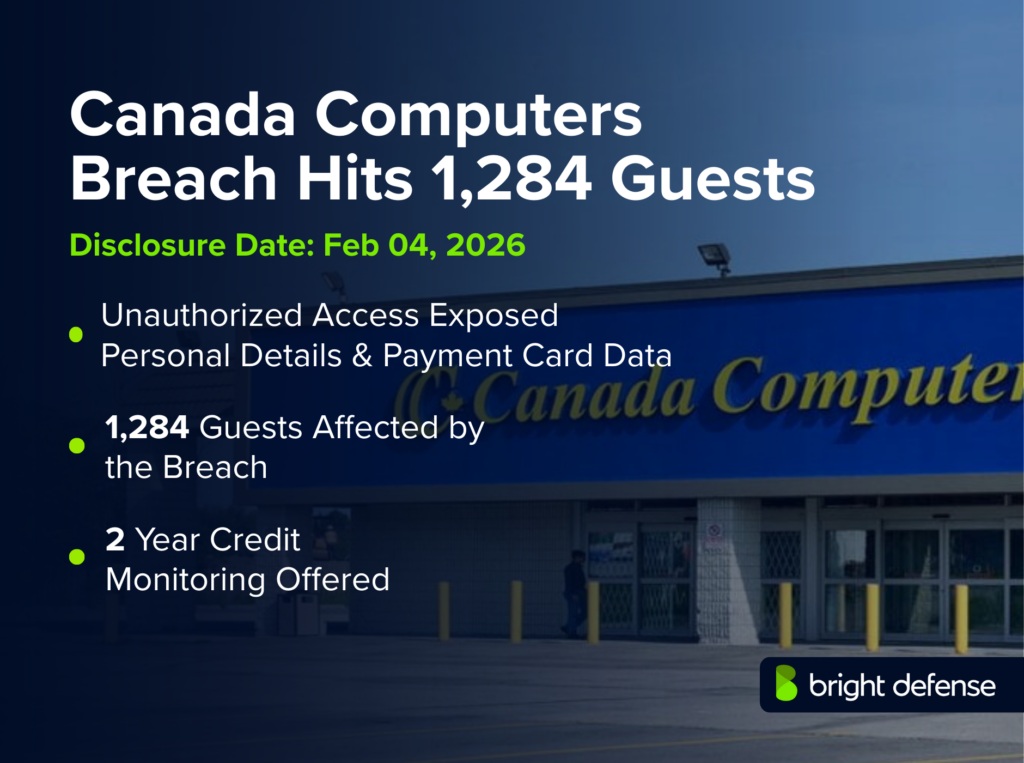
Canada Computers said its investigation indicates 1,284 customers had personal details and payment card data exposed after unauthorized access to systems supporting its retail website. The company tied risk to guest checkout orders placed between 29 Dec, 2025 and 22 Jan, 2026, while member account checkouts and in store purchases were not implicated.
Canada Computers reported detecting the incident on 22 Jan, 2026, notifying affected customers on 25 Jan, 2026, and alerting law enforcement and regulators.
An external forensic firm is reviewing root cause and scope, and the retailer is offering 2 year credit monitoring and identity protection. Some shoppers reported early warnings that were later corrected.
Canada Computers Breach Remains Limited To Guest Checkout Customers Latest Update
The Canada Computers update remains materially consistent with the original report. The confirmed scope centers on 1,284 guest-checkout customers who placed orders from Dec 29, 2025 to Jan 22, 2026, with exposed payment card details and two years of credit monitoring offered.
Source: Yahoo News Canada (CBC)
8. Washington Hotel Ransomware: 22:00 Server Hit
Breach Disclosed: 14 Feb, 2026
Japan’s Washington Hotel chain disclosed a ransomware incident on 14 Feb, 2026, after detecting unauthorized access at 22:00 on 13 Feb, 2026 on a limited set of internal servers. The company cut off external network connections, formed an incident task force on 14 Feb, 2026, and contacted police and outside responders while it reviews possible data exposure.
The firm confirmed access to business data on the affected server and said information leakage remains under investigation. Customer data for the “Washington Net” membership program sits on a separate vendor run server with no confirmed intrusion. Some properties reported card terminal outages, yet operations continued.
Washington Hotel Ransomware Still Has No Confirmed Customer Data Theft Latest Update
Washington Hotel’s official notice confirms ransomware on some servers at 22:00 local time on Feb 13, 2026, unauthorized access to business data, external network disconnection, police contact, and outside expert support. The company said Washington Net customer data sits on a separate server with no confirmed unauthorized access, though some hotels had credit card terminal disruption.
Source: Tech Radar
9. BTU Billing Outage After Ransomware Hits BridgePay
Breach Disclosed: 09 Feb, 2026
A ransomware attack on third-party payment processor BridgePay on 6 Feb, 2026 disrupted online billing for about 70,000 Bryan Texas Utilities (BTU) customers, forcing the utility to suspend credit and debit card payments and offer alternative in-person payment options.
The incident began when BridgePay’s systems went offline due to ransomware, affecting multiple organizations and municipalities that rely on its payment infrastructure.
BTU confirmed there has been no evidence of customer data compromise or card information exposure, and it is working with partners to restore services, with no firm recovery timeline announced. BTU is waiving late fees, avoiding service disconnections, and communicating updates through its website and status portals.
BTU Billing Was Restored After The BridgePay Ransomware Outage Latest Update
The BTU/BridgePay update is favorable: Bryan Texas Utilities says all card payment capability was restored as of 11 a.m. on Feb 12, 2026. BridgePay reporting still says the event was ransomware, with initial forensics finding no compromised payment card data and no evidence of usable data exposure.
Source: KBTX News
10. IDMerit Leak: 3B Records Exposed in 1TB DB
Breach Disclosed: 18 Feb, 2026
IDMerit is investigating after researchers found an unsecured MongoDB instance exposing roughly 3 billion records, including about 1 billion entries of sensitive KYC data across 26 countries. The exposed trove totaled about 1 TB and contained names, dates of birth, addresses, emails, phone numbers, national IDs, and telecom metadata, with the United States accounting for over 203 million records.
Researchers said the database was first observed on 11 Nov, 2025 and was locked down on 12 Nov, 2025; Cybernews published the findings on 18 Feb, 2026. The exposure raises risk of SIM swapping, account takeover, and targeted phishing using verified identity attributes.
Source:SC World
IDMerit Exposure Is Now Disputed In Scope Latest Update
The IDMerit update should be written carefully. Cybernews reported an exposed MongoDB instance with more than 3B records, about 1B sensitive KYC entries, and more than 203M U.S. records, while later reporting says IDMerit stated its own systems were never breached and partner investigations found no confirmed data exfiltration.
- Check Out the Whole ID Merit Data Breach Story!
11. Coinbase Support Leak Shocker: 30 Users Hit
Breach Disclosed: 03 Feb, 2026
Coinbase confirmed an insider breach on 03 Feb, 2026, after leaked screenshots of an internal support tool surfaced online and were later removed. A contractor improperly accessed customer data in Dec, 2025, affecting about 30 people, according to Coinbase.
The screenshots showed visibility into names, email addresses, phone numbers, dates of birth, KYC details, wallet balances, and transactions, raising targeted phishing and account takeover risk.
Coinbase said the contractor no longer works with the firm, impacted users were notified in 2025, regulators were informed, and identity theft protection was offered. Investigators are assessing whether the screenshot leak relates to the same access.
Coinbase Support Leak Remains A Small Insider Incident Latest Update
The Coinbase update remains limited to about 30 customers. Coinbase confirmed that a contractor improperly accessed customer data, the contractor no longer worked with the company, affected users were notified, and identity theft protection was offered. The incident remains separate from broader Coinbase support-contractor breach reporting.
Source: BleepingComputer.
- Read the Entire Coinbase Data Breach Story!
12. Volvo Shock: 17,000 Exposed In Conduent Hack
Breach Disclosed: 10 Feb, 2026
Volvo Group North America disclosed an indirect breach on 10 Feb, 2026 after learning customer and staff data was exposed through Conduent, a business services provider it uses. Conduent said intruders accessed its systems between 21 Oct, 2024 and 13 Jan, 2025, taking files containing full names, Social Security numbers, dates of birth, health insurance policy details, ID numbers, and some medical information.
Conduent publicly disclosed the wider incident in Apr, 2025. Volvo said nearly 17,000 people were impacted, and notices provide identity monitoring for at least 1 year, plus steps such as credit freezes and fraud alerts. Volvo said no misuse has been confirmed so far.
Volvo Group North America Impact Is 16,991 People Latest Update
The Volvo update is more precise than “nearly 17,000.” A Maine filing cited in later reporting puts the affected total at 16,991 people, tied to Conduent’s earlier intrusion window from Oct 21, 2024 to Jan 13, 2025.
Source: BleepingComputer
13. European Commission Staff Data Exposed in Mobile System Breach
Breach Disclosed: 06 Feb, 2026
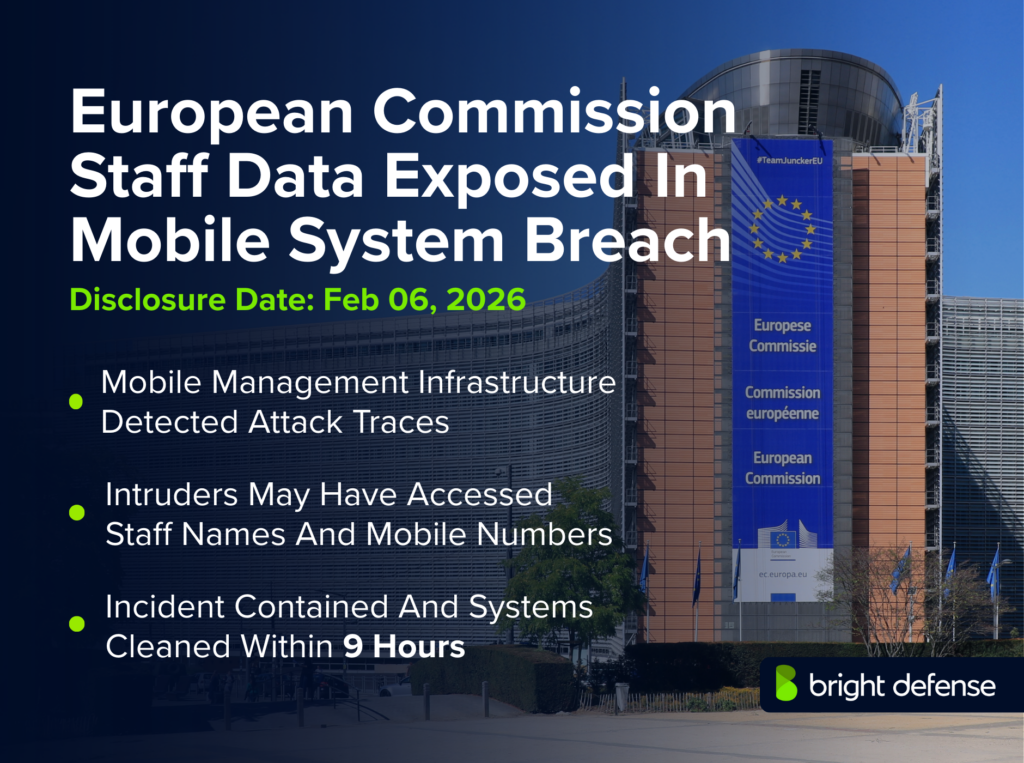
The European Commission disclosed a staff data breach on 06 Feb, 2026, after its mobile device management infrastructure detected attack traces on 30 Jan, 2026.
Investigators said intruders may have accessed staff names and mobile numbers, with no confirmed compromise of the mobile devices themselves. The Commission contained the incident and cleaned affected systems within 9 hours while internal response teams began a forensic review to scope access, confirm what data was touched, and identify the intrusion path.
Reporting linked the activity to attacks targeting Ivanti Endpoint Manager Mobile, following Ivanti’s advisory on 29 Jan, 2026 and the Commission’s cybersecurity package announcement on 20 Jan, 2026.
European Commission Staff Data Breach Remains Limited To Contact Data Latest Update
The European Commission mobile-infrastructure incident remains limited in public detail. The official release says the attack may have exposed some staff names and mobile numbers, the system was cleaned within 9 hours, and no mobile devices were compromised. Reporting linked the activity to Ivanti Endpoint Manager Mobile vulnerabilities.
Source: BleepingComputer.
14. Senegal ID System Halted After 139TB Hack Claim
Breach Disclosed: 05 Feb, 2026
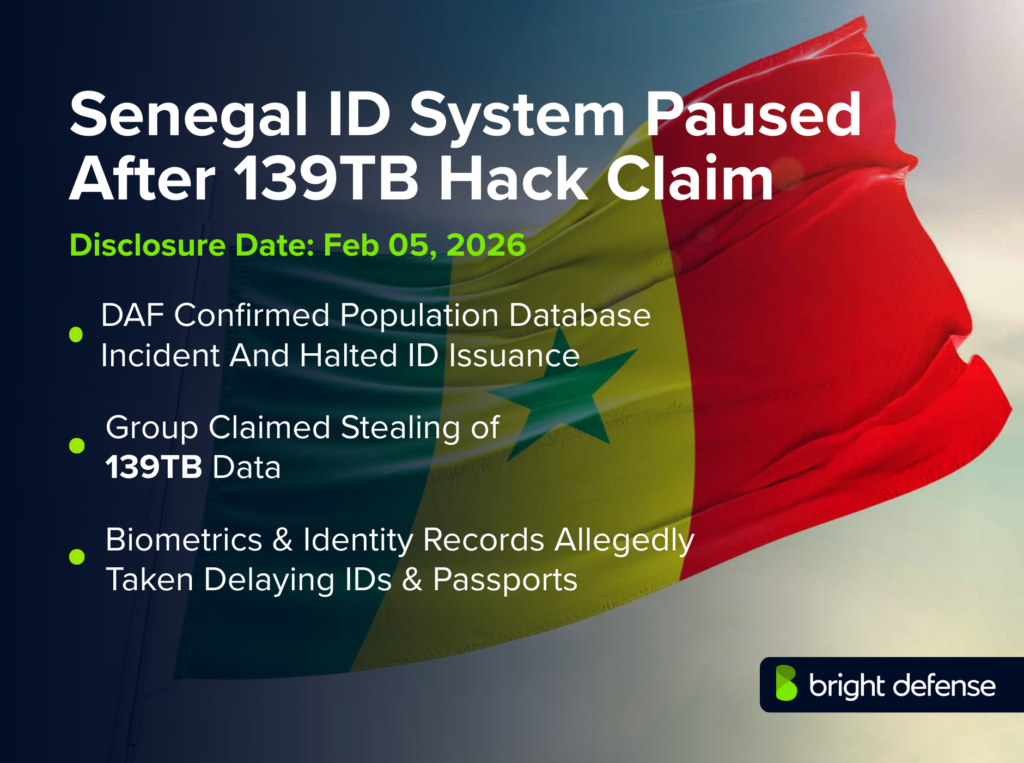
Senegal temporarily halted national ID card issuance after the Directorate of File Automation confirmed a cyber incident affecting its population database and opened an investigation.
Reporting tied the intrusion to the “Green Blood Group,” which claimed it breached two DAF servers on 19 Jan, 2026 and later posted proof of compromise, alleging theft of 139TB of data that may include biometrics, identity records, and immigration files.
DAF publicly acknowledged the incident on 05 Feb, 2026 and said technical teams are working to restore services while maintaining data integrity. The outage delays new IDs, passports, and related document workflows nationwide.
Senegal ID System Breach Remains A Severe Claim With Limited Official Scope Latest Update
The Senegal ID system item remains partly claim-based. Public reporting links the case to Green Blood Group claims of theft from DAF systems and possible exposure of identity, biometric, electoral, and immigration data, while the public government-side detail remains focused on service disruption, investigation, and restoration.
Source: Dark Reading.
15. Idaho Clinic Alert: Vendor Hack Risks Patient SSNs
Breach Disclosed: 09 Feb, 2026
Terry Reilly Health Services reported a third-party data security incident on 09 Feb, 2026, after TriZetto Provider Solutions notified OCHIN, the electronic medical record vendor that supports Terry Reilly. Investigators say unauthorized access occurred at the vendor level, and Terry Reilly moved to notify law enforcement and outside cybersecurity specialists while the vendor contained and removed the threat.
Potentially exposed data can include patient names, addresses, dates of birth, Social Security numbers, health coverage member numbers, insurer and provider details, dependent information, and certain health and insurance data. Impacted patients will receive mailed notices within about 1 week with free credit monitoring enrollment instructions.
Source: Terry Reilly Health Services.
16. Japan Airlines Luggage System Breach Hits 28K Users
Breach Disclosed: 10 Feb, 2026
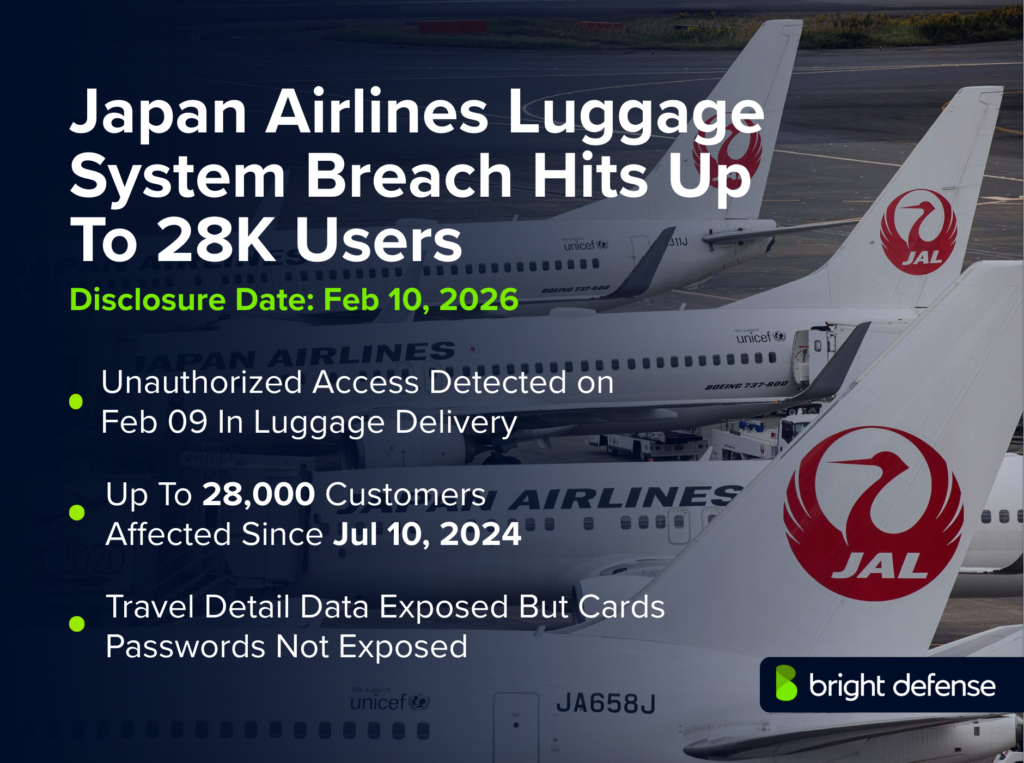
Japan Airlines disclosed a breach affecting up to 28,000 customers after detecting unauthorized access to the Same Day Luggage Delivery Service reservation system at about 12:40 a.m. on 09 Feb, 2026. Impacted records relate to reservations made since 10 Jul, 2024.
Exposed fields may include names, email addresses, phone numbers, JMB customer numbers, flight numbers, departure and arrival airports, and destination hotel names, while credit card numbers and passwords were not in scope.
JAL paused the service, brought in external incident responders, and started log review to confirm whether any data left its environment. Customers should expect targeted phishing that references travel details.
Japan Airlines Breach Needs A Major Correction Latest Update
The Japan Airlines item should be corrected. Later reporting says JAL’s investigation found no personal information was leaked, no external unauthorized access occurred, and the service problem came from accidental data deletion during maintenance work at a contracted system maintenance operator.
Source: Japan Airlines.
Web and API penetration testing prevent breaches like the Japan Airlines incident by identifying and fixing unauthorized access paths within reservation systems before attackers can exploit them. These tests focus on how booking platforms handle user input, enforce authentication, and restrict access to customer data, which directly addresses the type of exposure seen in this case.
17. Flickr Third Party Email Flaw Exposes User Data Fields
Breach Disclosed: 05 Feb, 2026

Flickr disclosed a third party email system security incident on 05 Feb, 2026, after it was alerted to a vulnerability at an email service provider that may have permitted unauthorized access to Flickr member information and Flickr cut off access within hours.
Exposed data can include names, usernames, email addresses, account types, IP addresses, general location, and Flickr activity metadata, while passwords and payment card numbers were not affected. Flickr stated that exposure is possible rather than confirmed theft, and no threat actor has publicly claimed a Flickr dataset so far. User risk centers on targeted phishing that references account details and IP based location context.
Flickr Third-Party Email Flaw Remains A Possible Exposure Latest Update
The Flickr update remains a third-party email provider incident, not a confirmed mass data theft. Flickr said exposed fields may include names, usernames, email addresses, account types, IP addresses, general location, and Flickr activity, while passwords and payment card data were not affected.
Source: SecurityWeek
18. San Diego Eye Bank Ransomware: 2026 Hit
Breach Disclosed: 08 Feb, 2026
San Diego Eye Bank reported a ransomware event after the pear gang listed the organization as a victim on 08 Feb, 2026, the closest verified public disclosure date. Threat intel tracking links the intrusion to activity dated 04 Feb, 2026, with the listing indicating potential data theft alongside encryption.
San Diego Eye Bank supports corneal donation and transplant services, so exposed files could include operational records and sensitive patient or donor data, though no verified dump has been published. Incident response typically involves isolating affected systems, restoring from clean backups, rotating credentials, and monitoring for extortion follow ups tied to the sdeb.org domain.
San Diego Eye Bank Still Lacks A Full Victim Notice Latest Update
The San Diego Eye Bank item remains claim-based in public sources. Ransomware trackers and security sites attribute the listing to PEAR around Feb 8, 2026, but no public victim statement, affected-person count, or verified leak size appeared in the sources found.
Source: ransomware.live.
19. Ivanti Bug Exposes Staff Data at 2 Dutch Agencies
Breach Disclosed: 06 Feb, 2026
2 Dutch bodies disclosed that a flaw in Ivanti Endpoint Manager Mobile let unauthorized parties view staff contact data at the Dutch Data Protection Authority and the Council for the Judiciary.
The notice on 06 Feb, 2026 said exposed fields can include names, work email addresses, and phone numbers, while the number of affected employees remains under investigation.
The Council reported the breach to the regulator, and the regulator filed its own report internally, with both organizations notifying staff and coordinating response with the Dutch NCSC. Officials warned that other agencies using Ivanti could face similar exposure until systems are patched and reviewed.
Ivanti Bug Exposure Expanded Across Dutch Government Bodies Latest Update
The Dutch Ivanti item has a broader follow-up. The Dutch Data Protection Authority and Council for the Judiciary confirmed employee contact exposure through Ivanti EPMM flaws, and later Dutch reporting said the Custodial Institutions Agency was likewise affected, with staff email addresses, phone numbers, and security certificates exposed.
Source: Tweakers.
20. Everest Claims 1.4TB Iron Mountain Leak
Breach Disclosed: 02 Feb, 2026
Iron Mountain acknowledged an alleged extortion event after Everest posted claims of stealing 1.4 TB of files on 02 Feb, 2026. Iron Mountain said the activity did not reach core systems and did not involve customer confidential or sensitive data.
The company attributed access to 1 compromised login credential that opened 1 folder on a public facing file sharing site used for vendor marketing materials. Everest published folder screenshots as proof and set a negotiation deadline of 11 Feb, 2026, yet independent verification of a large scale theft remains unavailable. Iron Mountain disabled the credential and continues forensic review and monitoring.
Iron Mountain Rejected The 1.4TB Customer Data Claim Latest Update
The Iron Mountain update weakens Everest’s 1.4TB claim. Iron Mountain said no core systems were breached, no ransomware or malware was involved, and the incident was limited to one compromised credential for a public-facing file-sharing folder used for vendor marketing materials.
Source: Iron Mountain.
21. Romania Pipeline Hit: 1TB Leak Claim
Breach Disclosed: 04 Feb, 2026
Romania’s national oil pipeline operator Conpet disclosed a cyber incident on 04 Feb, 2026, after detecting unauthorized access on 03 Feb, 2026 that disrupted parts of its corporate IT network and knocked its public website offline. Oil deliveries were unaffected.
Conpet said operational technology, including SCADA and telecoms, stayed functional, so crude transport across roughly 3,800 km continued without interruption. The Qilin ransomware group claimed theft of nearly 1 TB and posted sample files, yet Conpet has not confirmed data loss. The company filed a criminal complaint with DIICOT, engaged national cyber authorities, and is restoring affected business systems while the investigation continues.
Romania Pipeline Operator Conpet Still Reports No Operational Impact Latest Update
The Conpet update remains that corporate IT was disrupted, but oil transport operations were not affected. Qilin still claimed nearly 1TB of data theft and posted sample files, while Conpet reported that operational technology, SCADA, and telecom systems continued to function.
Source: AGERPRES.
Check Out the Full Romania Pipeline Data Breach Story
22. Hawk Law Group Hit By Incransom
Breach Disclosed: 01 Feb, 2026
Incransom ransomware operators publicly listed Hawk Law Group as a victim on 01 Feb, 2026, after activity tied to the incident was first observed around 31 Jan, 2026 at roughly 23:11 local time. A confirmed public statement from the firm has not been located, so claims about data theft and the final scope remain unverified.
Law firms tend to store sensitive case material and identity documents, which raises risk of client targeted phishing and extortion threats that reference real matters. The safest response is rapid containment, credential resets, system imaging for forensics, and direct outreach to cyber insurers and law enforcement while notification decisions follow verified findings.
Hawk Law Group Remains A Ransomware-Listing Claim Latest Update
The Hawk Law Group item remains claim-based. Public tracker and security-blog entries list Incransom activity around Feb 1, 2026, but no confirmed public victim statement, affected-person count, or verified data type appeared in the sources found.
Source: Ransomware.live
23. RTL Group Leak: 27K Employee Records Exposed
Breach Disclosed: 19 Feb, 2026
RTL Group is investigating attacker claims that its intranet was breached in Feb 2026, exposing data on more than 27,000 employees. A leak forum post shared a sample of 100 records showing names, work emails, job details, office addresses, and in some cases work and personal phone numbers. RTL told reporters on 19 Feb, 2026 that customer data is unlikely to be impacted while the review continues.
Employee contact lists can fuel spearphishing, SIM swap attempts, and impersonation of newsroom staff, which can pressure sources and disrupt reporting. Staff should treat unexpected messages as hostile and verify requests through known channels.
RTL Group Employee Leak Has Stronger Confirmation Latest Update
The RTL Group update is stronger than a generic leak claim. Reporting says RTL confirmed an investigation and said customer data was unlikely to be affected, while the attacker sample and later coverage pointed to more than 27,000 employee records containing names, work emails, job details, office addresses, and some phone numbers.
Source: Cybernews.
24. Qilin Claims ABAR S.p.A. Hit On 20 Feb, 2026
Breach Disclosed: 20 Feb, 2026
ABAR S.p.A., an Italy based company, was listed by the Qilin ransomware operation on 20 Feb, 2026, which is the earliest verifiable public disclosure located in current reporting and publicly available leak tracker data. The listing provides no narrative details and no confirmed data types, so theft claims remain unverified beyond a posted screenshot.
No public statement from ABAR has been found as of 21 Feb, 2026. Treat this as an alleged incident pending victim confirmation. Risk typically centers on business email compromise, credential reuse, and follow on extortion, so partners should validate any payment or invoice changes through known contacts.
ABAR S.p.A. Remains A Qilin Claim Latest Update
The ABAR S.p.A. item remains tracker-based. Qilin claimed responsibility on Feb 20, 2026, and Breachsense lists ABAR as a victim, but the sources found did not show a direct public company statement or confirmed leak size.
Source: Ransomware.live.
25. Adelphi UK Breach Claim: 16 Feb Leak Threat
Breach Disclosed: 16 Feb, 2026
Adelphi Group of Companies faced an alleged ransomware incident after DragonForce listed adelphi.uk.com on 16 Feb, 2026, with an estimated intrusion date of 11 Feb, 2026. Public reporting has not shown a victim statement confirming encryption or data theft, so the claim remains unverified.
The UK packaging and processing equipment supplier could face order delays and partner impersonation scams. Ransomware listings often signal data extortion pressure, which can drive spearphishing, fake invoice requests, and credential reuse attacks.
Incident response typically isolates affected endpoints, resets privileged credentials, reviews remote access logs, and monitors for copied files or posted samples while notification decisions follow confirmed findings.
Adelphi UK Now Has A Reported Leak-Size Tracker Entry Latest Update
The Adelphi UK item remains claim-based, but one tracker now lists a reported leak size of 457.87GB. DragonForce claimed responsibility around Feb 16 to 17, 2026, and the sources found still did not show a public victim statement confirming encryption, data theft, or notifications.
Source: (ransomware.live)
26. ADFSA México Breach Buzz: No Public Proof Yet
Breach Disclosed: 21 Feb, 2026
No verified public data breach disclosure for ADFSA México has been located through 21 Feb, 2026, despite searches across major security news coverage and public ransomware leak trackers. Public references identify ADFSA as Almacenes Distribuidores de la Frontera, yet none of the reviewed sources confirm ransomware, data theft, or customer notification activity in 2026.
This gap means the most defensible timeline is that disclosure remains unconfirmed rather than delayed. Organizations connected to ADFSA should treat unsolicited invoice changes, password reset emails, and broker style outreach as high risk and confirm requests through known phone numbers. Continuous monitoring for 30 days helps catch follow on credential misuse.
ADFSA México Now Has A Payload Ransomware Claim Latest Update
The ADFSA México item should be updated from “no public proof yet” to “tracker-only Payload ransomware claim.” Public breach trackers and security blogs now list Almacenes Distribuidores de la Frontera as a Payload victim around Feb 17 to 20, 2026, but no victim confirmation or data-type notice appeared in the sources found.
Source: Ransomware.live.
27. Qilin Ransomware Claims Saiful Bouquet Leak
Breach Disclosed: 17 Feb, 2026
Saiful Bouquet was publicly listed as a ransomware victim on 17 Feb, 2026, after Qilin posted the name on its leak site, a signal that extortion pressure may follow. A confirmed statement from the organization has not been located, so encryption status, data theft, and impacted parties remain unverified.
The safest assumption is increased phishing and impersonation risk that targets staff and vendors with fake invoices, password reset lures, and document share links. Partners should verify payment changes through known contacts, rotate shared credentials, and watch for new samples or a victim notice. Public leak posts sometimes include a negotiation countdown, yet none is visible in the current listing.
Saiful Bouquet Remains A Qilin Claim With Conflicting Public Descriptions Latest Update
The Saiful Bouquet item remains a Qilin claim rather than a confirmed victim disclosure. Public sources agree on a Feb 17 to 20, 2026 Qilin listing, but public descriptions conflict on the organization profile, so the safest wording is that Qilin listed the saifulbouquet.com domain and the confirmed scope remains unavailable.
Source: Ransomware.live.
Data Breaches that Occurred in January 2026
1. 4,500 ICE Names Leak Triggers Russian DDoS Chaos
Breach Disclosed: 14 Jan, 2026
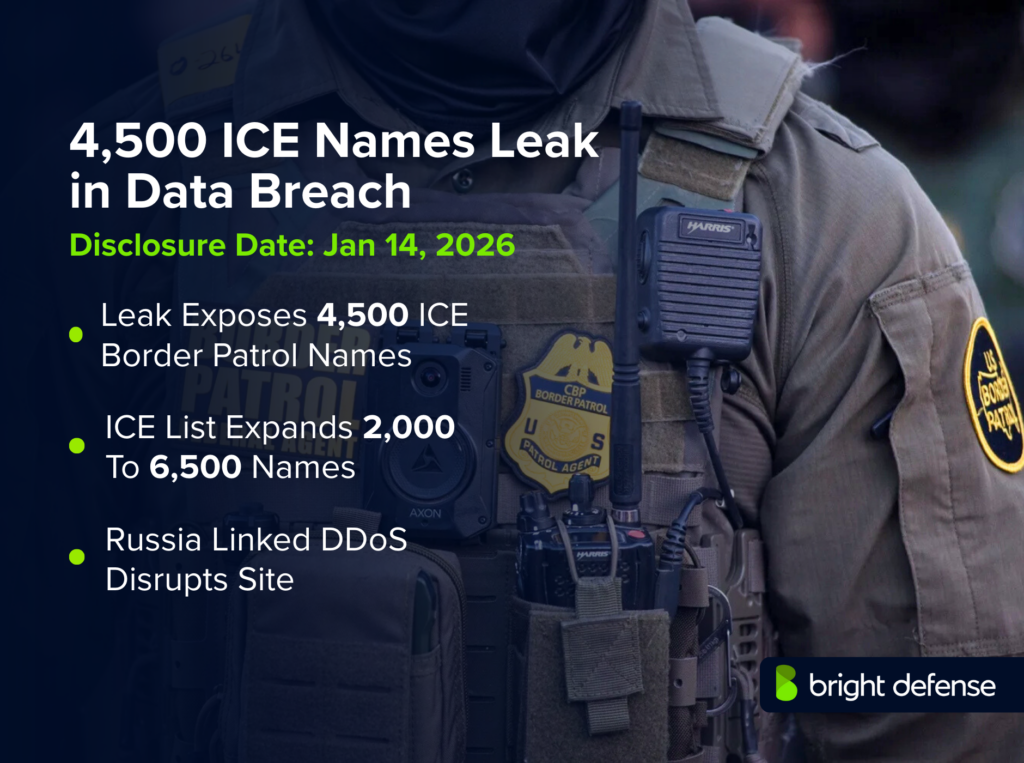
A reported DHS insider leak exposed details tied to about 4,500 ICE and Border Patrol workers, and the ICE List project said it would publish verified names as it expanded its database from about 2,000 to roughly 6,500. After news of the planned release, the site’s founder said a Russia sourced DDoS campaign began and disrupted access, pushing the team into recovery work and traffic filtering. The leak surfaced amid heightened backlash after ICE agent Jonathan Ross fatally shot Renee Nicole Good on 7 Jan, 2026, and the incident remained active as of 15 Jan, 2026.
(Source: Cybernews)
2. Eurail Breach: 1.3TB Dump for Sale Now
Breach Disclosed: 10 Jan, 2026

Rail pass provider Eurail said customer data in a cyberattack is offered for sale, with samples shared on Telegram, while investigators work out how many travelers are affected. Eurail first acknowledged the incident around 10 Jan, 2026, the closest verified date, after finding unauthorized access and data copied from its environment.
Eurail said it notified data protection authorities under GDPR and began customer outreach. The exposed set can include names, contact details, travel companion details, and passport information such as numbers and expiry dates, which raises phishing and identity fraud risk. Criminals claim they stole 1.3TB from cloud storage and support systems and threaten wider release if no buyer emerges.
Source: TechRadar.
25. Conduent Breach Hits 25.9M After February Surge
Breach Disclosed: April 9, 2025
Breach Scope Expanded: February 2026
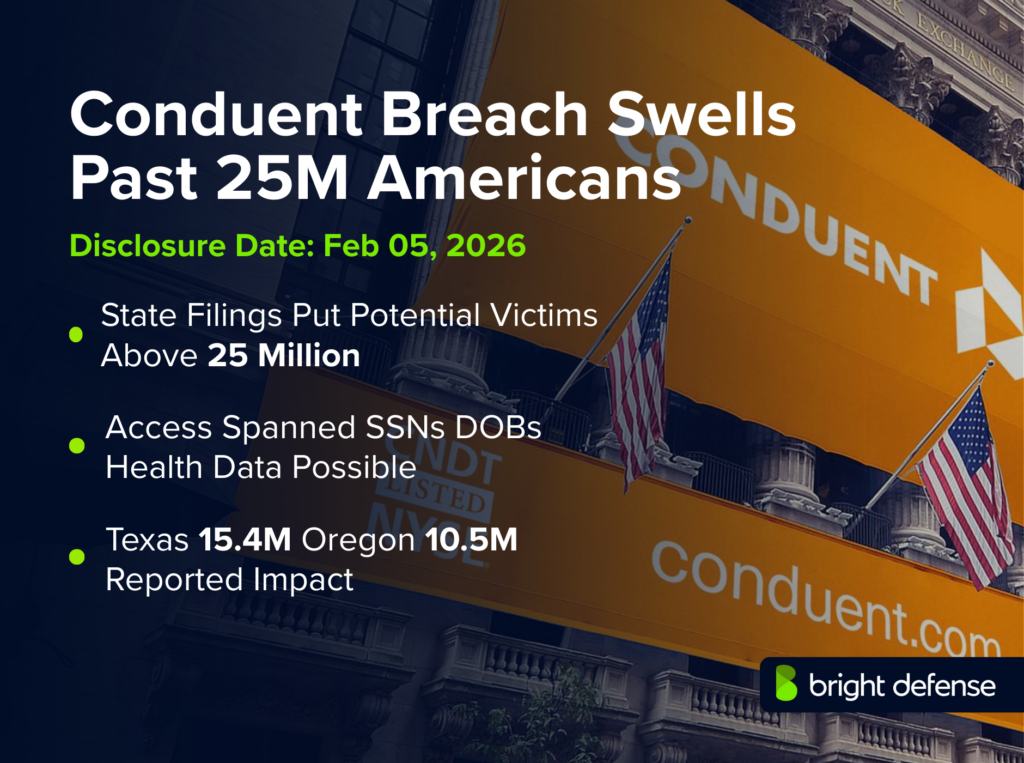
Conduent disclosed its ransomware breach in an SEC filing on April 9, 2025, confirming attackers accessed systems from October 21, 2024 to January 13, 2025 and stole more than 8 terabytes of data. Initial impact estimates near 4 million surged in February 2026, when Texas officials reported 15.4 million residents affected and Oregon identified 10.5 million, pushing the total to at least 25.9 million people. Exposed data includes Social Security numbers and medical information. State investigations intensified in February 2026 as notifications expanded nationwide and scrutiny grew over the scale of the breach.
Source: TechCrunch
3. Crunchbase Hack Exposes 2M Records via ShinyHunters
Breach Disclosed: 27 Jan, 2026
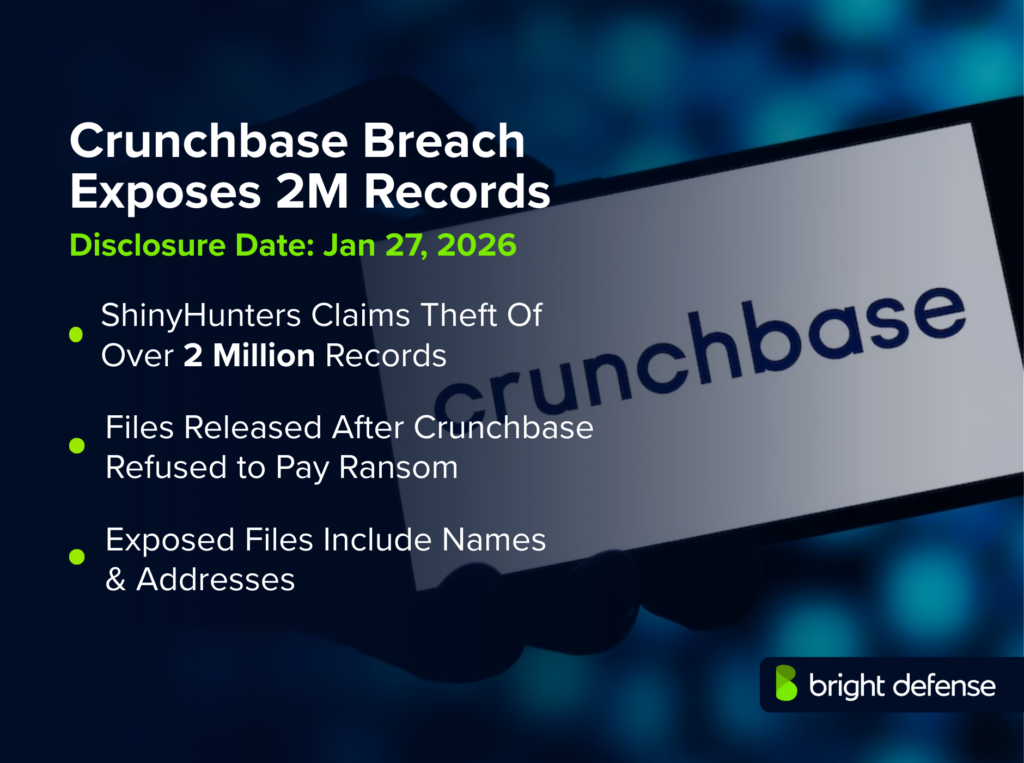
Crunchbase confirmed a data breach after the ShinyHunters cybercrime group published files allegedly stolen from its corporate network, claiming access to more than 2 million records. The exposed data reportedly includes full names, contact details, addresses, job information, contracts, and internal business documents.
After several days of public claims, Crunchbase acknowledged that a threat actor exfiltrated certain documents but stated no business operations were disrupted and systems were secured. The files were released after Crunchbase refused to pay a ransom. The breach surfaced publicly on 27 Jan, 2026, with ongoing review to determine regulatory notification requirements and potential downstream risks such as fraud and social engineering.
(Source: Cybernews)
- Read the Full Crunchbase Story Here!
4. Hinge, Match, OkCupid Leak Dumps 10M Dating Records
Breach Disclosed: 28 Jan, 2026
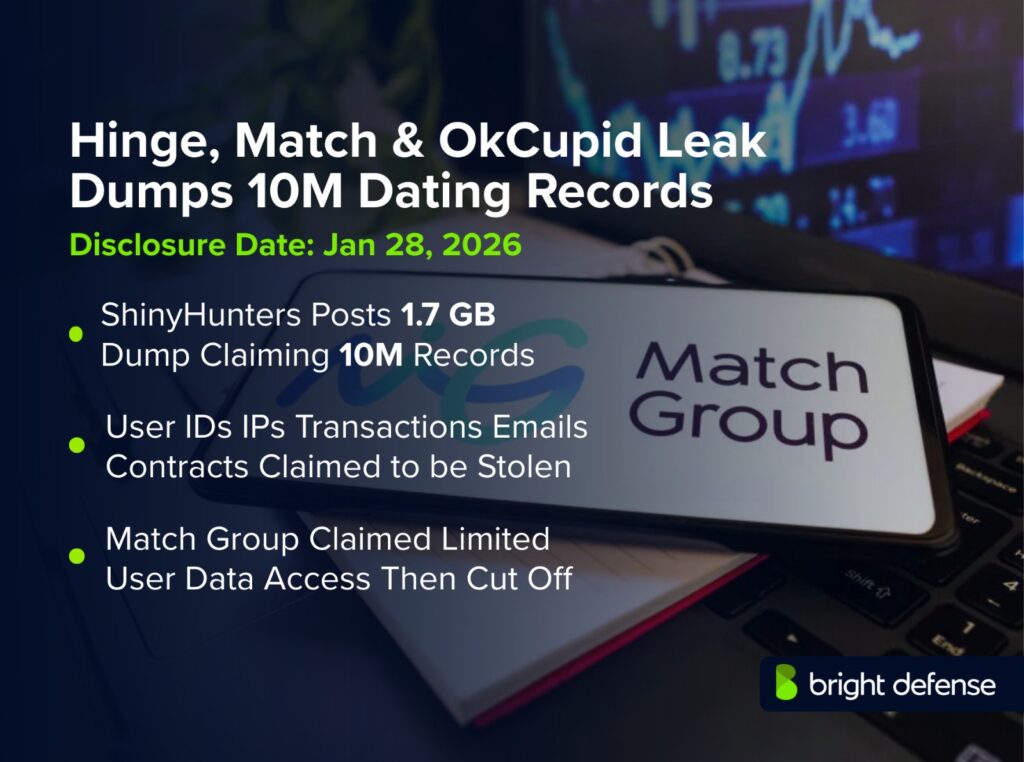
Match Group said it is investigating a security incident after ShinyHunters claimed the theft of more than 10 million records tied to Hinge, Match, and OkCupid, with the claim posted on 28 Jan, 2026. Reports describe a social engineering vishing campaign aimed at Okta SSO access and downstream exposure from marketing and analytics tooling, with leaked items said to include user IDs, IP addresses, Hinge subscription transaction IDs, amounts paid, internal employee emails, and corporate contracts. Match Group said it ended the unauthorized access, saw no indication of exposed passwords, financial data, or private communications, and began notifications where appropriate, while timelines may reach back to mid-January 2026.
- Learn More About the Match Group Breach!
(Source: BleepingComputer)
5. Nike Probe After 1.4TB Leak Hits Dark Web
Breach Disclosed: 26 Jan, 2026
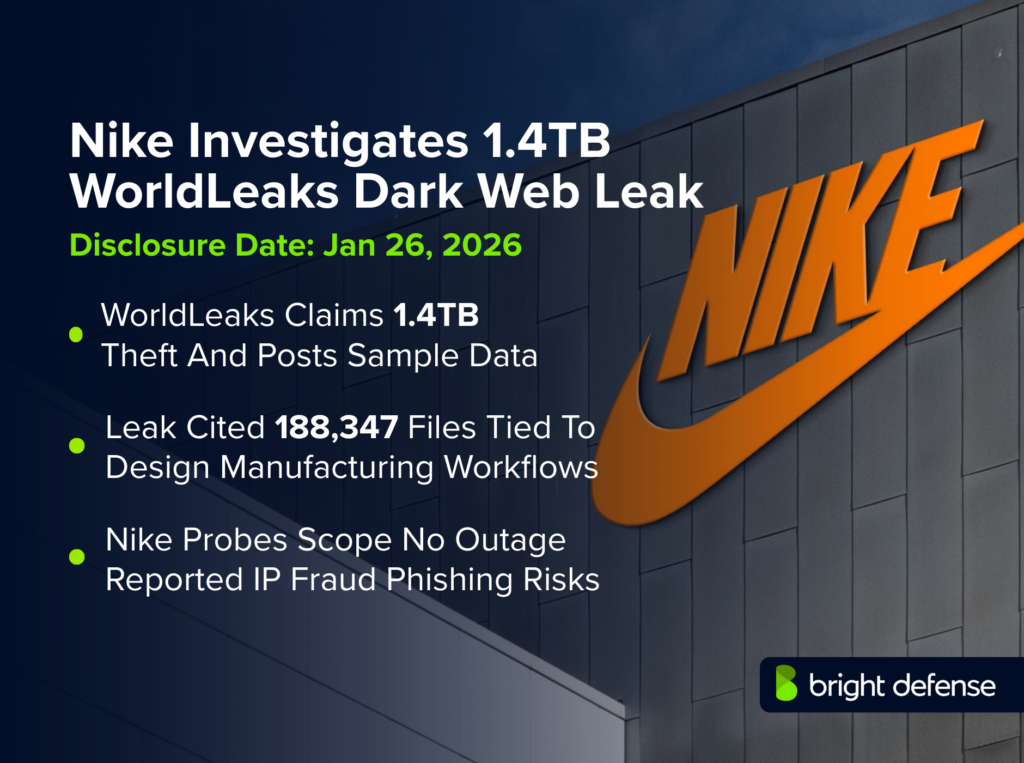
Nike said it is investigating a potential cybersecurity incident after the WorldLeaks extortion gang claimed it stole and posted samples of 1.4TB of internal files, described as 188,347 items linked to design and manufacturing workflows.
On 26 Jan, 2026, Nike said it was actively assessing the situation while declining to confirm what was taken or whether payment discussions occurred.
Early reporting indicated the material appeared focused on corporate documents rather than customer databases, which reduces immediate account exposure but raises risks for IP theft, counterfeits, supplier fraud, and targeted phishing against employees and partners. Nike had not reported operational disruption at the time of disclosure.
- Read the Entire Nike Data Breach Story Here!
(Source: The Register)
6. Under Armour Leak: 72M Accounts Dumped Online
Breach Disclosed: 22 Jan, 2026
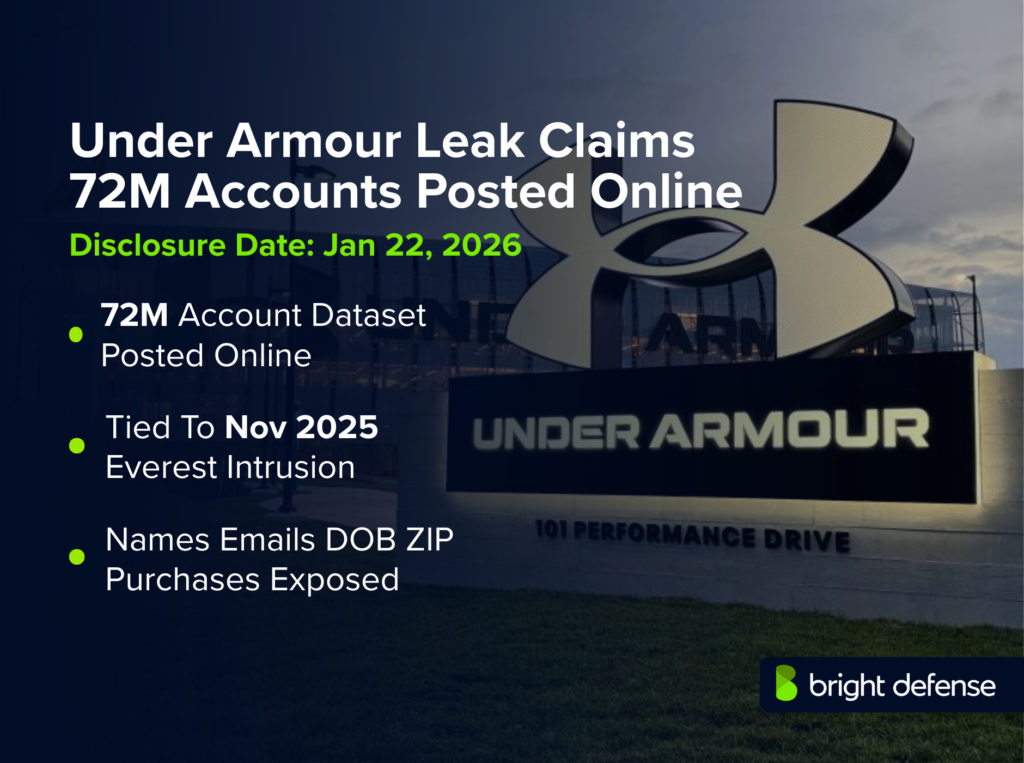
Under Armour said it is investigating claims that customer data tied to 72 million accounts was posted to a hacker forum. The seller told TechCrunch the files came from a November 2025 intrusion previously claimed by the Everest ransomware gang.
The breach gained wider attention this week after Have I Been Pwned obtained the dataset and notified 72 million people. Reported fields include names, email addresses, genders, dates of birth, ZIP codes or postcodes, and purchase related information, plus employee email addresses. Under Armour said there is no evidence the incident affected UA.com or systems that process payments or store passwords, and it has brought in external forensics support.
(Source: TechCrunch)
7. AT&T Data Breach Settlement Offers Up To $5k in Claims
Latest Update: 15 Jan, 2026
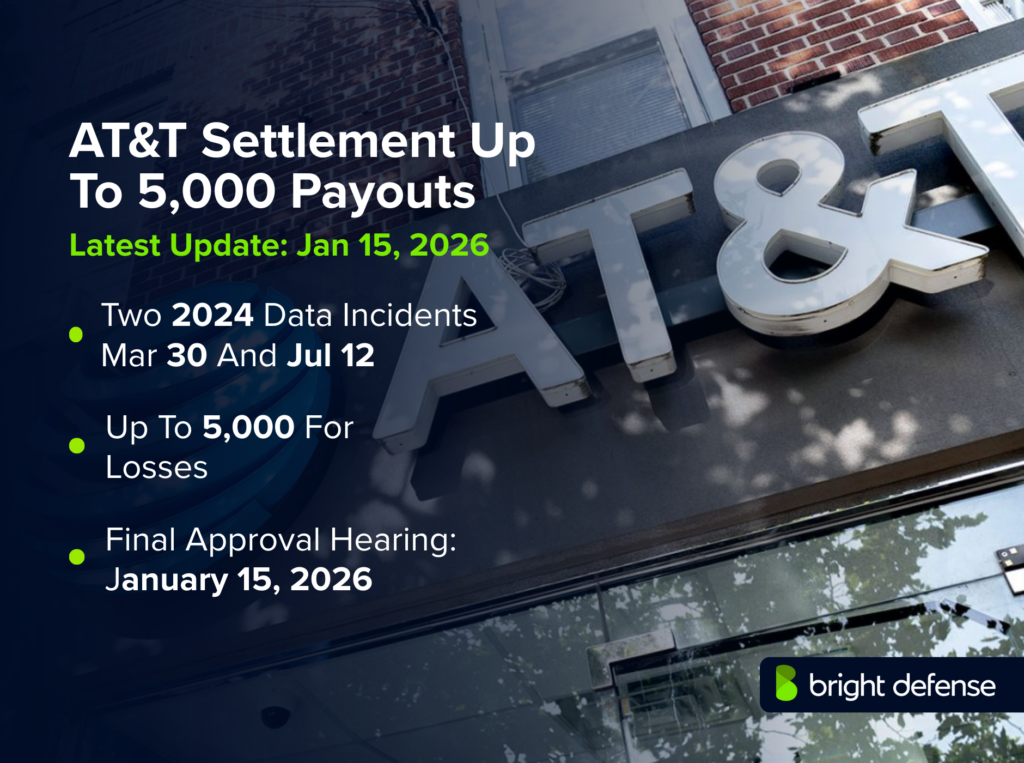
AT&T’s settlement process covers 2 incidents announced on 30 Mar, 2024 and 12 Jul, 2024, one tied to a dark web dataset that could include Social Security numbers and another tied to data downloaded from an AT&T workspace hosted with Snowflake that could include phone numbers and call or text interaction counts. Eligible U.S. class members could request documented loss payments up to $5,000 or $2,500, or choose pro rata tier payments, with tier 1 for Social Security number exposure set at 5 times tier 2. The online claim deadline was 18 Dec, 2025, and the court scheduled a final approval hearing for 15 Jan, 2026.
8. 17.5M Instagram Leak: The Reset Email You Must Avoid
Breach Disclosed: 10 Jan, 2026
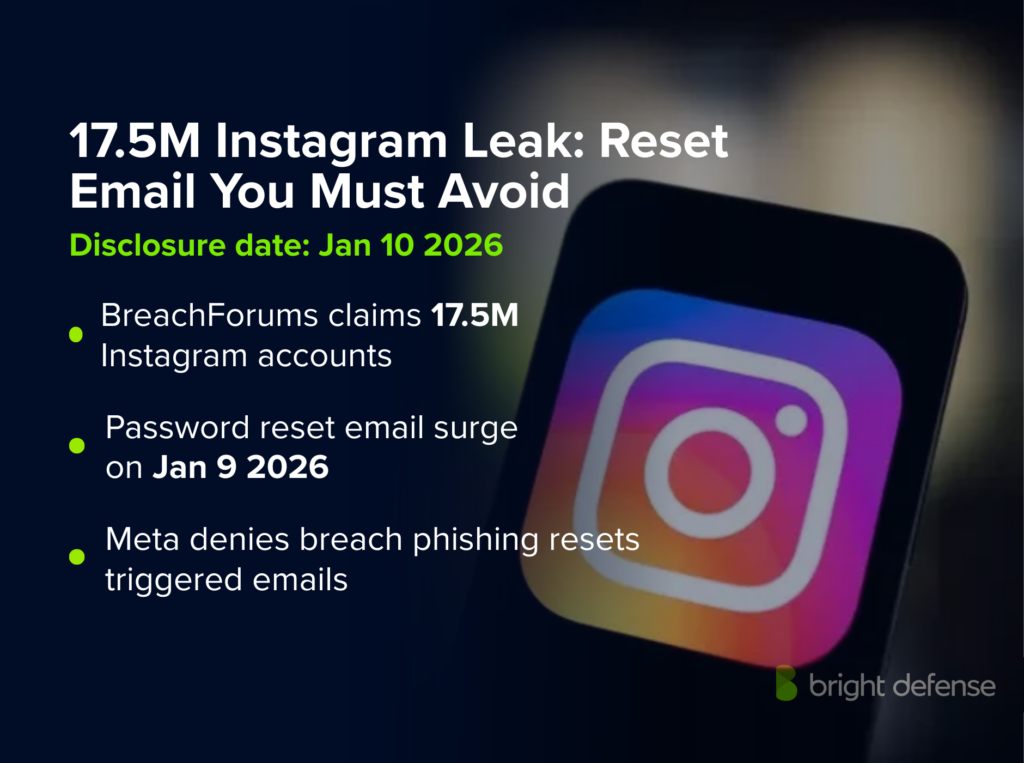
A report updated on January 10, 2026 ties a BreachForums post to alleged data from 17.5 million Instagram accounts and a spike of password reset emails that began around January 9, 2026. The messages can come from Instagram, which makes the bait convincing, but a reset request still can be attacker triggered.
Meta has not confirmed an internal breach, and some requests may start from simple typos. If you did not request it, do not click the link. Open Instagram, confirm 2FA is on, change your password, review recent logins, and revoke unknown sessions immediately. Also reset your email password if reused, and watch for new recovery emails.
Source: Forbes
View The Full Instagram Story Here
9. Google Chrome 143 Security Bypass Puts 3 Billion Users At Risk
Breach Disclosed: 06 Jan, 2026
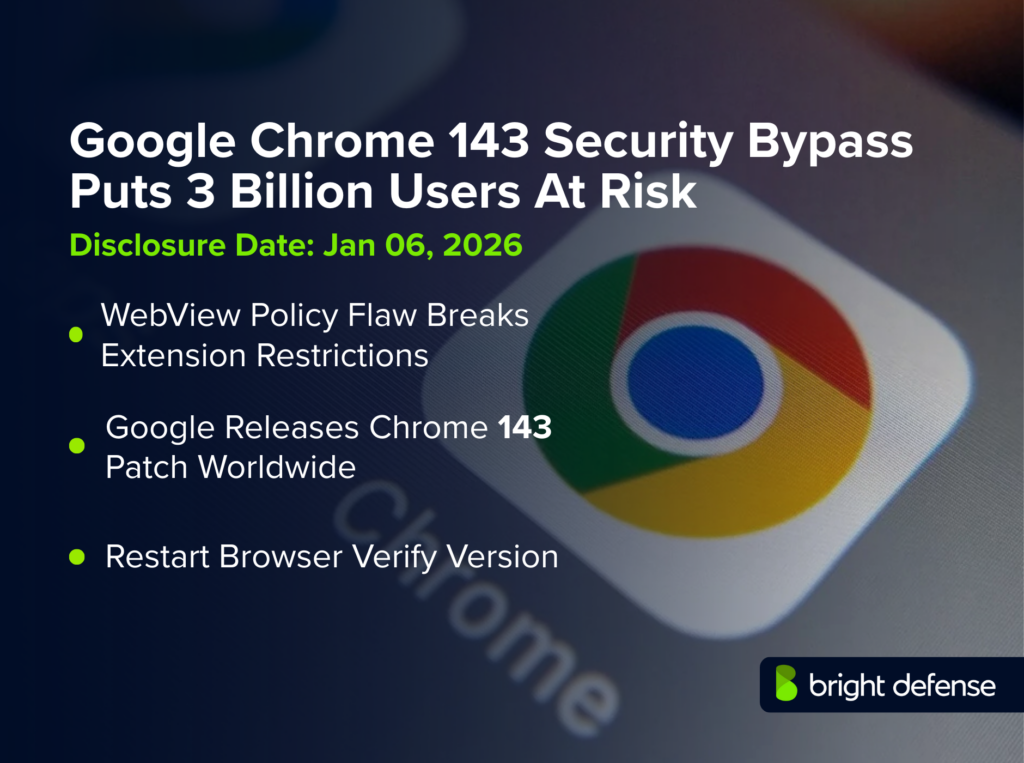
Google disclosed a Stable Channel security update on 06 Jan, 2026, pushing Chrome to 143.0.7499.192/.193 on Windows and macOS and 143.0.7499.192 on Linux. The update addresses 1 High-severity issue, CVE-2026-0628, described as “insufficient policy enforcement” in the WebView tag. Google credits researcher Gal Weizman and lists the report date as 23 Nov, 2025. Public technical detail stays limited until most users receive the patch, so treat this as a priority update. Restart Chrome after updating, then confirm the version across personal devices and managed fleets. (Chrome)
Check out the entire Chrome story here!
38. Oracle E-Business Suite Hack Still Generating Ransom Demands
Breach Disclosed: Started in Oct 2025, Still Ongoing
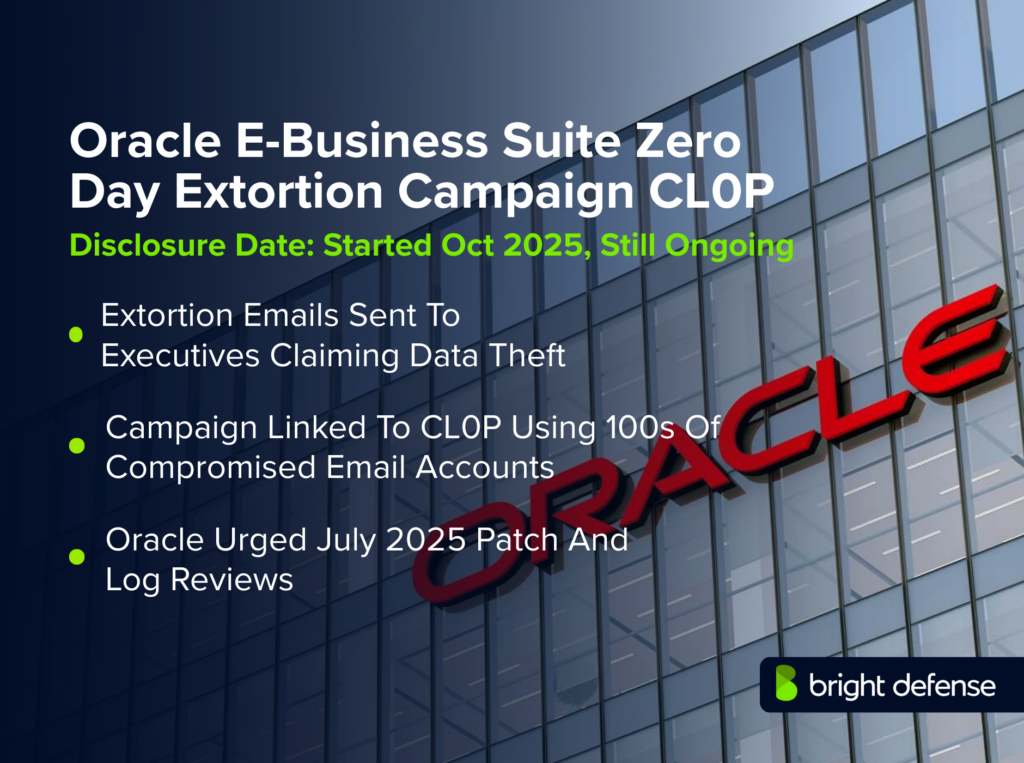
Executives at many large organizations are getting ransom demands weeks after a zero-day exploit in Oracle’s E-Business Suite was first identified. The criminal group linked to CL0P claimed it accessed sensitive ERP data and emailed leaders from compromised third-party accounts on or before Sept 29, 2025, demanding payment to prevent leaks. Patches were released in Oct 2025, but extortion continues and the number of companies receiving demands has risen past 100, including universities and major corporations. Experts say the attack exploited remote access flaws and emailed executives directly, pressuring them with seven- and eight-figure ransom figures.
Some of the major Oracle breach victim organizations include:
- Harvard University received ransom demands after data tied to its Oracle EBS systems was targeted.
- The Washington Post confirmed it was impacted and had to notify customers about a breach.
- Envoy Air (an American Airlines subsidiary) appeared on lists of targeted organizations.
Cox Enterprises showed up in the victim set reported by investigators. - Logitech was named among affected companies in reports tied to the campaign.
- Schneider Electric, Emerson, Pan American Silver, and LKQ Corporation appeared on leaked victim lists although not all confirmed the breach publicly.
- University of the Witwatersrand was cited on CL0P’s victim blog and various reports. (Wall Street Journal)
Read about the Entire Oracle EBS Breach Story Here!
10. ManageMyHealth Breach Exposes Up to 126K Users
Breach Disclosed: 01 Jan, 2026
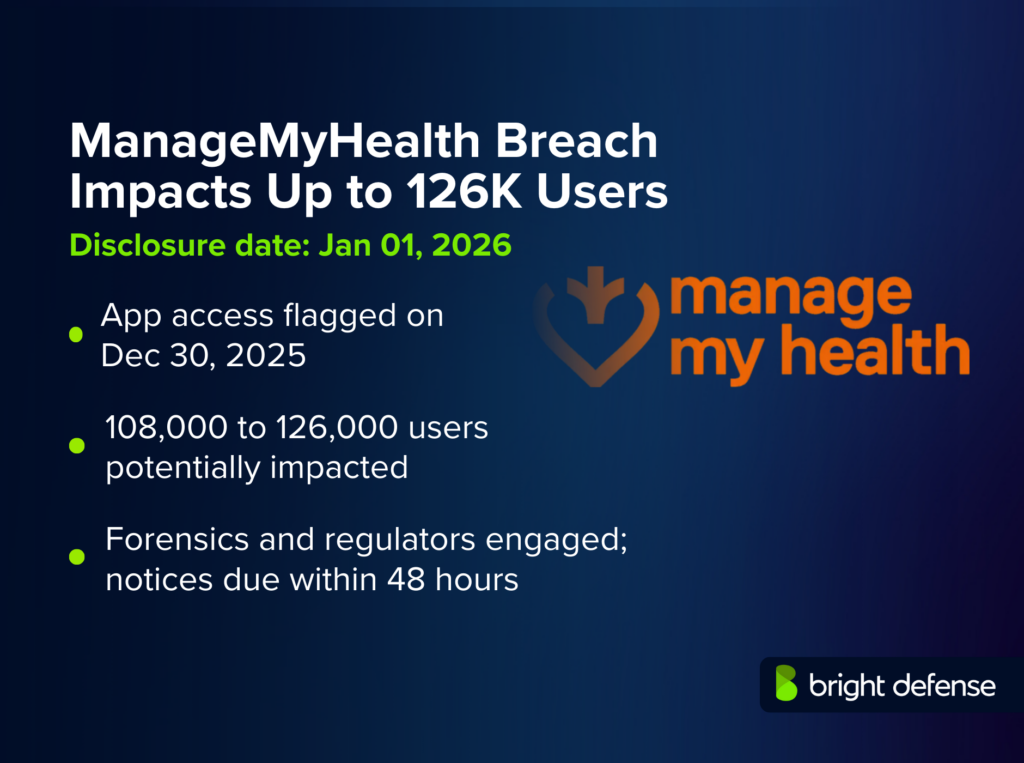
ManageMyHealth, New Zealand’s largest patient portal (about 1.8 million registered users), disclosed a cybersecurity incident involving unauthorized access to its application after the company was alerted on Dec 30, 2025. Initial containment actions focused on securing the platform, preserving evidence, and engaging independent cyber and forensic specialists.
ManageMyHealth later stated that approximately 6% to 7% of users may be impacted, roughly 108,000 to 126,000 people, with notifications expected within 48 hours. Authorities including Health New Zealand, Police, and the Privacy Commissioner were notified, while investigations continued with additional public clarification issued on Jan 2, 2026. (Manage My Health)
Get The Full Managemyhealth Breach Story Here!
11. Ledger Leak: Names, Addresses Exposed
Breach Disclosed: 05 Jan, 2026
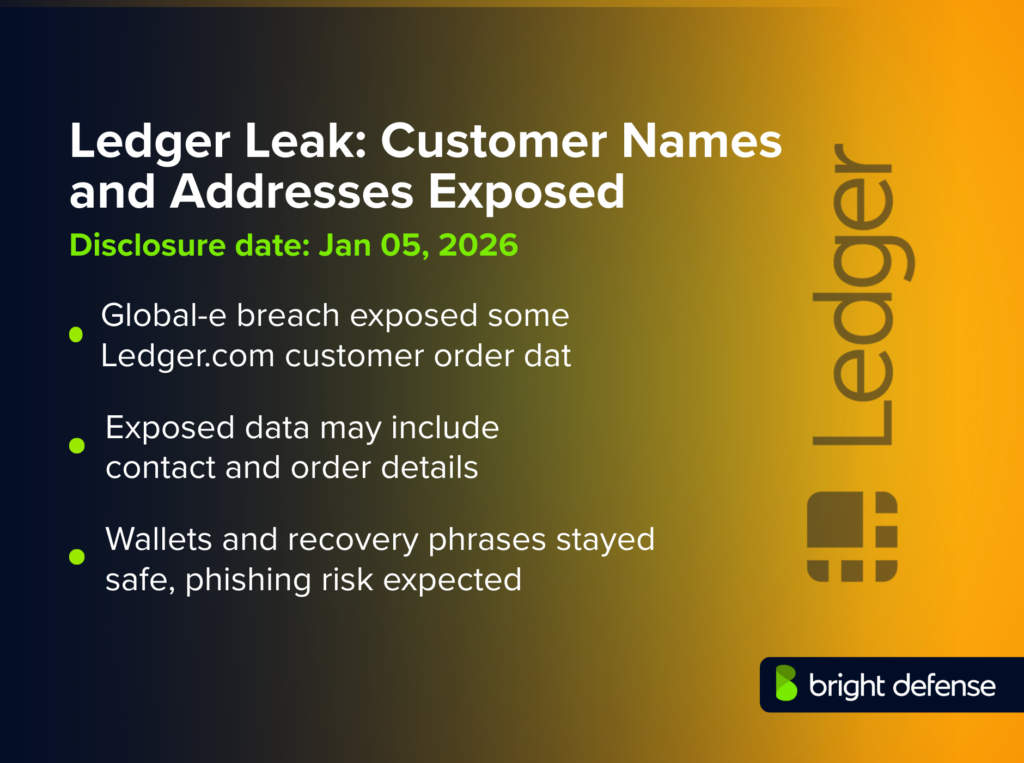
On 05 Jan, 2026, Ledger confirmed customer order data exposure after unauthorized access inside Global-e, an e-commerce partner used for some Ledger.com purchases. Global-e said an intruder copied personal data that can include names, postal addresses, email addresses, telephone numbers, and order details such as order number, product purchased, and price paid.
Ledger said its own platform, devices, and Ledger Live were not breached, and 24-word recovery phrases, balances, and payment data were not accessed. Global-e reported it contained the activity and started notifying affected people and regulators. Ledger warned customers to expect phishing in the days ahead and never share recovery phrases. (siliconangle.com)
Check out more about the Ledger Leak Here!
12. Brightspeed Breach: Hackers Claim 1M Hit
Breach Disclosed: 05 Jan, 2026
Crimson Collective says it accessed Brightspeed systems and took data on over 1 million customers. Reporting cites a Telegram post on 04 Jan, 2026 and a threat to drop a data sample on Monday night, 05 Jan, 2026, unless Brightspeed replied.
The alleged haul includes names, emails, phone numbers, billing addresses, account details linked to session or user IDs, payment history, partial card information, and appointment or order records.
Brightspeed acknowledged a reported cybersecurity event on 05 Jan, 2026 and said it is investigating, with updates for customers, employees, and authorities as facts firm up. Customers should watch for phishing and account takeover attempts, reset passwords, and review billing activity. (Bleeping Computer)
13. 34,504 Texans Hit In Vida Y Salud Data Breach
Breach Disclosed: 05 Jan, 2026

Vida Y Salud-Health Systems, a Crystal City, Texas FQHC, detected suspicious network activity on 08 Oct, 2025. Forensics found an unauthorized actor accessed systems between 07 Oct, 2025 and 08 Oct, 2025, copying files that could include names, Social Security numbers, driver’s license numbers, addresses, dates of birth, medical information, and account or claim numbers.
A filing with the Texas Attorney General reported 34,504 affected Texans on 05 Jan, 2026. The organization secured its network, brought in outside specialists, notified law enforcement and regulators, and began mailing notices plus credit monitoring. A dedicated help line, 833-792-0594, runs 7 AM to 7 PM CST on weekdays. (claimdepot.com)
Data Breaches that Occurred in December 2025
1. ESA Confirms Cybersecurity Incident After Hacker Claims 200GB Data Theft
Breach Disclosed: 30 Dec, 2025
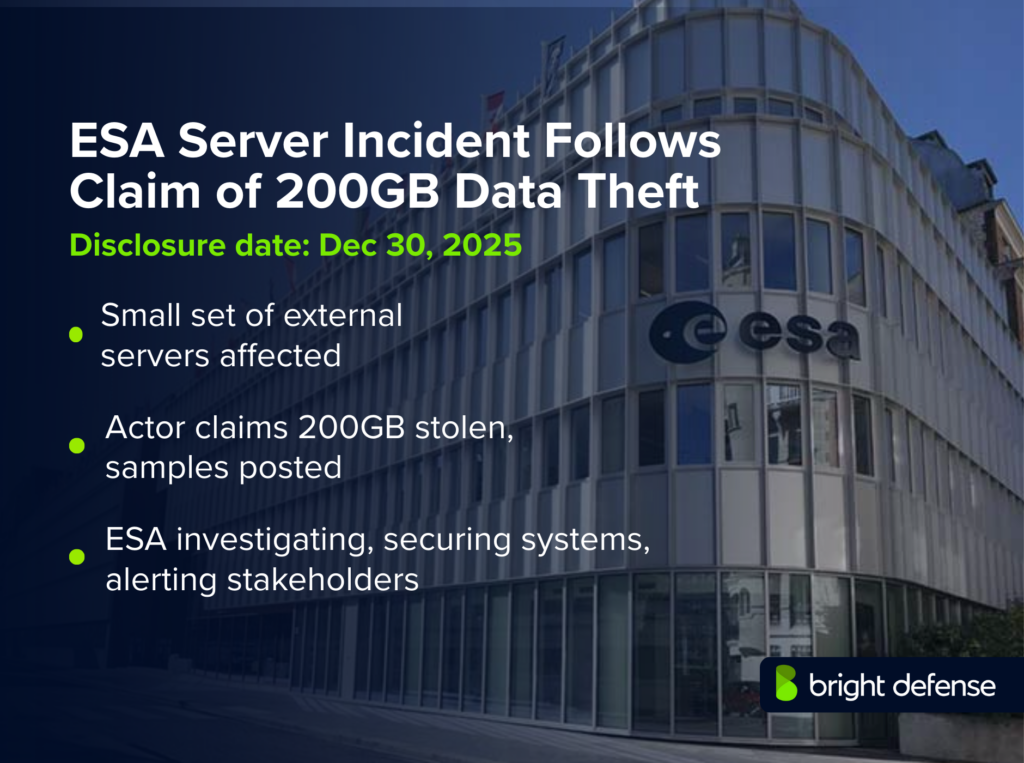
The European Space Agency (ESA) confirmed a cybersecurity incident involving a small number of external servers located outside its corporate network, after a threat actor claimed to have stolen about 200GB of data and offered it for sale. ESA said the impacted systems supported unclassified collaborative engineering and scientific work, not core mission or classified environments.
The agency launched a forensic investigation, began securing potentially affected devices, and notified relevant stakeholders. Public reporting indicates the actor shared proof samples, including references to private development repositories, though details remain under validation as ESA’s analysis continues. (TechRadar)
2. Pornhub Premium Leak Exposes 201M Data
Breach Disclosed: 12 Dec, 2025
Pornhub says a “select” number of Premium users had viewing behavior and search activity exposed after an unauthorized party accessed Mixpanel analytics data, not Pornhub’s own systems.
Reports indicate ShinyHunters obtained roughly 201M records covering user emails, locations, video URLs, video names, keywords, and event timestamps.
ShinyHunters allegedly issued an extortion demand and sought bitcoin payment to prevent publication. Pornhub stated passwords and payment information were not exposed and emphasized it ended its Mixpanel relationship in 2021, suggesting the dataset is historical.
Sophos said it has not seen the data posted to leak sites yet. (Guardian)
3. SoundCloud Reports Breach Exposing Emails of 20% of Users
Dec 15, 2025

SoundCloud disclosed a data breach after detecting unauthorized activity within an ancillary service dashboard. The company confirmed that attackers exfiltrated email addresses and other information already visible on public user profiles, affecting about 20% of its user base.
Based on third-party estimates of roughly 140 million total users, the incident likely impacts tens of millions of accounts. SoundCloud stated that passwords, financial data, and private content were not accessed.
During remediation, configuration changes caused VPN users to encounter “403 Error” access issues, which the company linked directly to its response efforts. After containment, SoundCloud experienced denial-of-service attacks, with two incidents briefly disrupting web availability.
The company said the threat has been resolved and urged users to remain alert for phishing attempts that often follow large-scale data exposures. (Cybernews) Read the whole Soundcloud story here!
4. 700Credit Breach Exposes SSNs of 5.6 Million People
Dec 22, 2025; Michigan, United States
700Credit disclosed a data breach that exposed highly sensitive personal information belonging to at least 5.6 million individuals. The Michigan-based credit check and identity verification provider said an unidentified attacker accessed data collected from auto dealerships between May and October 2025.
Stolen information includes full names, home addresses, dates of birth, and Social Security numbers, creating a significant risk of identity theft and financial fraud.
The company is notifying affected individuals by mail and offering credit monitoring services. Michigan Attorney General Dana Nessel urged recipients to act quickly, recommending credit freezes or monitoring to reduce the likelihood of misuse of stolen data. (TechCrunch)
Read more about the 700Credit Breach here.
5. GPS Spoofing Cyber Attack Targets 7 Major Indian Airports
Dec 1, 2025; India
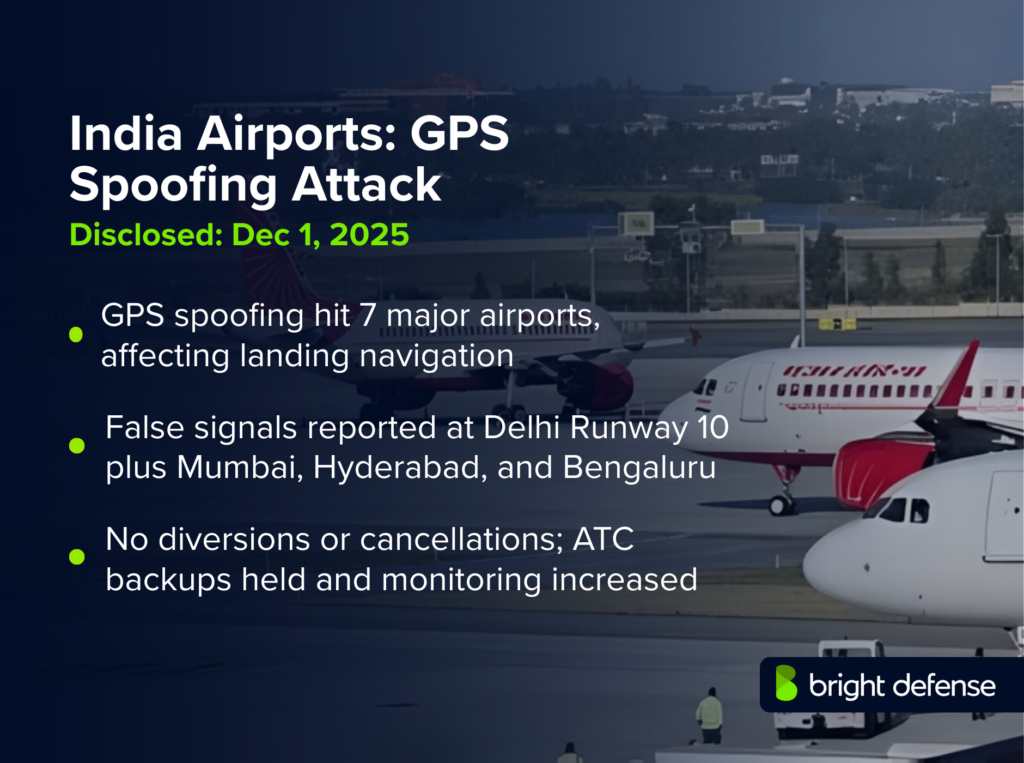
India’s central government confirmed that seven major airports were targeted in a cyber attack involving GPS spoofing that affected aircraft navigation during landing procedures.
Flights approaching Runway 10 at Delhi’s Indira Gandhi International Airport reported misleading GPS signals, with similar incidents identified at airports in Mumbai, Kolkata, Hyderabad, and Bengaluru. GPS spoofing transmits false location and altitude data to navigation systems.
Authorities said no flights were cancelled or diverted because air traffic control relied on backup procedures and existing safeguards.
Following the incident, aviation and security agencies increased monitoring, placed affected airports on high cyber alert, and began implementing additional countermeasures. (Financial Express)
6. Nissan Confirms Customer Data Exposure of 21k Customers
Dec 23, 2025
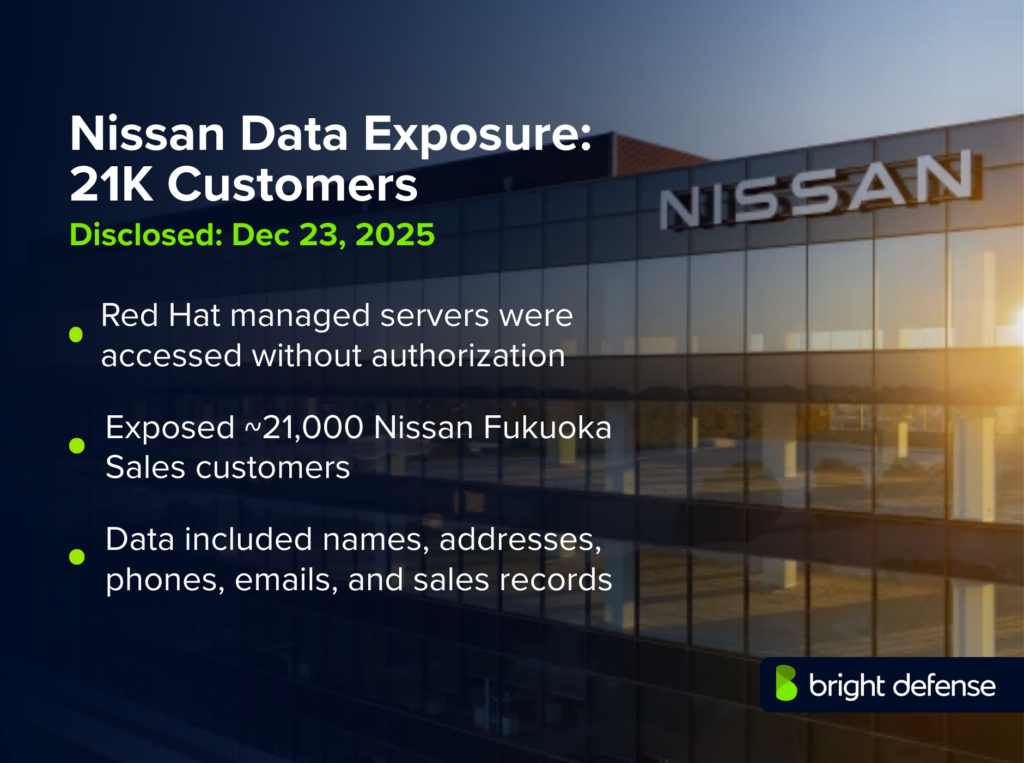
Nissan Motor Co. confirmed that unauthorized access to servers managed by Red Hat exposed personal data linked to approximately 21,000 customers of Nissan Fukuoka Sales.
The incident occurred in September and stemmed from Red Hat’s role in developing customer management systems for Nissan sales operations. Exposed data includes customer names, addresses, phone numbers, email addresses, and sales related records.
Nissan stated that no credit card or financial information was involved and that no additional Nissan data was stored in the affected environment. Red Hat disclosed the breach in early October. Nissan said it has reported the incident to authorities and found no evidence of data misuse. (Data Conomy)
Read the Whole Nissan Breach Story Here!
7. Spotify Investigates Scraping of 256M Tracks & 86M Files
Dec 22, 2025; Stockholm, Sweden
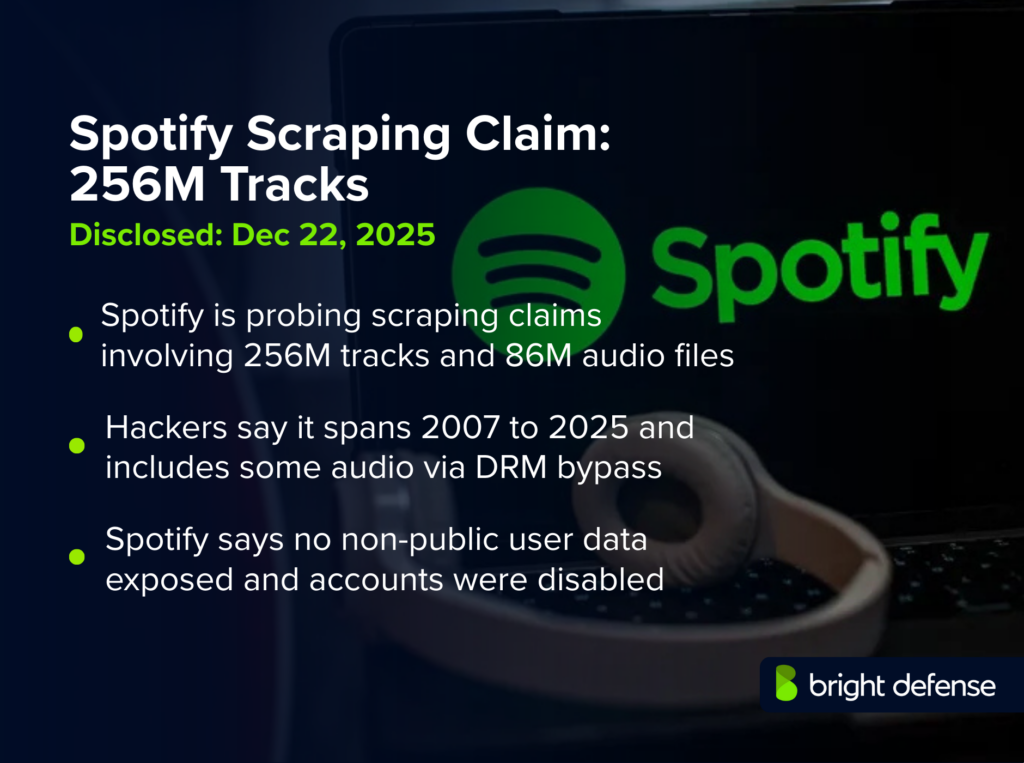
Spotify confirmed it is investigating unauthorized scraping of its music library after a pirate activist group claimed it released metadata covering roughly 256 million tracks and 86 million audio files. The data reportedly spans content added between 2007 and 2025 and represents nearly the full catalog. S
potify said the third party used illicit tactics to bypass DRM and access some audio files. The company stated it disabled involved accounts, added safeguards, and continues monitoring activity. Spotify reported no evidence of non public user data exposure, noting that any user related information involved only public playlists.
Hackers claimed the dataset totals just under 300 TB and could circulate on peer to peer networks. Rights holders raised concerns about potential misuse for large scale AI training, while Spotify reiterated its stance against piracy and support for artists. (Euronews)
Go Through the Entire Spotify Breach Story Here!
8. Marquis Vendor Breach Exposes Data of 400,000+ Bank Customers
Dec 3, 2025
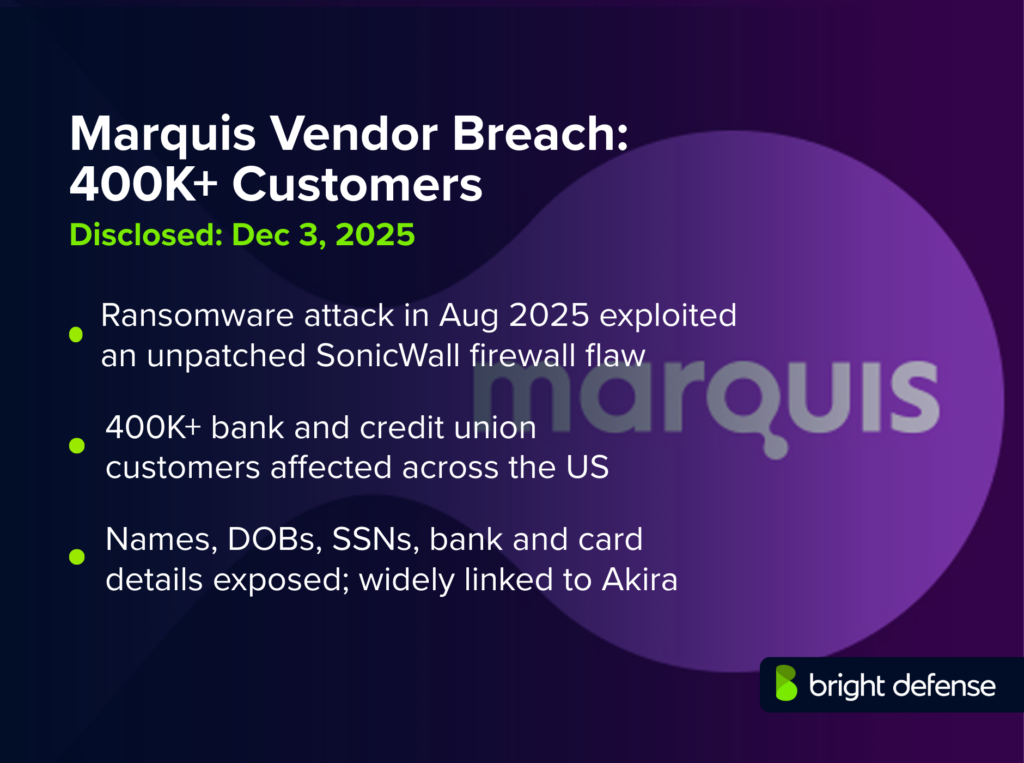
Financial services vendor Marquis disclosed that a ransomware attack exposed sensitive personal and financial data tied to more than 400,000 bank and credit union customers across the US.
The intrusion occurred in August after attackers exploited an unpatched SonicWall firewall vulnerability to access Marquis systems. Exposed data includes names, addresses, dates of birth, Social Security numbers, bank account details, and debit or credit card numbers.
Texas reported the highest number of affected individuals, with additional disclosures filed in several other states. Marquis provides services to over 700 financial institutions, allowing the breach to impact customers across multiple organizations.
The attack has been widely linked to the Akira ransomware group, though Marquis has not publicly named the attackers. (Fox News)
9. Asus Supplier Breach Raises Alarm After Ransomware Gang Claims 1 TB Data Theft
Dec 5 2025, Taiwan
Asus reported that a third party supplier suffered a ransomware intrusion after the Everest group claimed it had taken 1 TB of data tied to Asus, ArcSoft, and Qualcomm. Asus stated that stolen material involved camera source code used in its phone line, and that no internal systems, products, or customer data were affected.
Everest posted screenshots on its leak site and asserted that the haul included binary modules, firmware tools, RAM dumps, AI models, calibration files, test datasets, and debug logs. Asus has not validated those wider claims or clarified whether proprietary assets beyond the camera code were exposed.
The vendor’s disclosure followed recent warnings that about 50,000 Asus routers had been compromised in a separate China linked campaign targeting outdated firmware. Although unrelated, the supplier breach added pressure on the company as investigators assess the resilience of its supply chain and development processes. (The Register)
10. Penn and Phoenix Universities Hit in Oracle EBS Campaign That Exposed Sensitive Records
Oct 2025 to Nov 21 2025, disclosed Dec 3 2025, United States
The University of Pennsylvania and the University of Phoenix confirmed their involvement in the widespread Oracle E-Business Suite hacking campaign disclosed in Dec 2025. Both institutions reported that attackers accessed personal and financial data through compromised Oracle EBS systems used for core business functions. Penn began sending notices after determining that nearly 1500 Maine residents were affected, though the full count remains unknown.
Phoenix detected the intrusion on Nov 21, one day after appearing on the Cl0p leak site. Investigators found that names, contact details, birth dates, Social Security numbers, and bank account information were exposed. While other victims saw hundreds of gigabytes released online, no Phoenix data has surfaced publicly, and Cl0p has not yet listed Penn.
The campaign has touched more than 100 organizations, including Harvard, Dartmouth, Canon, Mazda, Cox, and Logitech. Analysts continue to examine the zero-day flaws and threat actors behind the activity. (Security Week)
11. Renesas Electronics Hit with Ransomware Claim from CoinbaseCartel
Dec 6 2025, Japan
Renesas Electronics was named in a ransomware claim on Dec 6 2025 after the group CoinbaseCartel stated it had attacked the company and would release stolen data unless contact was made through specified channels. Renesas, a key semiconductor manufacturer, is reviewing its systems to determine whether data was removed and how the intrusion occurred.
No technical details have been confirmed, but the threat suggests possible exposure of internal files. Security teams are monitoring dark web activity while investigators check for persistence and assess the impact.
Recommended actions for organizations in similar situations include a rapid compromise assessment, verified offline backups, updated threat intelligence, stronger authentication controls, and early coordination with incident response specialists who can support technical and legal decisions as the investigation continues. (Dexpose)
12. TridentLocker Claims 30 GB Data Theft in Breach Affecting bpost
Dec 3 2025, Belgium
bpost confirmed a data breach after the ransomware group TridentLocker posted 5,140 files totaling more than 30 GB on its leak site. The material was fully downloadable, a sign that bpost did not meet ransom demands. Early reports from Tweakers.net highlighted the exposure, but the authenticity of all files has not been independently verified.
bpost stated that the breach involved a limited set of personal and business information tied to a department that operates through a third party exchange platform not connected to core letter or parcel operations. The company reported that security teams contained the incident, applied corrective measures, and engaged external specialists.
bpost also notified authorities and is preparing direct outreach to affected customers. TridentLocker, a newer ransomware operation, has claimed attacks on several organizations this year. The scale of the posted data suggests at least partial exfiltration despite bpost’s ongoing investigation. (Cybernews)
13. Data Breach Hits Over 22M Aflac Customers
Breach Disclosed: Publicly confirmed Dec 19, 2025
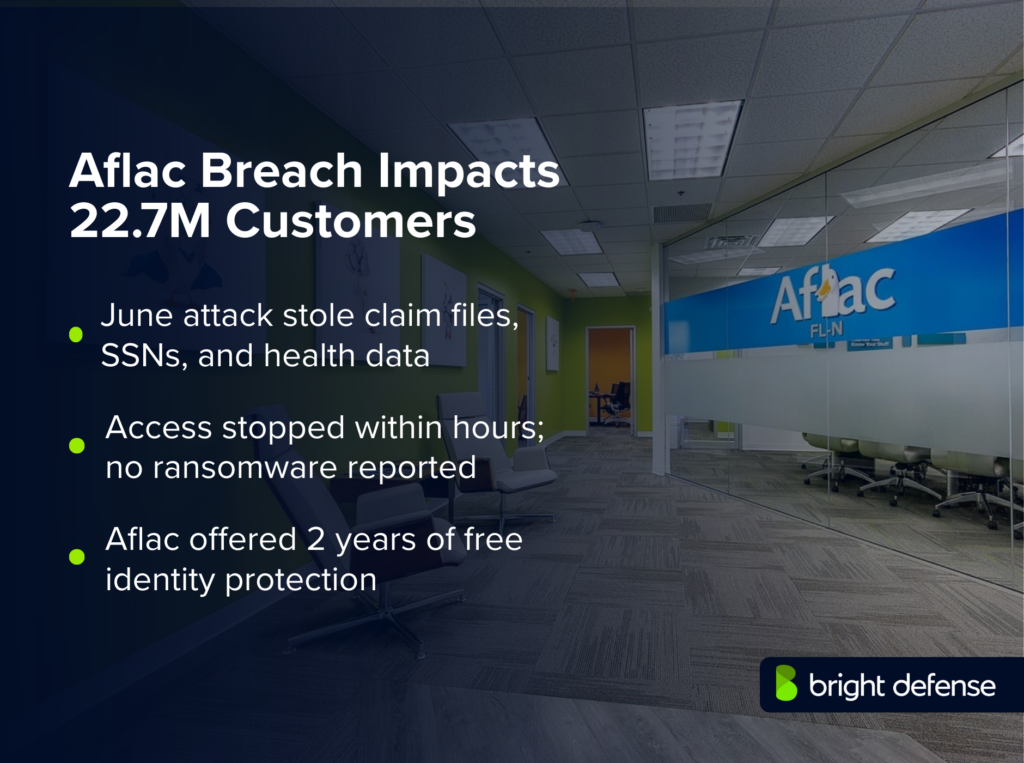
Major U.S. insurance firm Aflac had data from nearly 22.7 million customers, beneficiaries, employees, and agents stolen following a cyberattack in June, reports The Record, a news site by cybersecurity firm Recorded Future.
Unauthorized access to Aflac’s systems has been thwarted “within hours” of the intrusion’s discovery but not before threat actors were able to pilfer documents containing individuals’ insurance claims, Social Security numbers, and health details, according to the Georgia-based insurance giant.
Aflac, which emphasized that it did not experience a ransomware intrusion, offered two years of complimentary identity protection services to individuals affected by the incident. Such an intrusion against Aflac came amid Scattered Spider’s attack spree against multiple insurance companies, including the Philadelphia Insurance Companies, Erie Insurance, and Scania Financial Services.
Aside from having its data leak site dismantled by U.S. and French law enforcement in October, Scattered Spider also had its members apprehended and indicted in the UK. (SC World)
14. Rainbow 6 Siege Breach Hands Out ~2B Credits to Gamers
Breach Disclosed: 27 Dec, 2025
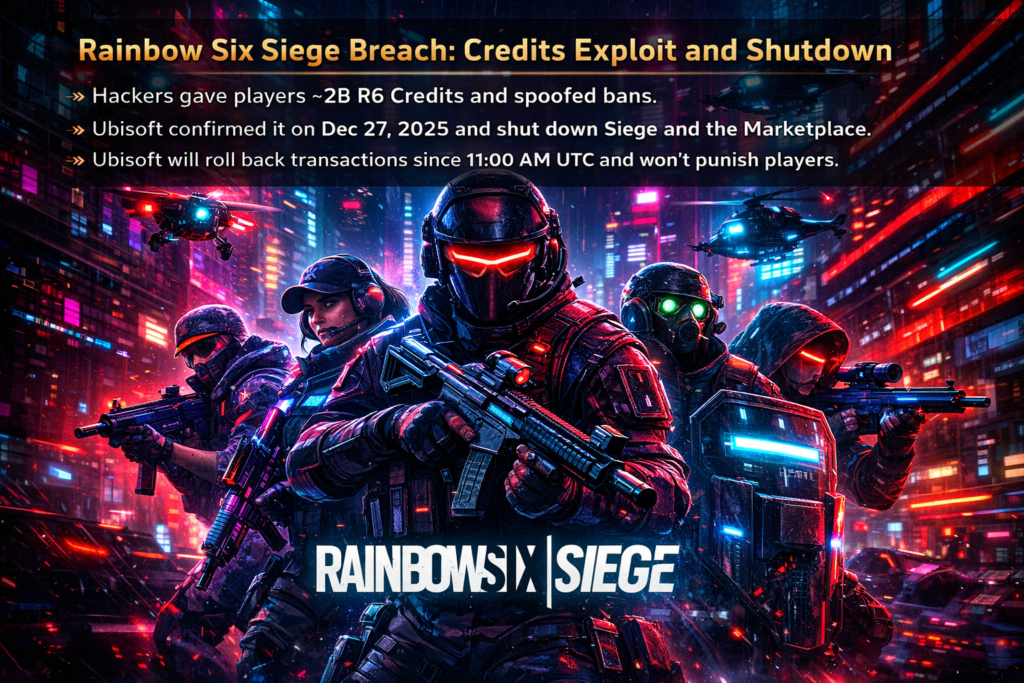
Ubisoft confirmed a major Rainbow Six Siege incident on Saturday, Dec 27, 2025, after widespread player reports showed attackers abusing internal systems to ban and unban accounts, inject fake moderation ticker messages, and grant roughly 2 billion R6 Credits plus Renown alongside unlocking all cosmetics, including developer-only skins. R6 Credits are premium currency, and the injected balance equated to an estimated $13.33 million at Ubisoft’s pricing. Ubisoft took Siege and the in-game Marketplace offline, disabled the ban ticker, and announced a rollback of all transactions since 11:00 AM UTC, while stating players would not be punished for spending the credits. (Bleeping Computer)
15. Hacker Posts 2.3M WIRED Records After Alleged Condé Nast Breach
Breach Disclosed: 20 Dec, 2025
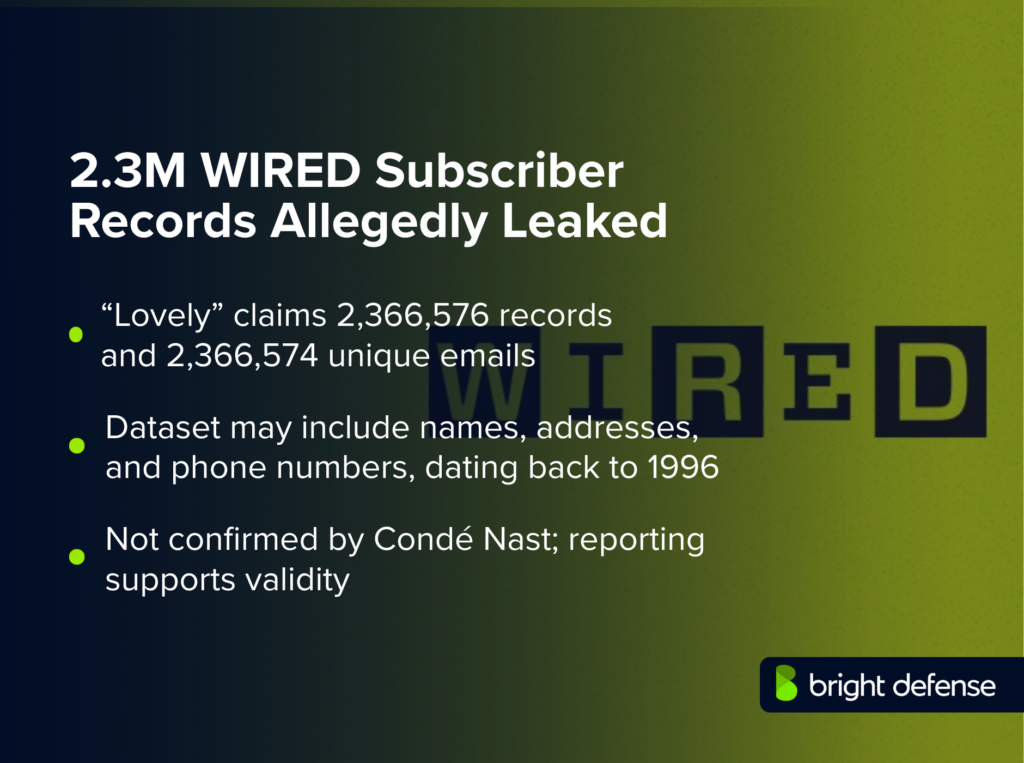
On 20 Dec, 2025, a threat actor named “Lovely” posted an alleged WIRED subscriber database from Condé Nast, offering access for about $2.30 in forum credits and warning that 40+ million more records from other brands could follow. Review of the leak shows 2,366,576 records and 2,366,574 unique email addresses, with timestamps from 26 Apr, 1996 to 9 Sep, 2025. Some entries also include names, phone numbers, physical addresses, gender, and birthdays, though many fields are empty. Condé Nast has not confirmed the incident. Treat it as a phishing risk: change reused passwords tied to your WIRED login and enable MFA. (bleepingcomputer.com)
16. Coupang Breach: Hackers Laptop Dumped in the River, Recovered Anyway
Date: 29 Nov, 2025
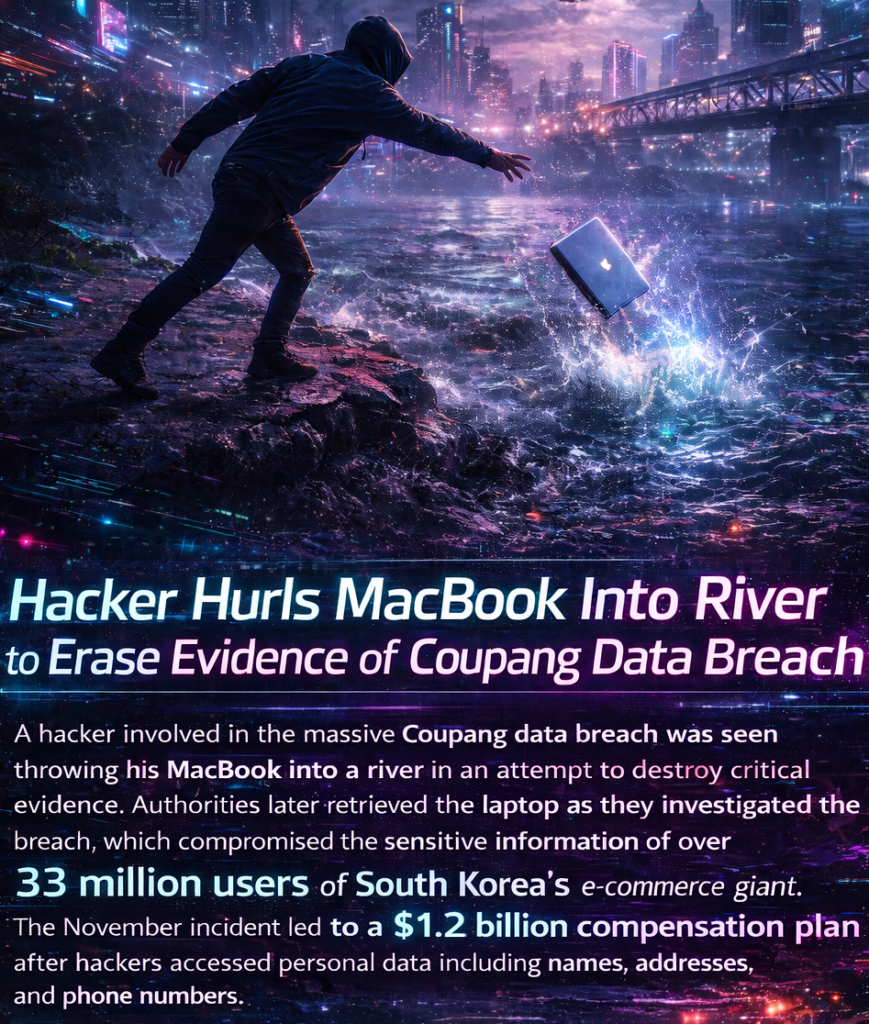
Coupang says its insider breach probe took a soggy turn after divers recovered a smashed MacBook Air from a nearby river, allegedly dumped in a brick weighted canvas bag to erase evidence. The South Korean e-commerce giant disclosed that 33.7 million customer accounts were exposed after unauthorized access was detected on Nov 18. Coupang says digital fingerprints and third party forensics teams inventoried the recovered laptop, identified a former employee, and found the person kept data from about 3,000 accounts, then deleted it after media coverage, with no sign of sales or sharing so far. It also announced 1.685 trillion won ($1.18B) in vouchers while scrutiny and lawsuits continue. (The Record)
17. Anubis Claims 30k Patient Records in AllerVie Health
Breach Disclosed: 22 Dec, 2025
AllerVie Health, an allergy and immunology provider based in Frisco, Texas, detected unusual network activity on 2 Nov, 2025 and later confirmed unauthorized access between 24 Oct, 2025 and 3 Nov, 2025. A records review on 24 Nov, 2025 found exposure of names and government identifiers such as Social Security and driver’s license or state ID numbers; reporting also points to possible addresses, dates of birth, insurance details, and health information.
AllerVie mailed notices on 22 Dec, 2025, offered credit monitoring and identity theft protection, and reported the incident to state regulators on 23 Dec, 2025. The Anubis ransomware group claimed responsibility on 26 Nov, 2025 and asserted over 30,000 patient records. (The HIPAA Journal)
18. Petco Breach: 500+ Californians Affected After Files Go Online
Breach Disclosed: 03 Dec, 2025
Petco disclosed a data exposure on Dec 3, 2025, inferred from a report that cited a Wednesday filing with California’s attorney general, after a software application setting left certain files accessible online. The state posted a sample notice saying Petco found the issue during a routine security review, corrected it immediately, and removed the files from online access.
The letter does not list the specific data elements, though Petco said it provided more detail to affected people. California’s 500-resident threshold suggests at least 500 affected customers in the state, plus an unspecified number in Massachusetts and 3 in Montana. I used AI to condense reporting into a clear timeline.(techcrunch.com)
Data Breaches that Occurred in November 2025
1. Coupang Data Breach Exposes 33.7M Accounts
Breach Happened: 24 Jun, 2025
Breach Disclosed: 29 Nov, 2025
Coupang disclosed that 33.7 million customer accounts had personal data exposed after unauthorized access persisted for nearly 5 months. Investigations indicate access began June 24, 2025, via overseas servers and continued until November 8, with unusual activity detected on November 6 and the incident confirmed on November 18. Exposed data reportedly included names, phone numbers, emails, delivery addresses, and purchase history, while payment data and passwords were not accessed. Reporting says a former employee retained authentication keys after leaving, enabling insider credential abuse. Regulators, lawsuits, and major fines remain likely.
2. Hackers Steal Salesforce Data From 200+ Companies
Incident disclosed 14 Nov 2025 Silicon Valley
Hackers stole Salesforce-hosted data linked to more than 200 companies after compromising third-party apps developed by Gainsight. Salesforce reported unauthorized access to customer environments that originated from external application connections rather than flaws in its platform.
Google Threat Intelligence confirmed the scale of exposure, noting hundreds of affected Salesforce instances across multiple sectors.
Soon after the disclosure, Scattered Lapsus Hunters claimed responsibility in a Telegram channel and listed companies that included Atlassian, GitLab, Malwarebytes, SonicWall, Verizon, and others.
Several firms said they were still investigating, while CrowdStrike reported it had dismissed an insider tied to suspicious activity. Early indicators showed the attackers first breached Salesloft customers, stole Drift authentication tokens, then used those tokens to enter connected Salesforce environments and pull stored data.
Salesforce revoked all Gainsight-related tokens as a precaution. Gainsight engaged Mandiant and launched a forensic review while Salesforce began notifying affected customers. (TechCrunch)
3. DoorDash Confirms Breach Exposing Customer Contact Data
Incident occurred Oct. 2025, disclosed 18 Nov 2025 San Francisco
DoorDash confirmed a data breach that occurred in October 2025 after an employee fell victim to a social engineering scam. The attacker gained access to internal systems that held names, phone numbers, physical addresses, and email details for an undisclosed number of customers.
DoorDash said sensitive data such as Social Security numbers, government IDs, driver’s license information, and payment card data were not accessed.
The response team detected the intrusion, cut the attacker’s access, began an internal investigation, and notified law enforcement. The company brought in an external cybersecurity firm to support the review.
DoorDash also rolled out new security controls and issued additional employee training focused on social engineering risks. Wolt and Deliveroo customers under the DoorDash umbrella were not affected. This marks the company’s third breach in six years, following incidents in 2019 and 2022, prompting calls for a deeper security reassessment. (Infosecurity Magazine)
4. Harvard Donor Cybersecurity Data Breach Follows 3 Ivy Attacks in 2025
Cybersecurity Breach discovered Nov. 22, 2025 Cambridge, Massachusetts
Harvard confirmed that information systems used by its Alumni Affairs and Development Office were accessed this week after a phone-based phishing attack.
An attacker used social engineering on the phone to gain credentials, then reached systems holding donor records, event attendance data, and contact details including email, phone, and home addresses.
Administrators say these systems typically do not store Social Security numbers, passwords, or bank account numbers, and they have not yet determined exactly what data the intruder viewed or exfiltrated. Harvard cut off the attacker’s access on Tuesday and engaged external cybersecurity experts and law enforcement.
A new breach information site and FAQ explain that alumni, donors, family members, and some current students and faculty may be affected. The university has not committed to direct notifications. The incident mirrors recent phone-based attacks on development offices at Princeton, Penn, and Columbia that also targeted donor records and contact data. (The Harvard Crimson)
5. Logitech Confirms Zero Day Breach After Clop Claims Data Theft
Incident revealed Nov. 2025 via SEC filing, reported from Fremont California
Logitech reported a recent breach after hackers exploited a zero day flaw in a third party software platform and copied data from its internal IT system. The company’s SEC filing said the exploited bug was patched once the vendor released an update.
Stolen data likely included limited details tied to employees, consumers, customers, and suppliers. Logitech stated that national ID numbers, credit card information, and other sensitive records were not stored in the affected system.
The attack did not affect hardware, manufacturing, or business operations, and the company expects cyber insurance to cover related expenses.
The disclosure came one week after the Clop group claimed it accessed Logitech through a zero day in Oracle’s E Business Suite. Logitech declined to confirm the link. Security teams at Google and others reported that attackers used several Oracle vulnerabilities in this campaign. Multiple organizations have since confirmed related data theft incidents. (The Record)
6. Somalia eVisa Cybersecurity Breach Exposes Data of 35000 Applicants
Nov 13, 2025 Mogadishu
Somalia confirmed a breach of its electronic visa system after foreign governments warned travelers about exposed personal data. Officials reported that unknown actors accessed records for at least 35000 applicants, including thousands of US citizens.
The first alerts surfaced on Nov 13 when the US Embassy reported unauthorized access and noted the scale of the leak. The UK issued a similar notice the next day and urged travelers to consider the risks before submitting new applications.
Attention grew after users on X shared what appeared to be applicant details. Somali authorities had promoted the eVisa system as a security tool that blocked extremist groups from entering the country. The government moved the portal to a new domain without offering an explanation.
Investigators are working to define the source and scope of the cybersecurity breach. Officials plan to release a public report and notify affected individuals. Political tension with Somaliland increased after its leaders criticized Mogadishu’s response. (Al Jazeera)
7. Swiss Bank Hit by Qilin Ransomware Group in Major Data Theft
On November 5, 2025, the Qilin ransomware group claimed responsibility for attacking Habib Bank AG Zurich. The group alleged it stole over 2.5 terabytes of data and nearly two million files, including customer details, transaction records, and internal source code. Screenshots shared on Qilin’s dark web site appeared to support these claims.
The bank, which operates in Switzerland, the UK, the UAE, Hong Kong, Kenya, South Africa, and Canada, has not yet confirmed the breach. Experts warn that the stolen data could expose customers to financial and identity risks.
Qilin, active since 2022, is known for targeting large organizations and has recently allied with LockBit and DragonForce. The Habib Bank attack adds to a series of major financial breaches this year, showing the growing threat ransomware poses to global banking institutions. (Cybernews)
8. Data Leak Linked to Russian and Chinese Hackers Targets Tisza Party Supporters in Hungary
A political data leak in Hungary has raised concerns after the personal details of about 200,000 Tisza Party sympathizers appeared online. The breach, reported on October 31 on the site LeakBase.la, exposed names, email addresses, home addresses, and phone numbers of users who registered through the Tisza Világ app.
Opposition leader Péter Magyar responded in a recorded statement on November 6, accusing international networks with Russian and Chinese ties of trying to influence Hungarian politics. He said these groups aim to keep Prime Minister Viktor Orbán in power and claimed they were behind the attack on Tisza’s supporter database.
The leaked list was later shared by Prohardver.hu, a major Hungarian IT portal, before being removed. Government-aligned media confirmed its authenticity after an individual recognized their own data. The National Authority for Data Protection and Freedom of Information (NAIH) has opened an investigation into the incident, which could lead to penalties for the Tisza Party.
Magyar announced a new strategy in response to the leak, shifting the Tisza candidate voting process to a separate website, nemzethangja.hu, instead of the compromised app. He also urged supporters to remain calm, alleging that the leak was part of an intimidation effort against opposition voters. (Daily News Hungary)
9. RansomHouse Claims Attack on Japanese Retailer Askul
On November 3, 2025, Japanese retailer Askul confirmed that customer and supplier data was exposed after a ransomware attack earlier in October disrupted its e-commerce operations. The breach affected Askul’s main platforms Askul, Lohaco, and Soloel Arena, revealing user contact details, inquiry records, and supplier information stored on internal servers.
The RansomHouse group took credit for the attack, claiming to have stolen 1.1 terabytes of data. Unlike traditional ransomware operators, RansomHouse focuses on extortion without encrypting files, threatening to release stolen information if victims refuse to pay. The group has been linked to several Russia-aligned threat actors, including Alphv/BlackCat, LockBit 3.0, and RagnarLocker.
Askul’s logistics network supports major Japanese retailers such as Muji and The Loft, whose operations were disrupted, though neither company has confirmed a direct data impact. The company issued an apology and continues to investigate the scope of the breach.
The incident follows a series of cyberattacks against Japanese businesses this year. In October, Asahi Group Holdings and TEIN, an automotive parts manufacturer, both reported ransomware disruptions tied to Russian-speaking gangs, marking an escalating wave of attacks on Japan’s corporate sector. (The Record)
Data Breaches that Occurred in October 2025
1. Qantas Data Leak: Hackers Release 5.7 Million Records After Ransom Deadline Cross
Hackers from Scattered Lapsus$ Hunters have reportedly leaked the personal information of 5.7 million Qantas customers after a ransom deadline expired on October 11.
The group, an alliance of Scattered Spider, ShinyHunters, and Lapsus$ members, claimed to have stolen data from 39 companies using Salesforce based systems, affecting over one billion records worldwide. Other victims include Toyota, Disney, McDonald’s, and HBO Max.
The Qantas data, believed to come from a July 2025 breach of a Salesforce hosted customer service platform, includes names, emails, phone numbers, addresses, dates of birth, genders, frequent flyer numbers, status tiers, and points balances.
Despite Salesforce refusing to pay ransom or negotiate, the hackers published Qantas related data on the dark web with the message: “Don’t be the next headline, should have paid the ransom.”
Qantas has launched an investigation into dark web sources to confirm the leak’s extent. The airline also obtained a Supreme Court injunction to block data publication, though this cannot prevent dark web circulation.
Salesforce said it is working with authorities and reiterated that its core systems remain uncompromised, linking the incidents to unauthorized third party apps.
Qantas is offering 24/7 support and identity protection services to affected customers while advising vigilance against potential scams. (news.com.au)
2. Louvre Museum Jewelry Heist Exposes Cybersecurity Weaknesses
On October 19, 2025, the Louvre Museum in Paris suffered a high-profile theft of the French Crown Jewels from the Apollo Gallery. The heist, executed in daylight by a group posing as construction workers, highlighted serious weaknesses in both physical and digital security controls.
Investigations revealed that the museum’s video surveillance systems suffered from outdated software, weak passwords, and network segmentation flaws. Earlier audits found that the CCTV network used credentials such as “LOUVRE” and “THALES”, leaving administrative access open to misuse. These lapses undermined camera coverage and incident response during the theft.
While authorities have no evidence of a live cyberattack disabling alarms or cameras, the museum’s poor digital hygiene combined with blind spots in surveillance amplified the attackers’ advantage. Officials admitted that the museum’s security technology was years behind standard for a site housing national treasures.
Experts warn that such issues show how cybersecurity and physical protection are inseparable for cultural institutions. Default credentials, legacy systems, and weak network boundaries can turn physical theft into a broader digital incident affecting footage integrity and investigative outcomes.
(Sources: Reuters, Independant , AP)
3. Crimson Collective Strikes: Red Hat Hit with Major Data Breach
A cyber extortion group calling itself the Crimson Collective claimed to have breached Red Hat’s private GitHub and GitLab systems, stealing roughly 570GB of compressed data from more than 28,000 internal repositories. The leak allegedly includes about 800 Customer Engagement Reports (CERs) containing infrastructure details, configuration data, and credentials tied to large enterprise clients.
Red Hat confirmed that attackers gained unauthorized access to a GitLab instance used by its consulting team but clarified that it was separate from the company’s main software supply chain. The firm stated that it has taken corrective steps and continues cooperating with authorities.
The group disclosed the breach on October 1, 2025, claiming the intrusion occurred in mid-September and accusing Red Hat of ignoring extortion demands after receiving a standard vulnerability disclosure response.
Leaked directory listings suggest exposure across sectors such as finance, telecom, healthcare, government, and defense. Named clients include Bank of America, AT&T, NASA, IBM, Cisco, Shell, and Boeing.
While the data’s authenticity is unverified, its size points to several years of consulting records. If genuine, it could support future targeting of affected organizations.
The incident coincides with an unrelated OpenShift AI flaw (CVE-2025-10725), though the overlap has intensified concerns about Red Hat’s internal security practices. Impacted entities are advised to audit consulting materials, reset credentials, and review configurations to minimize potential risk. (Anomali)
4. Discord Confirms Data Exposure Linked to Third-Party Vendor Breach
Discord reported a security incident involving its external vendor, 5CA, which manages customer support operations. The event did not compromise Discord’s internal infrastructure but did expose information from users who had interacted with the Customer Support or Trust & Safety teams.
Roughly 70,000 users worldwide were affected, and some of the leaked data included government ID images. Other potentially accessed details included names, usernames, email addresses, limited billing data such as payment type and the last four digits of cards, conversations with support agents, IP addresses, and certain internal training files. Passwords, complete credit card numbers, and user activity within Discord were not impacted.
After detecting the incident, Discord revoked 5CA’s system access, launched an internal investigation, engaged a digital forensics firm, and notified law enforcement and data protection authorities. The company is directly contacting impacted users via [email protected] and has warned the public that it will not reach out by phone or through other channels. The attackers appear to have targeted 5CA in an attempt to extort a ransom from Discord.
The company has since reviewed its security controls, strengthened monitoring of third-party access, and continues to audit external providers. Affected users are advised to stay cautious of phishing attempts and verify any communications about this incident come from official Discord sources only. (Discord)
Phishing remains one of the most common and effective cyber threats. Check out 200+ phishing stats that reveal how these scams evolve, who they target, and their growing global impact.
5. Williams & Connolly Breach Under FBI Investigation Amid China Hacking Claims
On October 7, 2025, the Federal Bureau of Investigation’s Washington field office launched an investigation into a series of cyber intrusions targeting major U.S. law firms, according to The New York Times. Sources familiar with the matter suggested that the attacks may be linked to Chinese threat actors, though the FBI has not yet confirmed attribution.
One of the affected firms, Williams & Connolly, acknowledged that hackers had gained access to portions of its computer systems through a zero-day vulnerability. The firm reported that a small number of attorney email accounts were compromised but emphasized there was no evidence that client files or confidential data stored in other parts of its IT infrastructure had been accessed or extracted.
Williams & Connolly stated that the attack has since been contained, the threat blocked, and no further unauthorized activity detected. The firm is continuing to assess its systems to confirm containment and safeguard sensitive information.
Neither the FBI nor the Chinese embassy in Washington responded to requests for comment. U.S. authorities have long accused China-linked actors of conducting cyber operations to obtain trade secrets and intellectual property from U.S. organizations, and this incident appears to fit that ongoing pattern of suspected espionage activity. (Reuters)
6. SonicWall Confirms Cloud Backup Breach Affected All Users of Service
SonicWall announced that every customer using its cloud backup service was affected by the breach. Attackers gained access to firewall configuration backup files stored in MySonicWall accounts, overturning earlier statements that suggested only part of the user base had been compromised.

MySonicWall, the portal used for managing licensing, product registration, firmware updates, and backups, was the main system targeted. On September 17, SonicWall advised customers to reset their credentials and strengthen defenses after discovering the intrusion.
A subsequent investigation with Mandiant confirmed that all cloud backup users were impacted. The exposed files contained AES-256-encrypted credentials and configuration data that could potentially be abused if decrypted.
SonicWall distributed a reset checklist instructing administrators to update passwords, shared secrets, VPN keys, API tokens, authentication servers, TOTP codes, and cloud edge API keys. Customers can check if their devices are listed as affected through MySonicWall under Product Management → Issue List.The company urged administrators to complete all remediation steps promptly, give priority to internet-facing firewalls, and keep monitoring MySonicWall for any new alerts. SonicWall also cautioned that delayed credential resets could continue to present a security threat. (SonicWall)
7. SimonMed Imaging Healthcare Data Breach Report
Date of Breach: October 10, 2025
SimonMed Imaging, one of the largest medical imaging providers in the United States, experienced a ransomware incident linked to the Medusa group. The breach surfaced after a vendor alert on January 27, 2025, followed by detection of unusual activity in SimonMed’s network the next day. Investigators later confirmed that attackers had exfiltrated data between January 21 and February 5. Medusa claimed responsibility, alleging theft of over 200 gigabytes of sensitive data.
The compromised information differs across patients and may include names, addresses, birth dates, service details, medical record numbers, diagnostic and treatment information, prescriptions, insurance data, and driver’s license numbers. The group also asserted access to ID scans, financial records, account balances, medical reports, and raw imaging files. Roughly 1.27 million individuals were affected, creating significant identity and privacy risks.
SimonMed now faces regulatory scrutiny, possible litigation, and heavy response costs. The organization reset credentials, enforced multi-factor authentication, strengthened endpoint monitoring, limited vendor access, reported the breach to authorities, and offered credit and identity protection services.
This case illustrates how weaknesses in third-party systems can lead to major data breaches. Strong access control, real-time exfiltration alerts, and regularly tested response procedures are key to minimizing future exposure. (Source: FOX News)
8. Massive Infostealer Log Exposes 183 Million Email Accounts
Date of Breach: October 21, 2025
A massive dataset known as “Synthient Stealer Log Threat Data” was added to Have I Been Pwned, containing about 183 million unique email accounts with passwords stolen from infected devices. This was not a breach of Google’s systems. Google confirmed there was no Gmail-specific hack and called reports suggesting otherwise inaccurate.
The exposed data includes email addresses, passwords, and login site metadata where the credentials were captured. Around 16.4 million of the exposed accounts had not appeared in previous leaks. Attackers can use these email-password pairs to attempt account takeovers, exploit reused credentials, and access mail or business systems tied to those accounts.
Google highlighted its automated protections and urged users to enable 2-Step Verification or passkeys. The key takeaway is that infostealers compromise data directly from user devices. Using unique passwords and multi-factor authentication remains critical to reducing risk from such leaks.
(Source: Forbes)
9. Volkswagen Confirms Security Incident Following 8Base Ransomware Claims
Volkswagen Group has confirmed a security incident after the 8Base ransomware group claimed to have stolen sensitive company data. The attackers allege they obtained invoices, receipts, accounting files, employee records, contracts, and confidentiality agreements.
According to 8Base, the data was taken in September 2024, suggesting the group had been holding the information for more than a year before making it public. Volkswagen stated that its core IT systems remain unaffected, hinting that the breach may have originated through a supplier or subsidiary rather than direct network access.
8Base, believed to be an offshoot of the Phobos ransomware operation, has been active since 2023 and is known for its double-extortion tactics—encrypting data while threatening to leak it unless a ransom is paid. The group has targeted more than 1,000 organizations, reportedly collecting around $16 million in ransom payments.
Earlier in 2025, authorities in Thailand arrested four Russian nationals linked to 8Base in a multinational law enforcement operation that seized 27 servers tied to the group. If verified, the Volkswagen breach could mark a shift in 8Base’s strategy, as it has typically focused on small and medium-sized businesses.
Volkswagen has not disclosed whether any personal or corporate data was exposed and continues to investigate the extent of the incident. (IT Pro)
10. UK Ministry of Defense Data Leak
The UK Ministry of Defence (MoD) is investigating claims that Russian-linked hackers accessed and leaked hundreds of sensitive military documents online. Reports suggest the stolen files detail eight Royal Air Force and Royal Navy bases, along with names and email addresses of MoD staff.
The breach appears connected to a ransomware attack on Dodd Group, a maintenance and construction contractor working with the MoD. The company confirmed an “unauthorized third party” had temporarily accessed part of its internal systems and that it is working with forensic specialists to assess the impact.
The Mail on Sunday, which first reported the incident, stated that the leaked data includes information on bases such as RAF Lakenheath in Suffolk, home to the U.S. Air Force’s F-35 fighter jets. The MoD said it is “actively investigating” and declined to release further details to protect sensitive operational information.
This incident adds to a string of recent MoD-related data breaches. Earlier in 2025, personal data belonging to Afghans evacuated to the UK was exposed through a subcontractor, and last year, serving military personnel had their information accessed in another significant breach. (BBC)
11. UK Watchdog Fines Capita £14 Million Over 2023 Data Breach
Capita has been ordered to pay £14 million after a major cyber incident exposed the personal details of millions across the UK. The Information Commissioner’s Office (ICO) said the firm’s weak security controls allowed hackers to access sensitive data belonging to around 6.6 million people.
The 2023 breach occurred when large volumes of unprotected files were left online, some of which later appeared on the dark web. The stolen material reportedly included home addresses, passport copies, and financial information.
Capita, which provides outsourcing services for both public agencies and private companies, confirmed that hundreds of pension schemes it manages were affected. The company said it has since reinforced its security systems and cooperated fully with regulators.
The ICO initially planned a £45 million penalty but lowered the amount after Capita took corrective action and supported affected individuals. Commissioner John Edwards said the exposure “could and should have been prevented,” emphasizing the importance of protecting personal data.
The fine follows a wave of high-profile UK breaches this year, underscoring growing pressure on organizations to tighten cybersecurity defenses. (BBC)
12. Kido Nursery Breach by Radiant
A cybercriminal group calling itself Radiant says it has deleted stolen photos and personal data of children after facing widespread condemnation for targeting nursery chain Kido Schools. The hackers had posted profiles and images of children on the dark web in an attempt to extort a ransom reportedly worth £600,000 in Bitcoin.
Public outrage quickly followed the release of the material, prompting the group to first blur the images and then remove all data. They later issued an apology, telling the BBC that “all child data is now being deleted.” Experts, however, doubt the claim, noting that ransomware gangs often promise to erase stolen data but keep or sell it later.
The hackers reportedly obtained access to Kido’s systems through an “initial access broker” who sold compromised employee credentials. Much of the stolen content came from Kido’s account on Famly, an early childhood education platform. Famly confirmed its own systems were not breached.
Kido said it had reported the incident to authorities and is working with cybersecurity specialists to investigate. The Radiant group, believed to be new and inexperienced, appears to have abandoned the extortion attempt entirely, losing the money paid to acquire system access.
Cybersecurity experts described the attack as “a new low,” with one analyst saying the group’s retreat was “driven by fear, not morality.” (BBC)
Data Breaches that Occurred in September 2025
1. Volvo Data Breach Linked to Miljödata Ransomware Attack
Volvo Group confirmed a significant data breach on 25 September 2025, following a ransomware attack on its Swedish HR software provider, Miljödata. The DataCarry ransomware group was identified as the perpetrator behind the incident, which began around 20 August 2025. Miljödata detected suspicious activity three days later and, after forensic analysis, confirmed that sensitive data had been stolen by early September. The breach occurred through the vendor’s systems rather than Volvo’s internal infrastructure.
The exposed information included employee first and last names and Social Security Numbers for some U.S. staff. From Miljödata’s wider client base, additional compromised data consisted of email addresses, government IDs, physical addresses, and dates of birth. Volvo clarified that no financial, payroll, or insurance data were affected.
Approximately 870,000 email records were leaked across Miljödata’s clients, with an undisclosed number of Volvo North America employees impacted. The exposed SSNs increased the risk of identity theft and fraud, raising regulatory and reputational concerns for Volvo.
In response, Volvo offered 18 months of free credit monitoring and identity protection to affected employees. The company reaffirmed that its internal systems remained secure, while Miljödata engaged forensic specialists, enhanced system monitoring, and began a comprehensive security review. Volvo also initiated a reassessment of vendor management practices to reduce third-party exposure in the future.
This breach illustrated a critical truth in cybersecurity: third-party risk is enterprise risk. Even when internal defenses are strong, vendor vulnerabilities can compromise sensitive information. Continuous vendor security assessments, strict access controls, and clear incident response agreements are essential to protect against cascading supply chain attacks. (Security Boulevard)
2. Gucci, Balenciaga, and Alexander McQueen Data Breach
Kering Group disclosed that a cyberattack in September 2025 exposed customer data from its luxury brands Gucci, Balenciaga, and Alexander McQueen. The hackers, known as Shiny Hunters, stole personal details including names, email addresses, phone numbers, home addresses, and spending totals from store transactions worldwide. While no credit card or banking information was taken, the inclusion of “Total Sales” data—showing individual purchases of up to $80,000—sparked concern that high-spending customers could face further targeting from scammers.
Shiny Hunters claimed responsibility for the breach, saying they accessed Kering’s systems months before and reached out in June with ransom demands in Bitcoin. Kering denied any form of negotiation and confirmed it had refused payment, citing long-standing advice from law enforcement. The company reported the breach to regulators and notified affected customers directly but withheld the total number of impacted individuals.
Investigators believe the attackers used stolen Salesforce credentials to gain temporary access to Kering’s systems—a tactic consistent with previous Shiny Hunters campaigns. The breach adds to a growing list of cyberattacks against luxury retailers in September, marking a tense period for the global fashion industry. (BBC)
3. Hackers Contact Harrods After 430,000 Customer Records Stolen in September Breach
Harrods confirmed that hackers reached out to the company after stealing data linked to 430,000 customer records in September 2025. The luxury retailer said the compromised information was obtained through a third-party provider and was limited to names, contact details, and marketing or loyalty card data. The company emphasized that no passwords, payment information, or order histories were exposed.
Harrods stated it refused to engage with the hackers and had reported the breach to authorities while notifying affected customers. The firm described the stolen data as “unlikely to be interpreted accurately” by unauthorized parties and said it continues to cooperate with investigators.
The incident follows an earlier hacking attempt on Harrods’ internal systems in May, which prompted temporary internet restrictions at its stores. Authorities arrested four individuals in July in connection with that earlier attack, which was linked to breaches at Co-op and M&S. The latest incident adds to a growing wave of cyberattacks on major UK businesses in 2025, including those that severely disrupted Co-op, M&S, and Jaguar Land Rover. (BBC)
4. Wealthsimple Confirms September Cybersecurity Data Breach Exposing Client SINs and Financial Details
Wealthsimple confirmed a security breach in early September 2025 that exposed sensitive data belonging to fewer than one percent of its three million clients. The compromised information included Social Insurance Numbers, government-issued IDs, financial account numbers, and IP addresses. The company emphasized that no funds were stolen and all accounts remained secure.
According to Wealthsimple, the incident stemmed from a breach in third-party software used by the platform. The firm contained the issue within hours and launched a detailed investigation with external cybersecurity experts. Affected customers were notified directly by email, and anyone who did not receive communication was not impacted.
Wealthsimple apologized for the cybersecurity breach and announced that it would provide two years of free credit and dark web monitoring, along with insurance and identity theft protection for affected clients. The company said it has since strengthened its security systems to guard against similar incidents in the future. (CBC)
5. RatOn: New Android Trojan Automates Bank Transfers and Device Takeover
A new Android banking trojan called RatOn appeared in mid-July 2025 and is already considered one of the most advanced threats of its kind.
It spreads through adult-themed websites disguised as app installers, mainly targeting users in the Czech Republic and Slovakia. Once installed, it uses a dropper to load additional payloads, requests Accessibility and Device Administrator permissions, and secures full control of the device.
The malware goes beyond ordinary banking trojans. After gaining privileges, it installs a third module known as NFSkate, which was originally designed for NFC relay attacks. This gives attackers the ability to skim card data while also controlling the infected phone remotely. RatOn then automates fraudulent transactions against the Czech banking app George Česko.
It launches the app, simulates user actions like PIN entry, and executes unauthorized transfers. Commands are sent in JSON format, including recipient details, account numbers, and transfer amounts. Stolen PINs, usually gathered through phishing or overlays, allow these transfers to go through without the victim noticing.
Researchers noted that RatOn was written entirely from scratch, with no code borrowed from earlier malware families. Its ability to blend overlay attacks, NFC relay components, and automated transactions makes it highly dangerous. The trojan can also lock devices for ransom if direct fraud attempts fail, showing its operators’ intent to maximize profit from every infection.
6. Windows BitLocker Flaws Allow Privilege Escalation Through Memory Corruption
Microsoft has fixed two significant security flaws in its Windows BitLocker encryption feature. The vulnerabilities, tracked as CVE-2025-54911 and CVE-2025-54912, were disclosed on September 9, 2025, and rated “Important.” Both issues could allow an attacker with existing access to elevate their privileges to the SYSTEM level, giving them full control of the affected device.
The vulnerabilities are classified as Use-After-Free bugs, a type of memory corruption problem that occurs when software attempts to access memory that has already been freed. In this case, a malicious actor could manipulate the freed memory to execute arbitrary code. If successful, this would result in complete privilege escalation, enabling the attacker to install software, modify or delete data, and create accounts with unrestricted access.
Microsoft’s advisory notes that exploitation is considered “less likely,” and no active attacks have been reported. However, an attacker would need low-level access to the system and some form of user interaction to trigger the flaw, making it harder to exploit remotely. Still, the potential consequences remain serious once an attacker gains an initial foothold.
The vulnerabilities were patched as part of the September 2025 Patch Tuesday release. Microsoft strongly recommends that all users and administrators apply updates immediately to reduce risk. The discovery of CVE-2025-54912 was credited to Hussein Alrubaye, who worked with Microsoft’s security team. (Cybersecurity News)
7. Chrome Update Fixes Critical Remote Code Execution Vulnerability
Google has released an urgent security update for Chrome on Windows, Mac, and Linux to address a critical flaw that could allow attackers to run arbitrary code remotely. Users are urged to update immediately, as the fix is rolling out gradually but can also be applied manually through Chrome’s settings.
The patched version numbers include 140.0.7339.127/.128 for Windows, 140.0.7339.132/.133 for Mac, and 140.0.7339.127 for Linux. The most severe issue resolved is CVE-2025-10200, a use-after-free vulnerability in the Serviceworker component, reported on August 22, 2025, by security researcher Looben Yang. Exploiting this flaw could allow a malicious website to execute code on a victim’s system. Google rewarded Yang with a $43,000 bug bounty.
A second issue, CVE-2025-10201, was also patched. This high-severity vulnerability stems from an inappropriate implementation in Mojo, a library set handling inter-process communication. Reported on August 18, 2025, by Sahan Fernando and an anonymous researcher, the flaw carried a $30,000 bounty. Exploitation of this bug could weaken Chrome’s sandbox protections.
Google has withheld full technical details until most users apply the update to reduce the risk of active exploitation. The company advises users not to delay updating their browsers to stay protected against potential attacks. (Cybersecurity News)
8. Elastic Security Incident Tied to Salesloft Drift Cybersecurity Breach Exposes Email Account
Elastic has confirmed a security incident linked to the Salesloft Drift cybersecurity breach disclosed on August 26, 2025. The compromise allowed unauthorized access to one internal email account that contained valid credentials, though the company emphasized that its Salesforce environment was not affected.
An internal investigation revealed that the exposed account was connected through the Drift Email integration. The breach may have given a threat actor read-only access to emails in that inbox. A review of its contents uncovered a small number of messages containing potentially valid credentials. Elastic notified affected customers directly through its support channels, clarifying that those not contacted were not impacted.
Upon learning of the third-party breach, Elastic’s security team disabled all Drift integrations, reviewed logs and network activity, and coordinated with Drift’s security staff. The company also monitored intelligence feeds for indicators of compromise while reaffirming its commitment to protecting customer data.
This incident is part of a wider supply chain attack stemming from Drift, which has impacted several major organizations. Confirmed victims include Palo Alto Networks, Zscaler, Google, Cloudflare, PagerDuty, Tenable, Qualys, and Dynatrace. Each of these companies has reported varying levels of data exposure, often involving business contact details, sales records, or limited customer information. (Cybersecurity News)
Data Cybersecurity Breaches that Occurred in August 2025
1. Google’s Salesforce Data Breach – Asks 2.5B Users to Update Their Passwords
Google has issued an urgent warning to more than 2.5 billion Gmail users after a breach connected to a Salesforce cloud system exposed account information and fueled a rise in phishing and credential theft attempts. Hackers are using fake login pages and fraudulent calls to trick people into giving up their details, and Google stressed it never contacts users to ask for passwords.
The company urged users to change their Gmail password immediately and to enable two-factor authentication for stronger protection. Passkeys, which replace traditional passwords, were also recommended as a safer login option. Users are advised to watch for suspicious activity in their accounts and to remain cautious of messages or calls pretending to be from Google.
Updating a Gmail password is simple. On desktop, users can sign in, go to “Manage your Google Account,” open the security section, and reset their password under “Signing in to Google.” The Gmail app on mobile devices follows the same process. If a password is forgotten, Google’s recovery flow can send reset instructions to a backup email or phone.
Google also encouraged better security habits, including the use of long, complex, and unique passwords, password managers for storage, and regular reviews of recovery details and connected apps. The alert serves as a reminder that individual action remains essential to defending against large-scale cyber threats. ( Trend Micro)
2. TransUnion Data Breach Exposes 4.4 Million Americans’ Sensitive Information
On 28 July 2025, credit reporting agency TransUnion suffered a major data breach linked to a third-party application, exposing the personal information of 4,461,511 individuals. The incident was discovered on 30 July, and the company began notifying affected customers in late August.
While credit reports and core credit files were not compromised, attackers accessed names, dates of birth, Social Security numbers, billing addresses, phone numbers, and email addresses. Security experts believe the extortion group ShinyHunters carried out the attack, likely through third-party integrations or OAuth-connected apps disguised as Salesforce tools.
This method allowed persistent access to customer records and ties the incident to a broader extortion-as-a-service campaign. Experts note that the exposure of Social Security numbers makes this breach far more damaging than many other recent incidents, heightening the risk of identity theft and financial fraud.
TransUnion, which manages financial data for over 260 million Americans, is offering affected customers two years of free credit monitoring and identity theft protection. At least one law firm has already begun investigating the breach, with the possibility of a class action lawsuit.
Cybercrime is expanding faster than ever. Check out 250+ cybercrime stats that reveal how attacks spread, the industries most affected, and the rising costs linked to digital crime.
3. Connex Credit Union Data Breach Affects 172,000 Individuals
Connex Credit Union, serving more than 70,000 members and managing assets exceeding $1 billion, disclosed a cybersecurity breach that compromised the personal data of 172,000 individuals. The breach was detected on June 3, with investigations showing that attackers accessed Connex systems between June 2 and June 3.
Files potentially stolen during the intrusion contained names, account numbers, debit card details, Social Security numbers, and government-issued IDs used for account openings. Connex stated that there is no evidence of unauthorized access to member accounts or funds at this time.
The Maine Attorney General’s Office confirmed receiving a copy of the notification letter being sent to those affected. In addition, Connex has posted an alert on its website warning customers of scam calls and text messages impersonating employees to obtain PINs, passwords, and account information, though it is unclear whether these scams are directly tied to the breach.
The identity of the attackers remains unknown, and no threat group has publicly claimed responsibility. It also has not been confirmed whether this incident involved ransomware.
4. Manpower Data Breach Linked to Ransomware Impacts 140,000 Individuals
Manpower, a staffing and recruiting firm based in Lansing, Michigan, confirmed that a ransomware attack led to the compromise of personal information belonging to approximately 140,000 individuals. The breach came to light during an investigation into an IT outage on January 20, 2025, which revealed that hackers had accessed the company’s systems between December 29, 2024, and January 12, 2025.
According to a notice filed with the Maine Attorney General, data from 144,180 people was affected. The stolen files contained personal information, and Manpower is offering impacted individuals free credit monitoring and identity theft protection services.
The RansomHub ransomware group claimed responsibility, listing Manpower on its leak site on January 22 and asserting it had stolen 500 GB of data. Samples published by the group included HR, financial, marketing, and corporate documents, along with databases containing sensitive personal details.
RansomHub’s activity has since subsided, with no updates on its leak site after April 2025. Reports suggest that its affiliates may have been absorbed into the DragonForce group, raising concerns about the continuity of stolen data operations under a different banner.
5. Orange Telecom Data Breach Tied to Ransomware, Customer Data Posted Online
French telecommunications giant Orange SA confirmed a ransomware attack that led to the theft and publication of business customer data on the dark web. The incident, reported to national authorities at the end of July, involved ransomware linked to a group calling itself Warlock. About 4 gigabytes of data were released online in mid-August.
According to Orange, the attackers gained only limited access to internal systems and were able to exfiltrate outdated or low-sensitivity data. Affected companies were informed in advance, and Orange stated that it has been working closely with them and relevant authorities since the discovery of the breach. The company declined to comment on the ransomware group itself or on whether other organizations were impacted.
Warlock operates as a ransomware-as-a-service model, leasing its tools to other hacker groups who then lock systems and demand payments. The Orange breach adds to a string of security incidents targeting the telecom provider in 2025. In July, customer data from its Belgian division was exposed in a separate compromise, and earlier in the year, employee data from its Romanian operations surfaced on the dark web.
Telecommunications companies continue to face intense pressure from cybercriminals due to the sensitive nature of the financial, governmental, and business information they handle. Orange’s repeated targeting this year highlights both the scale of the threat and the challenges in protecting critical communications infrastructure.
6. Air France and KLM Report Third-Party Platform Cybersecurity Breach News Impacting Customer Data
On August 7, 2025, Air France and KLM informed customers of a possible security incident connected to a third-party customer support tool both carriers use. The breach could have exposed passenger names, contact details,
Flying Blue loyalty numbers, and the subject lines of service request emails. According to the airlines, no passwords, passport data, payment card details, itineraries, or loyalty point balances were affected.
Travelers have been urged to stay alert for phishing attempts through phone calls or email. Authorities in France and the Netherlands have received official notification of the incident. While the vendor’s name remains undisclosed, early signs suggest the cybersecurity breach is part of a broader series of attacks on external CRM platforms.
Investigations from cybersecurity analysts indicate links to a campaign targeting Salesforce environments. The hacking group ShinyHunters has claimed responsibility, with some intelligence hinting at cooperation between ShinyHunters and Scattered Spider, a group recently focused on airline targets. Their tactics rely heavily on phishing and social engineering schemes, rather than exploiting vulnerabilities in Salesforce technology itself. (Caliber)
Cyber threats keep rising across every sector. Explore 200 cybersecurity stats that highlight attack trends, financial impact, and how organizations are responding to defend against evolving risks.
Cybersecurity Data Breach News for July 2025
1. Allianz Life Data Breach Exposes Most US Customer Records
Hackers accessed a third-party cloud-based CRM system used by Allianz Life Insurance Company of North America on July 16, 2025. The breach exposed personal data for most of Allianz Life’s 1.4 million customers, as well as information on financial professionals and some employees.
The attack used social engineering techniques to gain access. Allianz reported the incident to the FBI and stated there is no evidence of intrusion into its core systems, including its policy administration platform.
Allianz, which serves 125 million customers worldwide, is contacting affected individuals and providing assistance. The breach impacts only Allianz Life in the US. (BBC)
2. Moviynt Data Breach Exposes Personal Information – July 8
Moviynt disclosed a data breach involving unauthorized access to employee email accounts and files between February 27 and March 6, 2025. The breach exposed names and Social Security numbers of affected individuals.
The company launched an investigation with cybersecurity experts and began notifying individuals on July 8, 2025, including filing a notice with the New Hampshire Attorney General.
Law firm Levi & Korsinsky, LLP is investigating potential compensation claims for those impacted. Individuals who received a notice may be eligible for reimbursement related to identity theft or fraud risks caused by the breach. (Source: CNY Homepage)
3. Dell Data Breach: World Leaks Publishes 1.3 TB of Files
The World Leaks extortion group has leaked 1.3 terabytes of data allegedly stolen from Dell Technologies. The breach impacts Dell’s Customer Solution Centers, which host product demos and internal testing tools.
Dell confirmed that the accessed system is isolated from customer and partner networks and emphasized that the stolen data is “primarily synthetic, publicly available, or Dell systems/test data.” The company says no sensitive customer or corporate data appears to be involved.
What’s in the Leak?
- 416,103 files are now public on the World Leaks site
- File types include employee folders, backup data, software tools, and infrastructure scripts
- Mentions of Dell products (e.g., PowerPath, PowerStore) and VMware tools, with Terraform and automation scripts
- Structured naming patterns suggest real internal systems were involved
Formerly known as Hunters International, World Leaks appears to be dropping traditional ransomware tactics in favor of direct data leaks, bypassing encryption and ransom negotiations.
This incident follows a 2024 Dell breach that exposed personal data from over 10,000 employees. Investigations into the current breach are ongoing, and no ransom demands have been confirmed. (Source: Tech.co)
Data Breaches that Occurred in June 2025
1. 16 Billion Passwords Exposed in the Largest Data Breach in the Ever!
A massive data breach has exposed 16 billion login credentials across over 30 separate datasets. The leaked information includes usernames, passwords, tokens, cookies, and metadata linked to services such as Facebook, Google, Apple, GitHub, and Telegram. The data likely came from infostealer malware and is mostly recent.
The datasets ranged from 16 million to more than 3.5 billion records each, averaging around 550 million. Some filenames suggested ties to specific platforms or regions. Researchers noted this is not old data being reused, but fresh credentials that could lead to account takeovers, phishing, or business email compromise.
Some of the leaked session cookies may allow attackers to bypass two-factor authentication. While there’s no evidence of direct hacks into major companies, stolen credentials tied to login pages for major services were present in the datasets.
Users are urged to change passwords, enable multi-factor authentication, and watch for suspicious activity. This breach is among the largest ever recorded and underscores the ongoing threat posed by infostealer malware.
2. Sepah Bank Cyberattack Linked to Iran-Israel Escalation
Sepah Bank, one of Iran’s major state-owned financial institutions, suffered a cyberattack in June 2025 amid active military and cyber clashes between Iran and Israel following recent strikes and retaliations on both sides.
The Fars news agency reported that the attack targeted the bank’s infrastructure, disrupting online services, though officials expected to restore full service within hours.
An Israel-linked hacking group known as Predatory Sparrow (Gonjeshke Darande) claimed responsibility, stating it had “destroyed” bank data during the incident. Predatory Sparrow has previously conducted destructive operations against Iranian infrastructure.
While officials confirmed the disruptions, they have not disclosed whether sensitive data was permanently lost. Customers faced temporary outages, and authorities have not advised any further action. (Al Jazeera)
Data Breaches that Occurred in May 2025
1. Massive Data Google & Apple Breach Exposes 184 Million Passwords
Over 184 million login credentials tied to Google, Apple, Microsoft, Facebook, Instagram, Snapchat, and other platforms were exposed in a major data breach, according to the New York Post. Cybersecurity researcher Jeremiah Fowler found the database sitting online without encryption or any password protection. Anyone could access it.
The database held exactly 184,162,718 unique usernames and passwords. Fowler believes the data came from infostealer malware, which rips sensitive information from infected devices. That includes browser logins, cookies, autofill details, emails, and messaging apps.
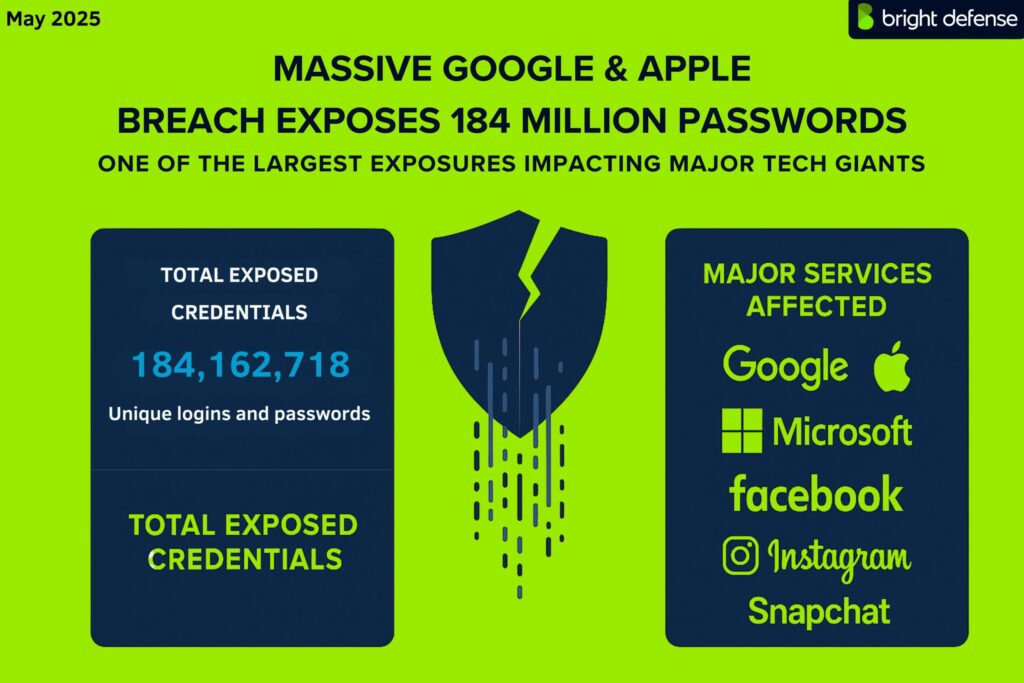
Snapchat claimed it found no signs of a breach on its own systems. But Fowler verified the data by contacting people listed in the dump. Many said the leaked credentials were accurate.
After Fowler reported the issue, the hosting provider took the database offline. No one knows who owned it or whether it was leaked by mistake or dumped intentionally.
Fowler warned that email accounts often store tax documents, contracts, medical records, and other personal files. He recommended deleting old sensitive messages and using encrypted storage for sharing important files.
Bottom line: change your passwords, turn on multi-factor authentication, and don’t trust your inbox to protect your private data. (New York Post)
2. SAP NetWeaver Breach: 581 Critical Systems Compromised by China-Linked APTs
Multiple China-based threat groups have exploited a recently disclosed vulnerability in SAP NetWeaver (CVE-2025-31324) to breach at least 581 critical systems globally. The flaw allows unauthenticated file uploads and remote code execution. Targets include infrastructure operators in the UK and US, such as gas, water, and medical manufacturing sectors, as well as Saudi government ministries.

Dutch cybersecurity firm EclecticIQ attributed the attacks to groups UNC5221, UNC5174, and CL-STA-0048. Attackers deployed web shells, reverse shells, and malware such as PlugX, KrustyLoader, SNOWLIGHT, VShell, and GOREVERSE. An exposed server tied to the campaign contained event logs and targeting lists, revealing both compromised assets and future plans.
SAP patched the flaw in May 2025. Security experts urge immediate updates to NetWeaver systems amid ongoing active exploitation and the discovery of an additional vulnerability, CVE-2025-42999, affecting the platform’s Visual Composer Metadata Uploader. (The Hacker News)
3. PowerSchool Breach: Data of 62.4 Million Students Exposed
PowerSchool, a major K-12 education tech provider, suffered a data breach in December 2024 affecting 62.4 million students and 9.5 million educators. The company paid a ransom to prevent the release of sensitive data, but hackers have resumed extortion attempts as of May 2025.
Hackers are now emailing school officials across the U.S. and Canada, demanding bitcoin payments. Exposed data includes Social Security numbers, medical records, and special education information.

In North Carolina, staff from at least 20 school districts received threats. The state plans to stop using PowerSchool in July and switch to Infinite Campus due to security concerns. PowerSchool confirmed that the attackers did not honor the original agreement to delete stolen data. Law enforcement in the U.S. and Canada is investigating. (The 74 Million)
Compliance plays a key role in protecting data and reducing risk. Explore 150 compliance stats that show how organizations handle regulations, audits, and the growing pressure to stay secure and compliant.
What Should I Do First After Receiving a Data-Breach Notification?
Below is a practical, step-by-step playbook for the first actions to take after you receive a data-breach notification—optimized to reduce account takeover risk and identity-fraud impact.
1) Confirm the notification is real (before clicking anything)
- Do not click links or open attachments in the email/SMS.
- Go to the company’s official website (type it in yourself) and look for a breach notice in your account dashboard or support page.
- If you must call, use a phone number from the company’s official site—not the message.
2) Identify what was exposed and what account it maps to
From the notice, capture:
- The service/account affected and the date range of exposure
- Data types (e.g., email, password, phone, address, NID/SSN, payment card, bank details, security questions)
- Whether passwords were hashed (still treat it seriously)
Write this down or screenshot it for records.
3) Secure the breached account immediately
- Change the password right away (make it unique and long).
- Turn on MFA/2FA (an authenticator app is typically stronger than SMS).
- Log out of other sessions (most services have “Sign out of all devices”).
- Review: account email/phone, recovery options, connected apps, forwarding rules (email), and any “trusted devices.”
Why this matters: Credential abuse remains a primary path to compromise—Verizon reports compromised credentials were an initial access vector in 22% of breaches reviewed in its 2025 DBIR research. Verizon
4) If you reused that password anywhere, change those next
Attackers often try the same email/password pair across banks, email, social, and shopping sites.
- Prioritize: email, financial accounts, mobile wallet, cloud storage, social media
- Use a password manager if possible to avoid reuse.
5) Watch for “breach follow-on” scams (phishing and fake support)
Expect emails like “confirm your refund,” “verify your identity,” “download your compensation form,” etc.
- Never share OTPs, recovery codes, or remote-access permissions.
- If someone contacts you “from the company,” hang up and call back using the official number.
6) Lock down financial exposure (based on what data was leaked)
- If card data may be exposed: call your bank/card issuer, request a replacement card, and set transaction alerts.
- If bank/mobile wallet access is at risk: change PINs, enable MFA, reduce transfer limits temporarily if available, and monitor transaction history.
7) Take identity-protection steps if sensitive ID data was exposed
If the breach involved government ID numbers, full DOB, or similar:
- Consider a credit freeze or fraud alert where available in your country (in the U.S., this is done via the 3 major credit bureaus).
- Obtain and review your credit report(s) if your jurisdiction supports it.
Context: Identity theft is common at scale—the FTC reported more than 1.1 million identity theft reports via IdentityTheft.gov in 2024. Federal Trade Commission
8) Monitor continuously for the next 30–90 days
- Review bank/credit statements weekly (daily at first if high risk).
- Watch for: password reset emails you didn’t request, new logins/devices, new payees, address changes, SIM-swap symptoms (sudden loss of mobile service).
9) Use any remediation the company offers (but validate it)
If the notice offers free monitoring, ID restoration, or support:
- Confirm it’s legitimate via the company’s official channels.
- Keep a record of enrollment confirmations and case numbers.
10) Document everything
Save:
- The breach notice, timeline, steps you took, receipts/case IDs
This is useful if fraudulent activity appears later.
Fast prioritization (if you only do 3 things today)
- Change password + enable MFA on the breached account (and your email).
- Change reused passwords on financial/mobile wallet accounts.
- Turn on transaction/login alerts and monitor closely.
FAQ
No, not always. Public disclosure timing depends on the type of organization, the laws that apply, and when the company confirms material facts. The FTC notes that breach notification duties vary across jurisdictions, and public companies may also face SEC disclosure rules for material incidents.
Yes, official sources are the best first check. Good starting points include company notices, regulator portals, and government breach pages such as HHS for HIPAA-covered incidents, Maine AG breach notices, and state attorney general breach notice repositories like California’s sample notice system.
Yes, you can check. Have I Been Pwned offers email checks and breach notifications, and its “Notify Me” feature lets users sign up for alerts when their email appears in new breaches.
Definitely act quickly. Start with the steps listed in the notice, change your password for the affected account, turn on multi factor authentication if available, and review your financial or account activity for unusual changes. The FTC also directs consumers to IdentityTheft.gov/databreach for breach-specific next steps.
Not always. A credit freeze is often more important when sensitive data like Social Security numbers or other identity data was exposed, while a password reset and account monitoring may be enough for lower-risk cases. The FTC guidance points readers to follow-up steps based on the type of information exposed.
Recent widely reported examples include the Abu Dhabi Finance Week (ADFW) document leak reported by Reuters on February 17, 2026 (more than 700 passports and IDs exposed via a third party storage environment), Nike investigating a claimed leak on January 26, 2026, Under Armour investigating a breach report affecting customer email addresses (AP report in January 2026), and the ongoing fallout from the Coupang breach in South Korea, which officials later said affected about 33.7 million customers.
If you mean the biggest data breaches by records compromised, a commonly cited March 2025 TechTarget ranking lists: Yahoo (3B), National Public Data (2.9B), Real Estate Wealth Network (1.5B), Aadhaar (1.1B), Shanghai Police (1B), First American Financial (885M), Indian Council of Medical Research (815M), Onliner spambot (711M), Ticketmaster (560M), and Yahoo 2014 breach (500M). Rankings can change depending on method and source.
Very recent breaches like Allianz Life in July 2025 and Qantas were caused by social engineering targeting third party platforms rather than internal systems. In these cases, attackers tricked staff into granting access, exposing millions of records
Yahoo. In 2013, hackers stole data from 3 billion accounts.
(Source:Wikipedia)
Sony PlayStation Network in 2011. Hackers stole personal data from 77 million users.
(Source:Wikipedia)
Yes. In June 2024, hackers accessed internal Apple tools. In February 2025, a passcode bypass flaw exposed iPhones to attacks.
(Sources: Forbes, New York Post)
Start with the organization’s official notice (and your account dashboard). For email exposure checks, services like Have I Been Pwned let you see whether an email address appears in known breach datasets. Some nonprofits also offer breach-alert subscriptions when an organization you use issues a public notice.
OpenAI has experienced security incidents, but whether it was “hacked” depends on definition. In March 2023, a bug exposed some users’ chat history titles and limited billing details for a small subset of Plus users. In November 2025, OpenAI disclosed a third-party analytics incident affecting some developer and API data, not ChatGPT passwords or payment details. Reuters also reported a 2023 intrusion into OpenAI’s internal messaging systems.
There is no confirmed single leaker. Reporting indicates that researchers identified multiple exposed datasets totaling roughly 16 billion credential records. These appear to be aggregated from many prior breaches and info-stealer malware logs, with significant duplication expected. This is best understood as a massive compilation of previously compromised data that became exposed, not one new breach of major platforms.
“Pwned” usually means your data, such as an email address or other attributes, appeared in a breach or leak. It does not automatically mean someone currently controls your account. It indicates exposure that could be used for phishing, credential stuffing, or account takeover attempts.
Generally, yes, if you use the official site. Have I Been Pwned is a well-known breach notification service and does not ask for your password to check an email address. Its Pwned Passwords feature uses privacy-preserving k-anonymity, meaning you do not submit a full password. As with any service, verify the domain and avoid look-alike links.
Usually, no. Deleting an email can disrupt access to many accounts and does not erase data that has already leaked. A better response is to change passwords, especially reused ones, enable multi-factor authentication, review recovery settings, and monitor for fraud. Creating a new email may make sense only if targeting is persistent and you can safely migrate accounts.
Several companies have disclosed data breaches recently, reflecting ongoing cyber risk across industries. Aflac reported a breach affecting millions of customers, with notifications updated in late 2025. Coupang disclosed unauthorized access to customer data, prompting regulatory scrutiny and lawsuits. Financial firms Prosper Marketplace and 700Credit also reported incidents impacting large numbers of records. Nissan confirmed customer data exposure linked to a third-party vendor breach. In addition, universities, healthcare providers, and retailers have continued to report breaches, underscoring persistent threats, especially from supply-chain vulnerabilities and credential compromise.
You can test whether your phone is compromised by using reputable mobile security apps and basic hygiene checks. Trusted options include Norton, Bitdefender, Malwarebytes, and Kaspersky, all of which offer strong malware detection, phishing protection, and risky-app alerts. Always download from official app stores, keep your OS updated, review app permissions, and enable multi-factor authentication.
Removing personal information from the web requires a mix of manual actions and specialized services. Data brokers collect and resell details such as names, addresses, phone numbers, and profiles, which are difficult to track individually. Services like DeleteMe handle this by continuously identifying data brokers and submitting opt-out requests on your behalf, with ongoing monitoring. Similar reputable alternatives include OneRep, Kanary, and Privacy Bee. You should also manually remove old accounts, adjust social media privacy settings, and opt out of people-search sites. While removal is not permanent, these services significantly reduce exposure and help limit future data misuse.
Often, yes. Senders can use tracking pixels that report when an email is opened, along with timing and device signals when images load. Some systems also use read receipts, which may require your approval depending on settings. To reduce tracking, disable remote image loading or use privacy features in your email client.
Not with an email address alone. However, it can be used for phishing, password-reset attempts, or account takeover if your email inbox is compromised or you reuse passwords. Protect your email with MFA, use unique passwords for email and banking, and enable bank alerts for logins, transfers, and new payees.
Common red flags include unexpected attachments or links, especially invoices, documents, ZIP files, or macro-enabled files; urgent or threatening language pushing immediate action; and sender or domain mismatches, or requests for passwords or sensitive personal information via email.
You are usually fine. Most compromises require clicking a link, opening an attachment, or entering credentials. Opening an email may still confirm your address is active or trigger tracking pixels if images load. Close the message, avoid suspicious unsubscribe links, mark it as spam, and run a malware scan if you opened an attachment
Get In Touch