CMMC for Small Business
Updated:
October 7, 2026
CMMC requires small defense contractors to demonstrate that they meet the cybersecurity requirements specified in applicable contracts.
The Cybersecurity Maturity Model Certification (CMMC) program verifies safeguards for Federal Contract Information (FCI) and Controlled Unclassified Information (CUI). Business size alone does not determine the required level or assessment type.
For small businesses, preparation starts with understanding contract requirements, defining which systems need protection, and addressing gaps in existing safeguards.
This guide explains CMMC levels, assessment obligations, practical preparation steps, and ongoing responsibilities for maintaining compliance.
Why CMMC Matters for Small Businesses
CMMC helps small defense contractors protect government information and meet cybersecurity requirements for applicable contracts. Its value includes clearer security responsibilities, assessment preparation, and evidence of implemented safeguards.
The following four benefits explain why CMMC matters for small businesses.
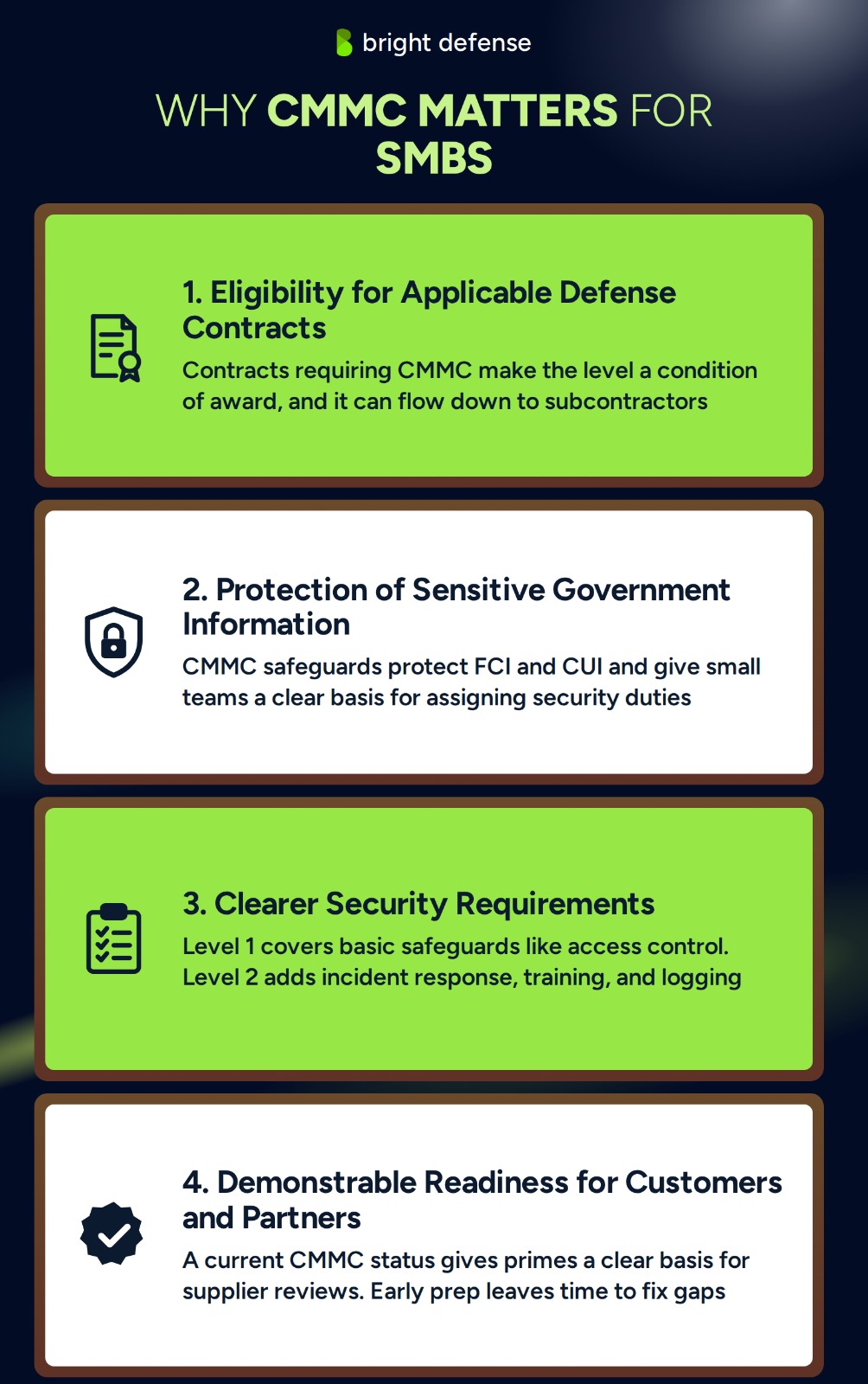
1. Eligibility for Applicable Defense Contracts
A current CMMC status is a condition of award when the solicitation requires it. Small businesses must meet the specified level and assessment requirements for the systems involved in contract performance.
This obligation can extend to subcontractors handling government information. CMMC does not require third-party certification for every defense contract, and meeting its requirements does not guarantee an award.
2. Protection of Sensitive Government Information
CMMC safeguards address unauthorized access, malicious code, insecure communications, and other threats to Federal Contract Information (FCI) and Controlled Unclassified Information (CUI).
For a small business with limited staff, defined requirements provide a basis for assigning security responsibilities and addressing gaps. Implementation costs and effort depend on the required level, assessment scope, and existing safeguards.
3. Clearer Security Requirements
CMMC gives contractors specific requirements and assessment objectives against which to evaluate their practices. Level 1 covers foundational safeguards such as access restrictions, identity verification, physical protection, and malicious code protection.
Level 2 adds requirements for incident response, security training, audit logging, risk assessment, and other areas. Understanding these distinctions helps businesses plan the work required for their contracts.
4. Demonstrable Readiness for Customers and Partners
Maintaining the required CMMC status gives contracting organizations and prime contractors a defined basis for checking cybersecurity eligibility. Current evidence and completed assessments can reduce uncertainty during supplier reviews.
Preparing before a contract deadline gives small businesses time to correct deficiencies, organize documentation, and assign ongoing responsibilities. This supports readiness for future opportunities that require the same CMMC level and assessment scope.
Understanding CMMC Levels
CMMC defines three security levels based on the information contractors handle and the requirements of their contracts. Each level has a distinct security baseline and assessment process.
| CMMC Level | Security Requirements | Assessment Requirements Under the Rule |
|---|---|---|
| Level 1: Foundational | It protects Federal Contract Information (FCI) through 15 FAR 52.204-21 safeguards, commonly mapped to 17 CMMC practices. | Organizations complete annual self-assessments and annual affirmations of compliance. |
| Level 2: Advanced | It protects Controlled Unclassified Information (CUI) through 110 requirements from NIST SP 800-171 Revision 2. | Organizations complete a self-assessment or C3PAO certification assessment every three years, with annual affirmations. |
| Level 3: Expert | It adds 24 selected NIST SP 800-172 requirements to the Level 2 baseline for designated programs facing advanced persistent threats. | Organizations undergo government-led DIBCAC assessments every three years, with annual affirmations. Final Level 2 C3PAO status is a prerequisite for the applicable scope. |
Small businesses preparing for Level 2 can use NIST SP 800-171 consulting support to evaluate gaps, document implementation, and organize assessment evidence.
Businesses That Need CMMC 2.0 Compliance
CMMC requirements apply to defense contractors and subcontractors when their contracts require a CMMC status for systems handling Federal Contract Information (FCI) or Controlled Unclassified Information (CUI). Company size and industry alone do not determine applicability.
The following six business categories illustrate how these obligations can arise.
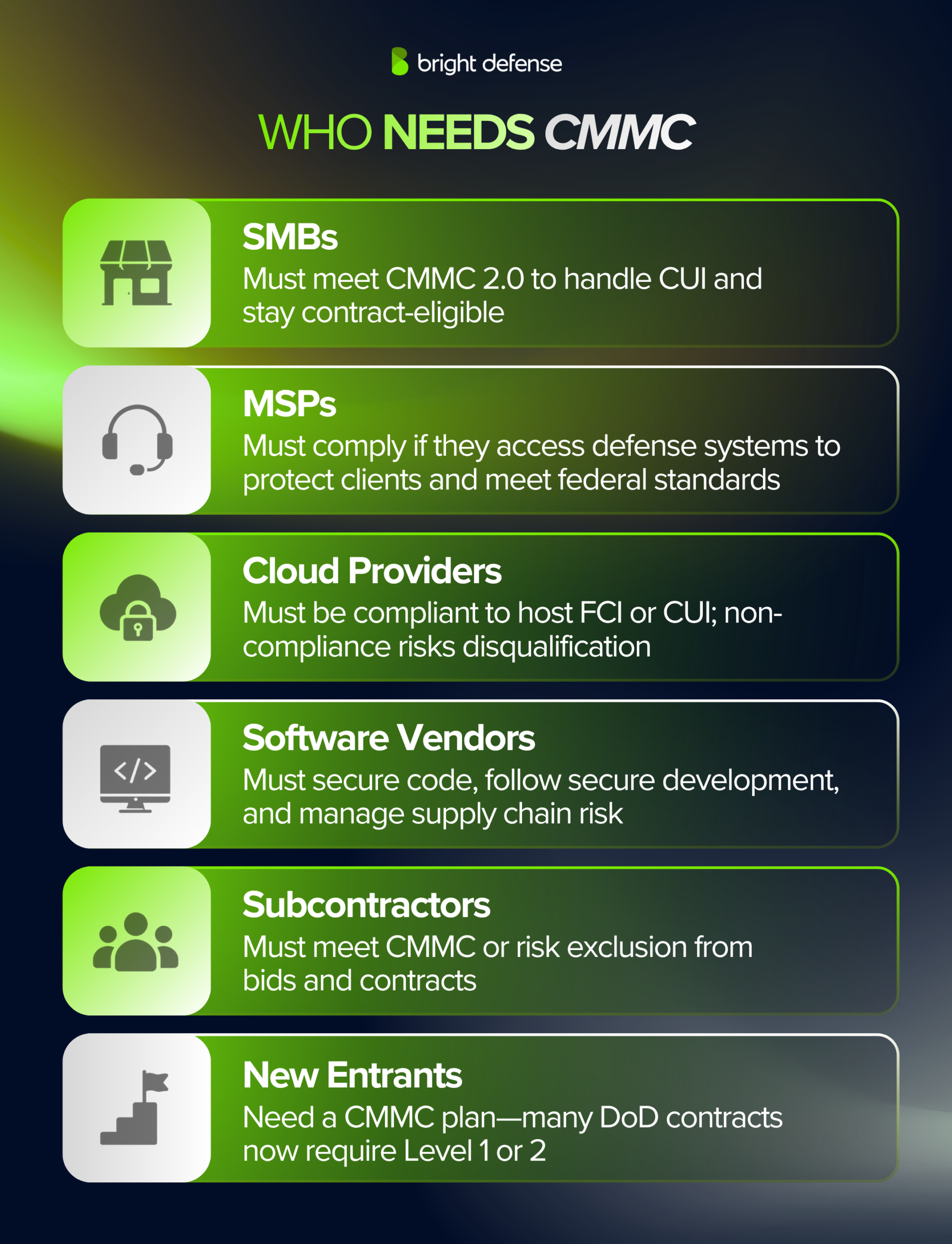
1. Small and Medium-Sized Businesses Handling Government Information
Manufacturers, engineering firms, consultants, and other small businesses may need CMMC status when their defense work involves FCI or CUI. Level 1 protects FCI, while Level 2 addresses CUI under applicable contractual requirements.
Businesses should confirm the required level and assessment type before planning compliance work. Handling commercially sensitive information alone does not establish a CMMC obligation.
2. Managed Service Providers Supporting Defense Contractors
Managed Service Providers (MSPs) can fall within a customer’s assessment scope when their services handle CUI or security protection data, such as relevant security logs and configurations.
Independent CMMC certification is not automatically required for every MSP. Relevant services can be assessed within the contractor’s assessment, while separate subcontract requirements may impose additional obligations. Responsibilities and evidence access should be documented.
3. Cloud Service Providers Handling CUI
Cloud offerings used to process, store, or transmit CUI must satisfy applicable FedRAMP Moderate authorization or equivalency requirements. Contractors must verify the specific service offering and their own configuration responsibilities.
Cloud services handling only FCI do not automatically require FedRAMP Moderate. Services handling security protection data without CUI receive different assessment treatment within the customer’s scope.
4. Software Vendors With Applicable Contractual Obligations
Software vendors may need CMMC status when their defense contracts or subcontracts involve handling FCI or CUI. Supplying an application to a defense contractor does not automatically trigger certification.
The vendor’s information flows, service model, and contractual requirements determine applicable CMMC security controls. Acquisitions solely for commercially available off-the-shelf products have a specific exclusion from CMMC contract-clause requirements.
5. Subcontractors Handling FCI or CUI
CMMC obligations can extend through multiple subcontracting tiers, including businesses without a direct government contract. Prime contractors must pass applicable requirements to subcontractors handling FCI or CUI.
The required status depends on the subcontracted work, information involved, and applicable flow-down requirements. A subcontractor does not automatically need the same CMMC level as its prime contractor.
6. New Entrants Pursuing Defense Contracts
Startups and first-time bidders should review target solicitations for CMMC requirements early. Preparation includes determining the information involved, defining system boundaries, and budgeting for safeguards and assessments.
Not every defense opportunity requires certification. Level 1 uses self-assessment, and Level 2 has distinct assessment paths. New entrants should follow current solicitation requirements and implementation guidance rather than assume one assessment type applies to all opportunities.

The Costs of CMMC Compliance
CMMC compliance costs depend on your required level, assessment scope, existing safeguards, and the work needed to address deficiencies. Small business size alone does not determine which level applies.
A realistic budget should account for security improvements, assessment preparation, staff time, and ongoing maintenance. Our CMMC cost statistics compare DoD’s assessment cost models with contractor spending on preparation and ongoing compliance.
The following three sections explain the cost considerations for each level.
CMMC Level 1 Costs
Level 1 protects Federal Contract Information (FCI). Its basic safeguards cover access restrictions, user authentication, physical security, malware protection, and other foundational measures.
Businesses with these safeguards already operating may need limited technology spending. Others may need endpoint protection, supported operating systems, physical access improvements, or changes to network configurations. Staff time for reviewing implementation and gathering evidence remains a cost even when existing tools are sufficient.
The DoD’s 2024 final rule estimated annual Level 1 assessment and affirmation costs of $5,977 for a small entity. This planning estimate includes preparation, assessment, reporting, and affirmation activities. It excludes the cost of implementing the underlying safeguards and is not a government fee or a current service quote.
Level 1 requires an annual self-assessment and affirmation through the Supplier Performance Risk System (SPRS). A third-party certification assessment is not required. MFA and security awareness training can support better security, but neither is a standalone Level 1 requirement.
Bright Defense can help evaluate your CMMC readiness, document existing safeguards, and plan corrective work before submission.
CMMC Level 2 Costs
Level 2 protects Controlled Unclassified Information (CUI) through 110 security requirements from NIST SP 800-171 Revision 2. Budget considerations may include MFA, secure CUI storage and sharing, logging, vulnerability management, employee training, and System Security Plan documentation.
The 2024 final rule provides two small-entity assessment estimates:
| Assessment Route | Estimated Three-Year Cost |
|---|---|
| Level 2 self-assessment and affirmations | $37,196 |
| Level 2 C3PAO assessment and affirmations | $104,670 |
These estimates include preparation, assessment participation, reporting, and annual affirmations. They exclude implementation and remediation costs. The certification estimate includes internal and external support costs alongside the assessor’s work.
Confirm the assessment route required by your applicable solicitation or contract before commissioning an assessment. Request separate estimates for readiness consulting, corrective work, assessment services, and recurring security operations.
CMMC Level 3 Costs
Level 3 adds 24 selected requirements from NIST SP 800-172 to the Level 2 foundation. Its budget must account for the prerequisite Level 2 certification, additional safeguards, specialized staff support, and ongoing operation of those safeguards.
Level 3 assessments are conducted by the government’s Defense Industrial Base Cybersecurity Assessment Center (DIBCAC). Contractors still incur costs for preparation, evidence collection, staff participation, and corrective work.
A quoted assessment figure alone cannot represent the total cost of Level 3 compliance. Build the budget around the systems in scope and the additional capabilities required, then separate initial implementation costs from recurring expenses.
Maintaining CMMC Compliance for Small Businesses
CMMC helps small businesses protect sensitive defense information and meet cybersecurity requirements for applicable DoD contracts. Preparation starts with confirming the required level, defining the assessment scope, and correcting security gaps.
Maintaining compliance requires effective safeguards, current evidence, timely assessments, and annual affirmations. Budgeting for these ongoing responsibilities supports contract readiness and reduces cybersecurity risk.
Bright Defense Provides CMMC Compliance Support
Bright Defense helps small businesses prepare for and maintain CMMC Level 1 and Level 2 compliance through monthly services that combine expert guidance with compliance automation. Support includes gap assessments, remediation planning, policy development, and assessment preparation.
Virtual Chief Information Security Officer (vCISO) services and managed security awareness training help businesses assign security responsibilities and maintain ongoing safeguards. Bright Defense supports organizations working toward SOC 2, HIPAA, ISO 27001, and applicable NIST requirements.
Contact Bright Defense to discuss your required CMMC level, current security practices, and preparation needs.
FAQs: CMMC and System Security Compliance
1. What Is CMMC, and Which Defense Contractors Must Comply?
The Cybersecurity Maturity Model Certification (CMMC) program assesses safeguards for Federal Contract Information (FCI) and Controlled Unclassified Information (CUI). Requirements apply to contractors and subcontractors through applicable DoD contracts. The required level depends on contractual obligations and the information handled, regardless of business size.
2. Do Managed Service Providers Need CMMC Certification?
Managed service providers (MSPs) can fall within a contractor’s assessment scope when their services handle CUI or provide security protection. Requirements depend on the services, data, and contractual arrangements. Supporting a defense contractor does not automatically require every MSP to obtain a separate CMMC certification.
3. How Does CMMC Relate to Federal Security Requirements?
CMMC verifies implementation of existing federal safeguards. Level 1 uses the 15 safeguarding requirements in FAR 52.204-21. Level 2 uses 110 requirements from NIST SP 800-171 Revision 2. Level 3 adds 24 selected requirements from NIST SP 800-172 to the Level 2 foundation.
4. Which Security Practices Does CMMC Cover?
CMMC requirements cover access control, user authentication, media protection, physical security, communications protection, and system integrity. Level 2 includes further requirements for training, logging, configuration management, incident response, maintenance, personnel security, risk assessment, and security assessment. The applicable level determines which requirements must be implemented.
5. How Often Must Contractors Complete CMMC Assessments?
Level 1 requires annual self-assessments, while Level 2 assessments generally follow a three-year cycle. Contractors must maintain applicable safeguards throughout contract performance and submit annual affirmations of continuing compliance. Security practices and documentation need updates when systems, risks, or requirements change.
6. What Is a System Security Plan Under CMMC?
A System Security Plan (SSP) describes system boundaries, operating environments, security implementation, and connections to other systems. CMMC Levels 2 and 3 require an SSP; Level 1 does not. The document must reflect actual implementation and receive periodic updates. Planned improvements alone do not demonstrate compliance.
7. How Can MSPs Help Contractors Meet CMMC Requirements?
MSPs can support secure configurations, access management, patching, monitoring, and evidence collection. Contractors should document shared responsibilities and verify that provider services satisfy applicable requirements. Outsourcing security operations leaves the contractor responsible for its own compliance status and affirmations.
8. Can Organizations Adopt Security Measures Beyond CMMC Requirements?
Organizations can adopt further safeguards based on their risks, customer obligations, and operational needs. Examples include phishing-resistant authentication, immutable backups, and additional penetration testing where appropriate. These measures support security beyond the applicable baseline but do not replace required CMMC safeguards or assessment evidence.