Drata vs Vanta: A Comprehensive Comparison
Updated:
September 27, 2026
Keeping up with compliance requirements has become a core part of running a secure and trustworthy business. Platforms like Drata and Vanta offer software that simplifies the process, helping teams meet frameworks such as SOC 2, ISO 27001, and HIPAA with less manual work.
This blog compares Drata and Vanta in practical terms. It covers how each tool works, where they differ, and what kinds of teams benefit most from each. Drata centers on automated control tracking and workflow efficiency. Vanta focuses on continuous monitoring and real-time visibility. Both tools reduce the overhead of audits, but the details matter when deciding which fits your environment.
Whether you’re starting from scratch or replacing spreadsheets, this comparison gives you a clear picture of what to expect from each platform.
Drata vs. Vanta: Company Overviews
Drata and Vanta provide compliance automation and trust management software. The following overviews explain their backgrounds, platform capabilities, and business growth:
Drata Company Overview
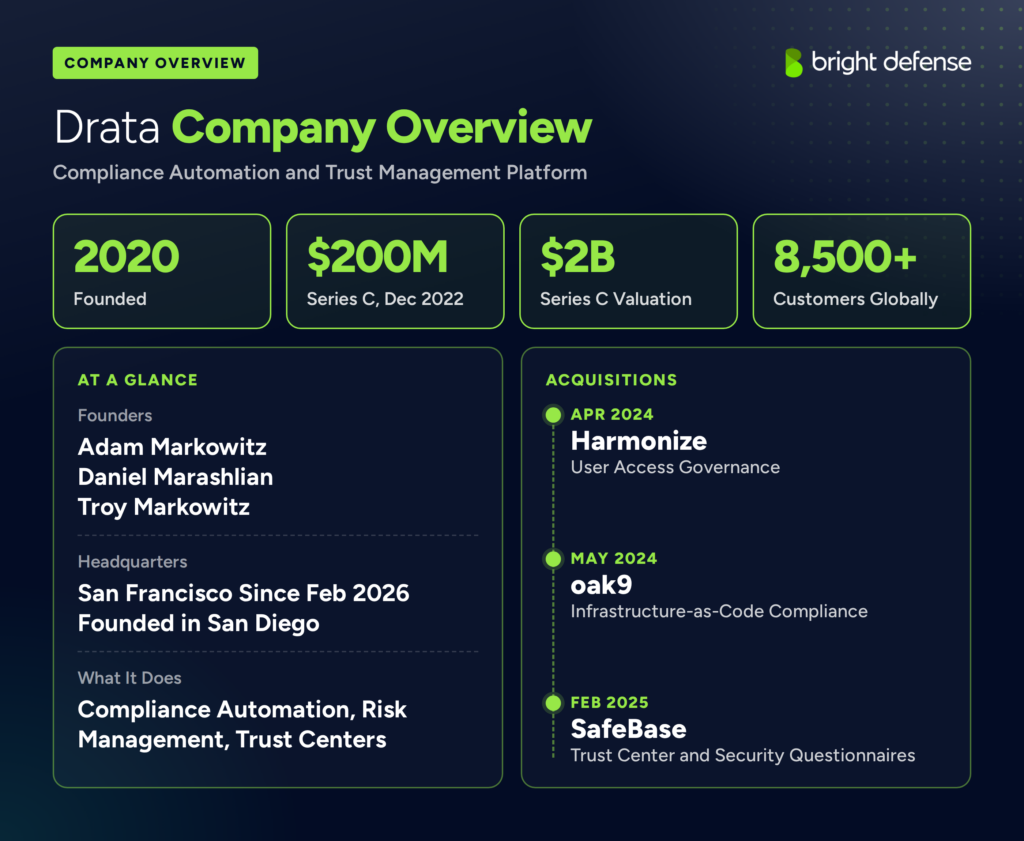
Drata is a compliance automation and trust management platform founded in 2020 by Adam Markowitz, Daniel Marashlian, and Troy Markowitz. It helps organizations collect audit evidence, monitor security controls, and manage compliance work across teams.
Originally focused on SOC 2 automation, Drata now supports compliance programs covering SOC 2, ISO 27001, ISO 42001, HIPAA, GDPR, and PCI DSS. Its platform has expanded to include internal and third-party risk management, Trust Centers, and AI-assisted security questionnaires.
Funding and Expansion
- Series C Funding: $200 million, announced in December 2022.
- Series C Valuation: $2 billion at the time of that round.
- Customers: 8,500+ globally, listed on Drata’s current website.
- Headquarters: Opened a San Francisco headquarters in February 2026, expanding beyond its San Diego origins.
Drata acquired Harmonize in April 2024 to expand its user access governance capabilities, followed by oak9 in May 2024 to strengthen infrastructure-as-code compliance testing. Its February 2025 acquisition of SafeBase expanded its Trust Center and security questionnaire capabilities.
Key Features and Services of Drata
- Automated Control Monitoring: Runs checks against connected systems and flags changes that affect control status.
- Evidence Collection: Collects evidence from integrated tools and organizes it for audit preparation.
- Custom Controls and Framework Mapping: Supports organization-specific controls and maps evidence across compliance requirements, reducing duplicate work.
- Software Integrations: Connects with hundreds of cloud, identity, HR, development, and security tools.
- Compliance as Code: Checks infrastructure code for compliance gaps during development, helping teams address issues before deployment.
- Risk Management: Supports internal risk tracking and third-party assessments, including AI-assisted vendor review workflows.
- Customer Assurance: Provides Trust Centers for sharing security documentation and AI assistance for answering customer security questionnaires. Feature availability depends on the selected plan and add-ons.
Vanta Company Overview
Vanta is a compliance automation and trust management platform founded in 2018 by Christina Cacioppo and Erik Goldman. Headquartered in San Francisco, the company serves startups, growing businesses, and large enterprises.
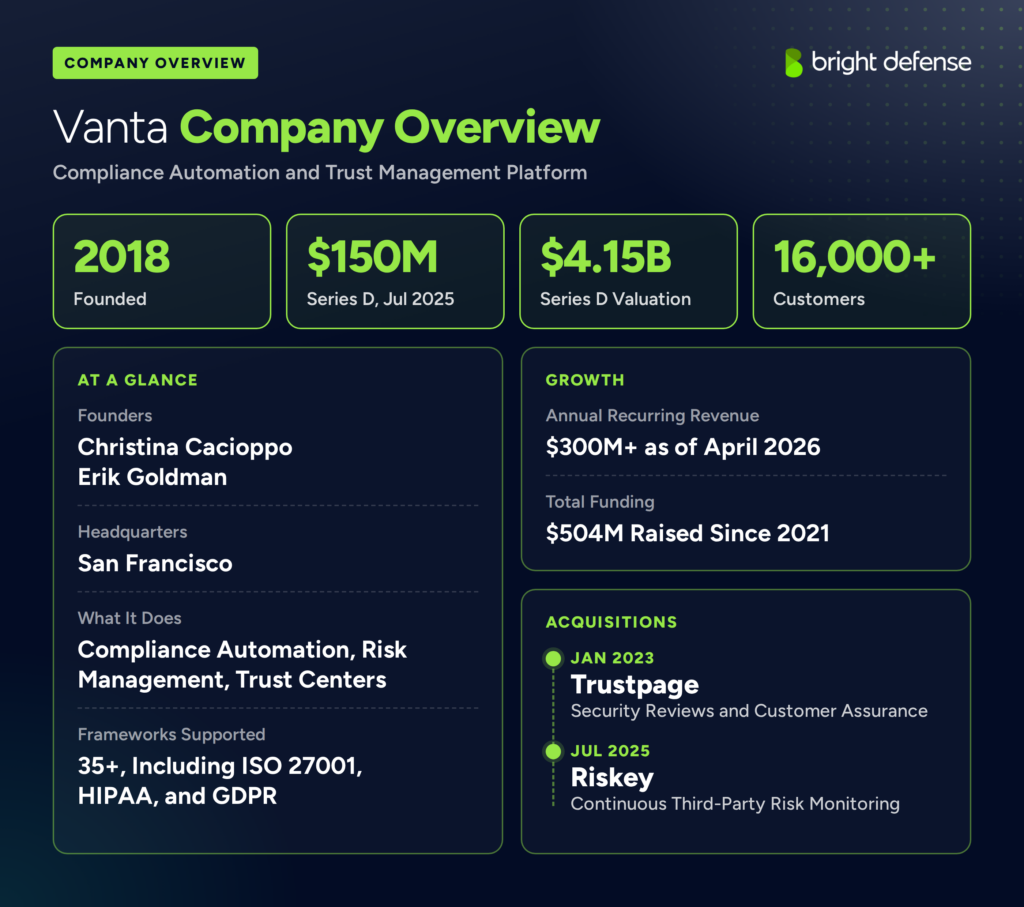
Vanta began by helping startups automate SOC 2 compliance and now supports more than 35 frameworks, including ISO 27001, HIPAA, and GDPR, alongside custom frameworks and controls. Its platform combines evidence collection, continuous control monitoring, audit workflows, and risk management to help teams maintain audit readiness.
Funding and Growth
- Valuation: $4.15 billion at its July 2025 Series D.
- Total Funding: $504 million raised since 2021, as disclosed with that round.
- Latest Announced Round: $150 million Series D in July 2025, led by Wellington Management, with participation from Sequoia Capital, Goldman Sachs Alternatives, J.P. Morgan, and other investors.
- Customers: More than 16,000 organizations.
- Annual Recurring Revenue: Surpassed $300 million in April 2026.
Vanta acquired Trustpage in January 2023 to expand its security review and customer assurance capabilities. It acquired Riskey in July 2025 to strengthen continuous third-party risk monitoring.
Key Features and Services
- Automated Control Monitoring: Runs automated checks against connected systems and maps results to relevant compliance controls.
- Evidence Collection: Collects evidence across cloud infrastructure, devices, identity systems, and business tools to reduce manual audit preparation.
- Framework and Control Customization: Supports predefined and custom frameworks, with control mapping to reduce duplicate work across standards.
- Risk Management: Connects internal risk registers, control information, vendor assessments, and continuous third-party monitoring.
- Customer Assurance: Provides Trust Centers for sharing security documentation and questionnaire automation for responding to customer reviews.
- AI-Powered Workflows: Uses the Vanta Agent to assist with evidence review, policies, vendor assessments, and other compliance tasks.
- Software Integrations: Supports 400+ integrations across cloud infrastructure, identity, HR, development, and security tools.
Both Drata and Vanta combine compliance automation, risk management, and customer assurance. The following feature comparison examines how their capabilities fit different operational needs.
Key Features Comparison
| Frameworks | Drata | Vanta |
|---|---|---|
| SOC 2 | ✅ | ✅ |
| HIPAA | ✅ | ✅ |
| GDPR | ✅ | ✅ |
| CCPA / CPRA | ✅ | ✅ Through USDP |
| PCI DSS | ✅ | ✅ |
| Cyber Essentials | ✅ | ✅ |
| CMMC | ✅ | ✅ |
| Microsoft SSPA | ✅ Requirements Only | ✅ |
| NIST CSF 2.0 | ✅ | ✅ |
| NIST SP 800-53 | ✅ | ✅ |
| NIST SP 800-171 | ✅ | ✅ |
| NIST AI RMF | ✅ | ✅ |
| FFIEC | ✅ Requirements Only | Not Publicly Listed |
| CSA Cloud Controls Matrix (CCM) | ✅ | Not Publicly Listed |
| ISO 27001 | ✅ | ✅ |
| ISO 27017 | ✅ | ✅ |
| ISO 27018 | ✅ | ✅ |
| ISO 27701 | ✅ | ✅ |
| ISO 42001 | ✅ | ✅ |
| Custom Frameworks | ✅ | ✅ |
| FedRAMP | ✅ | ✅ |
| NIS 2 | ✅ | ✅ |
| SOX ITGC | ✅ Requirements Only | ✅ |
| AWS Foundational Technical Review (FTR) | Not Publicly Listed | ✅ |
| Minimum Viable Secure Product (MVSP) | Not Publicly Listed | ✅ |
| Open Finance Data Security Standard (OFDSS) | Not Publicly Listed | ✅ |
| Essential Eight | ✅ | ✅ |
| CIS Critical Security Controls | ✅ | ✅ |
| APRA CPS 234 | Not Publicly Listed | ✅ |
| Digital Operational Resilience Act (DORA) | ✅ | ✅ |
| EU AI Act | Not Publicly Listed | ✅ |
| Title 23 NYCRR Part 500 / NYDFS | ✅ | ✅ |
| US Data Privacy (USDP) | Not Publicly Listed | ✅ |
Supported Frameworks by Drata and Vanta as of September 27, 2026, based on their public framework catalogs and product documentation.
✅ indicates publicly listed framework support. “Requirements Only” means Drata provides the requirements, but customers must map them to existing or custom controls. “Not Publicly Listed” means a dedicated framework was not verified in the vendor’s current catalog; custom configuration may be available. Framework availability, versions, and automation coverage depend on the subscription and implementation.
Vanta has a clear advantage in terms of the number of supported frameworks. Both support the most commonly used frameworks with the ability to import your own custom frameworks.
Integration Capabilities
Integrations determine how effectively a platform can automate and manage compliance across your existing systems. Both Drata and Vanta connect with HR systems, identity providers, device management tools, cloud infrastructure, version control systems, and task management platforms. The most useful comparison is which evidence each connector collects and which workflows it supports.
Both platforms also offer APIs that support reading and updating compliance data. Drata’s API supports evidence creation, updates, and uploads, while Vanta’s API supports document creation and evidence uploads. Compare the specific operations your team needs before choosing either platform for custom automation.
Drata vs Vanta Integrations Capabilities
Drata Integration Capabilities
- Integration Coverage: Drata offers hundreds of integrations across categories such as cloud infrastructure, HR, identity management, vulnerability scanning, and user access reviews. These connections help bring security and compliance information into one platform.
- Cloud and Development Tools: Its catalog includes infrastructure connections such as AWS and Azure, alongside version control and ticketing tools. Connector capabilities vary, so check which resources, settings, and evidence each integration supports.
- Personnel Imports: Drata supports CSV-based personnel imports for organizations using an unsupported identity provider. This option requires manual updates and cannot be combined with a synced identity provider connection.
- API Automation: Drata’s API supports retrieving, creating, updating, and deleting evidence, as well as uploading supporting files. These capabilities let teams automate evidence management alongside reporting.
Vanta Integration Capabilities
- Integration Coverage: Vanta’s integration catalog covers cloud providers, HR systems, identity providers, endpoint security, CRM platforms, and vulnerability scanners. Its integrations support infrastructure and application evidence collection as well as personnel monitoring.
- Cloud and Development Tools: Vanta connects with AWS, Azure, and Google Cloud. Its GitHub integration collects information about repositories, pull requests, and vulnerabilities, while Jira supports ticket evidence and automated ticketing workflows.
- Personnel Management: Vanta can synchronize personnel through an identity provider and enrich records with HR data. Administrators can also add personnel manually, including contractors who are missing from the identity provider.
- API Automation: Vanta’s API lets teams retrieve compliance information, create documents, and upload evidence, supporting custom audit preparation workflows.
- Manual Asset Tracking: Vanta supports adding custom inventory items individually or through bulk uploads. Available fields include ownership, descriptions, and information about stored user data and electronic protected health information.
When comparing platforms, ask each vendor to demonstrate your most important integrations using representative workflows. For specialized requirements such as StateRAMP compliance, confirm that the proposed setup captures the evidence your assessment requires.
User Interface and Experience
Vanta vs Drata Ease of Use
The user interfaces of Drata vs Vanta play a crucial role in how users interact with their respective platforms, impacting overall user experience and satisfaction.
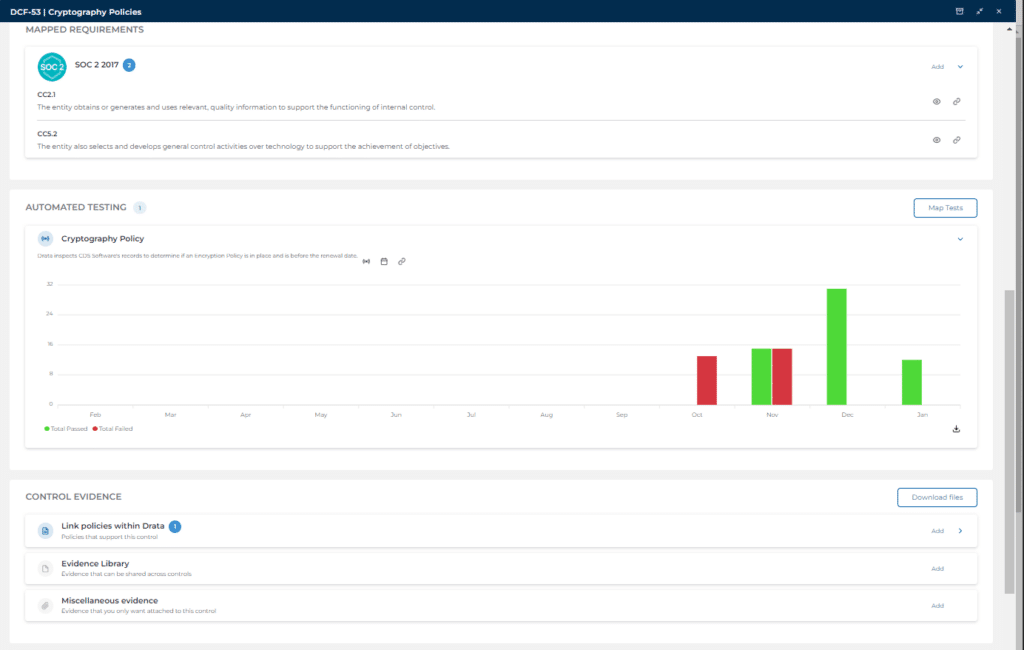
- Drata:
- The interface stands out for its clear and intuitive design. Drata allows users to navigate easily with direct access to key features and functions. Its straightforward nature particularly benefits businesses new to compliance automation.
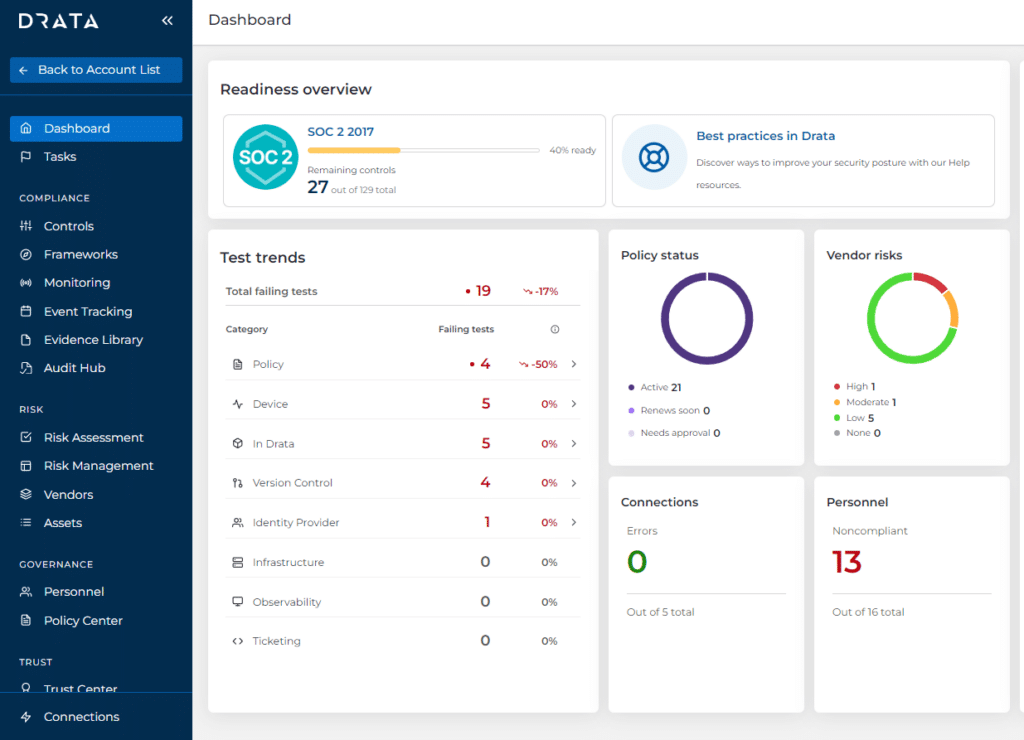
- The dashboard actively offers a comprehensive view of the compliance status, using visual indicators for continuous monitoring that swiftly inform users of their current state and necessary actions.
- However, the UI’s simplicity sometimes results in putting some items behind support center document links and non-intuitive menus.
- While Drata’s UI is user-friendly and makes it easy to check the status of a control, it could improve in showing what is required for control readiness. Typically, this involves uploading manual evidence, a process that could be made more straightforward.
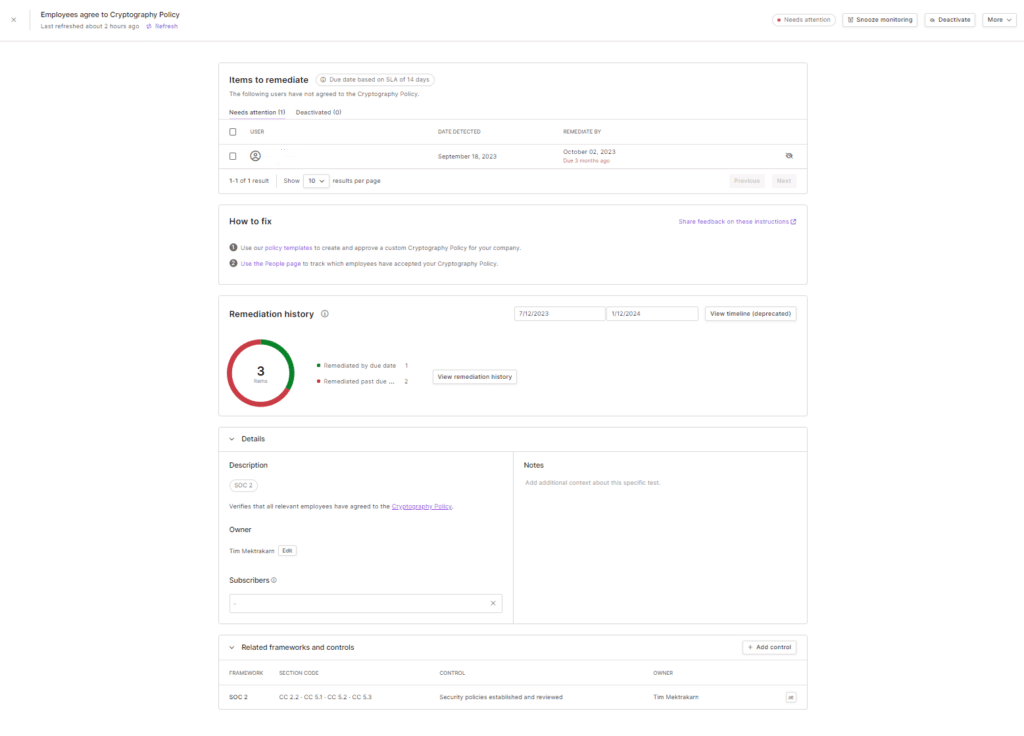
- Vanta:
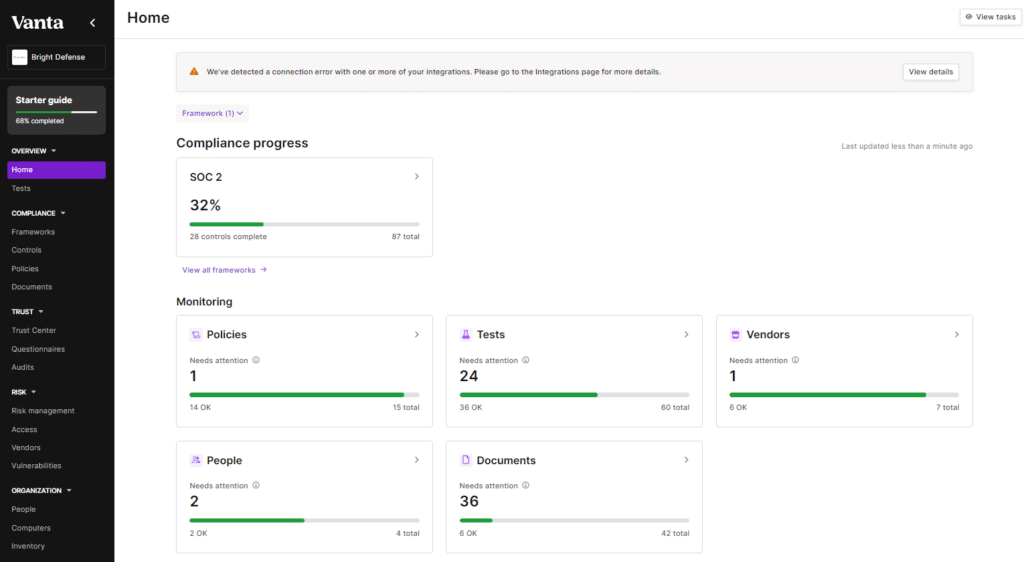
- Vanta’s interface is designed with a focus on user-friendliness, offering a clean and organized layout. Users appreciate the minimalistic approach, which reduces complexity and learning time.
- The platform features a basic dashboard that shows the overall progress towards compliance. We find that it lacks the ability to clearly determine what actions are required at the time of viewing.
- Vanta’s platform actively guides users towards achieving compliance, but its user interface, with its heavy emphasis on Common Control Framework mappings, can easily become monotonous and lead users to feel lost.
- Some quirks include the fact that Vanta likes to open new browser windows and its easy to lose track of how you got a certain page. It’s also not clear how remediate a Control, it seems that you need all the Tests and Documents to be remediated first.
Onboarding Process Drata vs Vanta
The onboarding process for each platform is a critical component of the user experience, determining how quickly and effectively users can start leveraging the platforms for compliance management.
- Drata:
- Drata’s onboarding process is structured and guided. New users receive a clear roadmap of steps to follow, which includes setting up integrations, defining compliance frameworks, and configuring settings. You can not deviate from this onboarding process!
- Onboarding typically involves a mix of self-service resources and direct support, ensuring users can quickly become proficient with the platform.
- Vanta:
- Vanta offers a streamlined onboarding experience, emphasizing ease of setup. The process includes automated guides and checklists that help users set up their accounts, integrate their systems, and start monitoring compliance.
- The platform also provides educational resources and templates, assisting users in understanding compliance requirements and how to meet them using Vanta.
Customer Support Vanta vs Drata
The level and quality of customer support offered by Drata vs Vanta significantly affect user satisfaction and the ability to effectively utilize the platforms.
- Drata:
- Drata offers comprehensive in-app customer support, including access to compliance experts, which can be invaluable for businesses navigating complex compliance landscapes.
- The in-app ability to chat with an expert makes it easy to use, and response times have been excellent.
- The online support documentation is also good,
- Vanta:
- Users have access to a knowledgeable team that can assist with both technical and compliance-related queries but you need to open the inquiry in their support portal which they do a good job of hiding leading you more towards the self service options.
- Vanta also offers an extensive knowledge base and community forums for peer support and shared learning.
Both Drata and Vanta prioritize user experience, offering intuitive interfaces and comprehensive onboarding processes. While Drata focuses on a more guided onboarding experience with extensive direct support, Vanta leans towards a more self-guided approach with robust educational resources. Their customer support systems are both well-regarded, ensuring users receive the necessary assistance for their compliance management needs.

Pricing and Plans
Vanta’s pricing starts at about $10,000 per year for the Essential Plan, while the Pro and Enterprise Plans typically range from $30,000 to $80,000 per year, depending on the specific compliance features and number of devices.
Drata’s pricing, on the other hand starts at $7,500 per year for startups and $15,000 per year for medium-scale companies, with custom pricing available for enterprises.
Note: Neither Vanta nor Drata publicly share their pricing on their websites. The following figures are based on user-reported data and may vary depending on the specific use case. For the most accurate and current pricing, it’s advisable to contact Vanta and Drata directly.
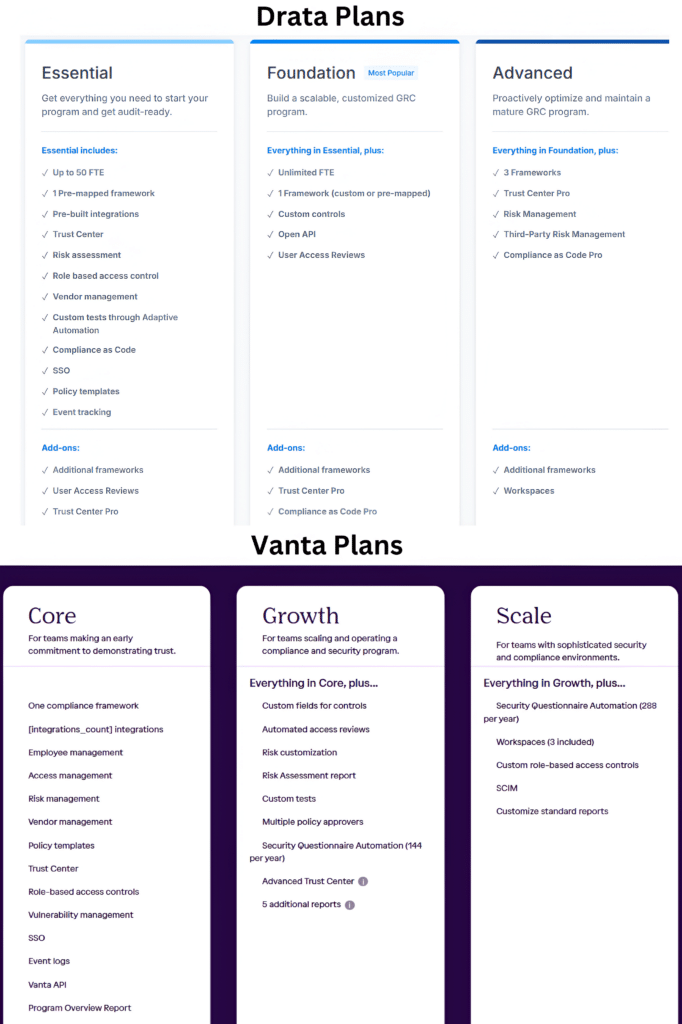
Pricing is based off the number of frameworks and employee count in the platforms.
Security and Reliability
As you would expect from a SaaS based compliance automation platform provider, both eat their own dog food with SOC 2 Type II, ISO 27001, HIPAA compliance and more. You can view all this in their respective Trust Centers. Both platforms utilize extensive end-to-end encryption technologies, perform regular security audits and monitoring, along with prioritizing advanced threat detection.
Pros and Cons of Drata and Vanta
Drata
Pros:
- Automated Compliance Monitoring: Drata excels in automated monitoring, providing continuous oversight over control testing and compliance status, which is crucial for businesses needing constant vigilance.
- Integration with Developer Tools: Its strong and deep integration capabilities, particularly with developer tools and cloud services, make it an excellent choice for tech-focused companies that are Cloud native.
- In-App Customer Support: With the ability to chat with experts right inside the platform, Drata makes it easy to get answers quickly and efficiently.
- Shifting-Left Compliance: Drata’s acquisition and integration of oak9’s Compliance as Code enables developers to find errors early on in the deployment of new infrastructure.
Cons:
- Learning Curve: The platform’s comprehensive nature may pose a steeper learning curve for new users, especially those less experienced in compliance matters.
- Automation checks: Each automation test performs a distinct check and if you’re not doing it exactly as Drata prescribes the test will fail. Compliance managers need to dive into the details of the tests and don’t take it for face value.
- Number of Integrations: They offer a robust number of integrations, but fewer than Vanta.
Vanta
Pros:
- User-Friendly Interface: Vanta’s clean, organized, and intuitive interface enhances user navigation and compliance task management.
- Broad Compliance Framework Support: The platform’s support for a diverse range of compliance frameworks, including country and industry specific frameworks.
- Access and Vulnerability Management: Vanta has modules for access review to streamline the cumbersome process and the ability to track vulnerabilities in the platform with an integration to a third party scanner such as Snyk.
Cons:
- Depth Shortcomings: Vanta’s integrations and documentation fall short in detailing what is tested, leaving admins uncertain about the actual tests and outcomes.
- Vanta’s Claims Can’t be Validated: Vanta’s assertion of automating 90% of security and privacy frameworks holds only if users fully adopt their integrations, leaving numerous manual tasks otherwise.
- Doing Anything to Win Customers: We’ve recently come across some crazy low offers from Vanta to acquire customers at all costs, which is driving the quality of the audits and penetration tests lower and lower. Vanta is definitely pushing the ethical boundaries offering a compliance automation tool and audit services to their customers.
- Focus on Speed: Vanta still claims to be able to get customers SOC 2 compliant in days, this cannot be achieved with a reasonable level of maturity that requires time and expertise.
What Does G2 Say?
One of the most respected SaaS review platforms, G2, has compared Drata and Vanta, two of the top names in automated compliance. According to verified user data, both tools perform exceptionally well, but Drata holds a slight edge across nearly every satisfaction metric.
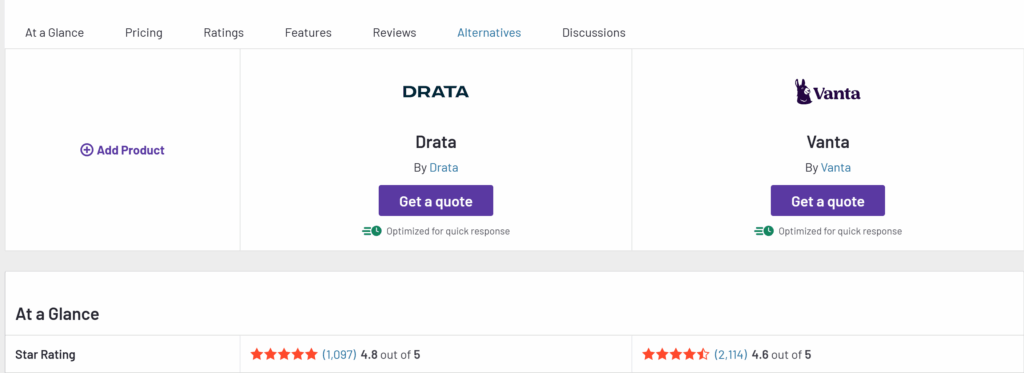
In the first image, Drata holds an overall rating of 4.8 out of 5 based on 1,097 reviews, while Vanta comes in at 4.6 out of 5 with 2,114 reviews. Both are primarily used by small businesses, with Drata’s reviews showing 53.4% from that segment and Vanta slightly higher at 58.4%.
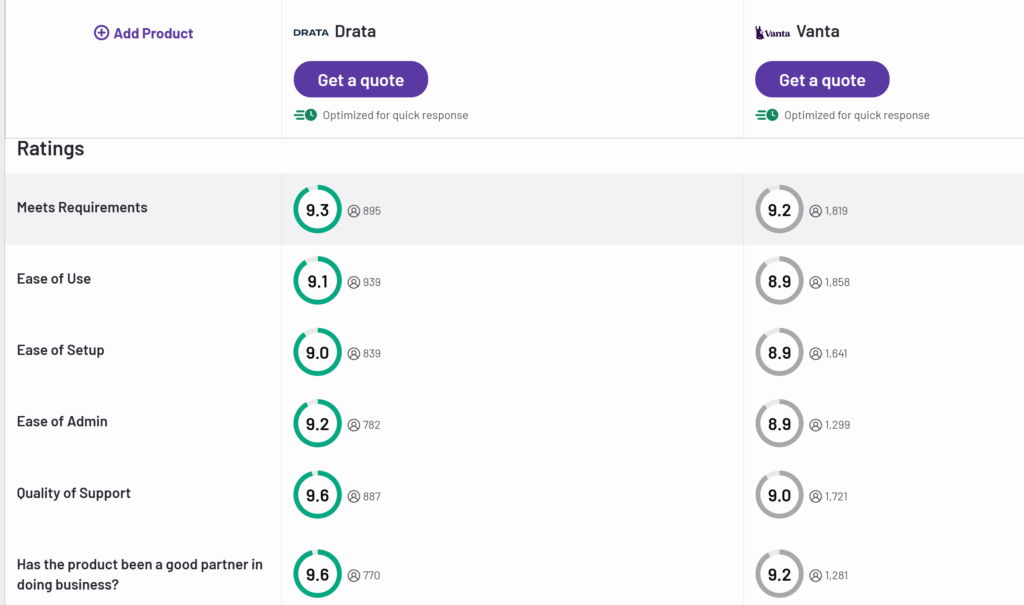
Looking at the second image, Drata leads nearly across the board in user satisfaction.
- Meets Requirements: Drata 9.3 vs Vanta 9.2
- Ease of Use: Drata 9.1 vs Vanta 8.9
- Ease of Setup: Drata 9.0 vs Vanta 8.9
- Ease of Administration: Drata 9.2 vs Vanta 8.9
- Quality of Support: Drata 9.6 vs Vanta 9.0
- Good Partner for Business: Drata 9.6 vs Vanta 9.2
- Product Direction (positive feedback): Drata 9.7 vs Vanta 9.5
These scores suggest that while both platforms are well regarded, Drata delivers a slightly better user experience overall, particularly in support quality and reliability. Vanta still commands a larger number of total reviews, showing it remains a popular choice in the compliance automation space.
Other Vanta and Drata Alternatives
Vanta vs. Drata is the most common comparison in the compliance automation space today, but there are other Vanta and Drata competitors worth exploring. Our guide to the best SOC 2 compliance software ranks the full field.
For a thorough evaluation, consider adding these products to your shortlist:
- Secureframe: Known for its robust integration capabilities, Secureframe automates compliance across frameworks such as SOC 2, ISO 27001, HIPAA, and GDPR. It efficiently manages security and compliance by monitoring cloud, vendor, and HR ecosystems, providing a streamlined process to ensure businesses are audit-ready. Check out our Drata vs. Secureframe comparison to lear more.
- TrustCloud: TrustCloud aids in managing governance, risk, and compliance with a suite of tools designed to automate and streamline compliance tasks. It supports continuous compliance across various standards and regulations, making it a versatile choice for organizations looking to enhance their compliance posture. Their free version for startups is compelling for small businesses on a tight budget, but lacks some of the features of Drata and Vanta. Our Drata vs. TrustCloud article highlights these differences in detail.\
- Sprinto: Targeted towards SaaS companies, Sprinto automates the compliance process for standards like SOC 2 and ISO 27001. For a side-by-side breakdown of how Sprinto stacks up against the larger Drata platform, see our Drata vs Sprinto comparison. Its features include real-time compliance monitoring.
- Hyperproof: Hyperproof offers comprehensive compliance management capabilities, including continuous monitoring, data governance, and automated control testing. It supports multiple compliance frameworks and allows for the customization of frameworks, catering to a broad range of compliance needs.
Word of Caution on Automation
Having the best tools and automation doesn’t automatically safeguard your data. Ensure that the automated tests align closely with your product’s architecture. Remember, people pose the greatest risk to an organization; therefore, conducting regular and comprehensive security awareness training is essential for maintaining a robust security program. Having a CISO to guide you through this process whether it’s a full time or fractional vCISO are critical to help startups and anyone exploring compliance. It’s like trying to climb Mount Everest without a sherpa. You will want someone that has done it numerous times before and can help you effectively reach your goals.
Final Thoughts
In summary, Drata and Vanta both offer strong features in compliance automation, but they cater to slightly different needs and preferences. Drata is a robust choice for tech-focused businesses needing customizable controls and extensive integration capabilities, though it’s thoroughness also increases the complexity of the platform.
Vanta, with its user-friendly interface and broad compliance support, is versatile for various business sizes but may lack the depth of developer tool integrations that some cloud-native companies require. Vanta’s marketing may also lead some clients to believe that the compliance journey will be more simple than it is.
Both companies have received significant funding, $203M for Vanta and $328M for Drata and over 4 rounds, cementing their places as #1 and #2 in the compliance automation space. Drata and Vanta, are both leaders in compliance automation and they are each others fiercest rival. If one comes out with a new feature, you can bet that a few months later the other will have the same.
About Bright Defense
Bright Defense offers three Continuous Cybersecurity Compliance-as-a-Service packages to fit various needs and stages of an SMB’s compliance journey. All packages include a compliance automation platform like Drata or Vanta.
- Sentry – Geared towards the do-it-yourself firms that are IT savvy and have a good handle on security. You can utilize our block of vCISO hours for various activities, including Risk Assessment, developing Incident Response playbooks, conducting Incident Response tabletop exercises, planning, developing, and testing Business Continuity/Disaster Recovery (BC/DR), preparing for and advising on audits, conducting Internal Audits, and planning IT Strategy.
- Guardian – Is our end-to-end delivery of a fully managed and robust Information Security Program all the way through pre-audit preparation. Customers can choose to bring in there own auditor from there.
- Defender – This plan has all the features and benefits of Guardian along with an annual SOC 2 audit with a US-based AICPA firm and monthly vulnerability scanning. Our Defender Plan is everything you need to achieve compliance in one attractive monthly cost.
Our focus frameworks include SOC 2, ISO 27001, HIPAA, CMMC, and PCI. Our other services include vCISO services, risk assessments, gap analysis, managed security awareness training, multifactor authentication, endpoint protection, and more. We’ve got everyone you need to make your compliance journey a smooth one. If you’re interested in seeing a demo of Drata or Vanta, let us know!
Drata vs. Vanta: FAQ
– Drata: Drata automates compliance monitoring and evidence collection, thereby streamlining compliance workflows to ensure audit readiness. It offers continuous automated control monitoring, helping maintain visibility and control over the security posture throughout the year.
– Vanta: Vanta’s compliance platform automates up to 90% of the compliance processes, including evidence collection and security checks. It ensures audit readiness by providing real-time updates and consistent monitoring across compliance frameworks.
– Drata: Drata supports a wide range of compliance frameworks and allows for the addition of custom frameworks. This feature helps organizations tailor the platform to their specific compliance requirements, enhancing operational efficiency and maintaining compliance.
– Vanta: While Vanta primarily focuses on standard frameworks like SOC 2, ISO 27001, and HIPAA, it also provides support for integrating custom control requirements into its automated compliance workflows, facilitating a comprehensive compliance program tailored to specific business needs.
– Drata: Drata provides an integrated compliance platform that automates workflows for monitoring, testing, and reporting on compliance statuses. This automation helps enhance operational efficiency by reducing manual efforts and streamlining compliance tasks.
– Vanta: Vanta offers streamlined compliance workflows that integrate seamlessly with existing cloud providers and other tech stacks, which helps in reducing the complexity and time involved in achieving compliance. This integration enhances operational efficiency and simplifies the management of sensitive data.
– Drata: Drata ensures the security of sensitive data by implementing robust data protection measures, including encrypted storage and secure data handling practices. Its continuous security monitoring helps detect and address vulnerabilities promptly, thereby strengthening an organization’s security posture (Zluri | Unified SaaS Management Platform).
– Vanta: Vanta emphasizes data security by providing comprehensive risk assessments, regular vulnerability scans, and automated alerts for any data security issues. It ensures the protection of sensitive data through strict access controls and regular compliance checks (Expert Insights).
– Drata: Drata integrates with multiple cloud providers to automate the gathering of compliance evidence and to ensure that the cloud services used by an organization comply with the required security standards. This helps maintain continuous compliance and security across all cloud-based assets.
– Vanta: Vanta also integrates with a variety of cloud providers, which allows it to continuously monitor cloud environments and manage compliance with cloud-specific regulations. This integration is crucial for maintaining an up-to-date security posture and ensuring that cloud-hosted data remains protected.
– Drata: Drata integrates with a wide range of third-party tools and services, including cloud providers, HR platforms, project management tools, and identity providers. This integration helps streamline compliance processes by automatically collecting evidence and monitoring controls across various systems.
– Vanta: Vanta offers extensive integrations with similar third-party tools, such as AWS, GCP, Azure, Okta, and GitHub, to automate security monitoring and evidence collection. These integrations help organizations manage compliance more effectively by providing real-time insights into their security and compliance status.
– Drata: Yes, Drata supports multiple compliance frameworks concurrently, such as SOC 2, ISO 27001, GDPR, and HIPAA. Its unified dashboard allows organizations to manage and track their compliance efforts across different frameworks, ensuring a consistent approach to maintaining compliance.
– Vanta: Similarly, Vanta is designed to support multiple frameworks simultaneously. It provides a consolidated view of an organization’s compliance status across SOC 2, ISO 27001, HIPAA, and more, allowing businesses to efficiently manage and prioritize their compliance tasks.
– Drata: Drata emphasizes continuous compliance by providing automated control monitoring and real-time alerts. This proactive approach ensures that organizations remain compliant throughout the year, not just during audits.
– Vanta: Vanta also focuses on continuous compliance through its automated monitoring and reporting features. By providing ongoing insights and notifications about compliance status, Vanta helps organizations identify and resolve issues before they escalate.
– Drata: Drata includes features for managing security awareness training and distributing company policies. These tools help ensure that employees understand and adhere to compliance requirements, contributing to a culture of security within the organization.
– Vanta: Vanta offers similar capabilities, providing tools for employee training and policy management. This feature helps organizations maintain compliance by ensuring that staff are well-informed about security practices and regulatory requirements.
– Drata: Drata provides dashboards and detailed reporting capabilities, allowing organizations to track their compliance status in real time. The platform offers insights into control performance, audit readiness, and potential risks.
– Vanta: Vanta offers intuitive dashboards and automated reports that help organizations monitor their compliance progress. These tools provide actionable insights, making it easier to prepare for audits and address compliance gaps proactively.
Vanta costs about $10,000 per year for the Essential Plan, with advanced plans ranging from $30,000 to $80,000 per year.